Oliver Twist, Still Writing, Stein on Writing, Uncommon Type, Signal Fires
Books were patient companions this month as I clawed for guilt-free time and focus like some sort of book-hungry long-clawed, guilt-riddled thing.
And then, in a continuing pattern of completely unhelpful thoughts, sometimes all I do is read and wonder what would happen if someone did a vampire modern “take” of them.
Some ideas are best left unexplored.
Trust me. Then I often drift into casting a Muppet version of the books.
Some ideas are worthy of exploration.
Which is all to say these are the books that I enjoyed enough to finish in the last month:
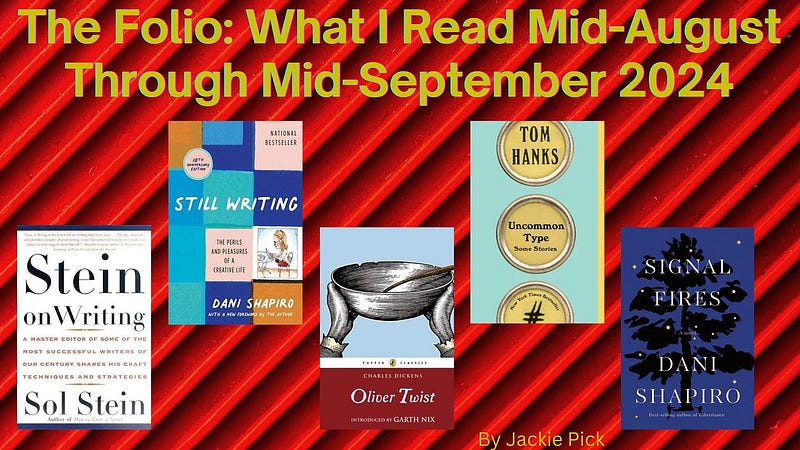
Oliver Twist by Charles Dickens
Like most people you know, Oliver was born. Unlike most people these days, he was born in a Victorian London workhouse. The kid eventually runs — of course, he runs — from the empty promises of that workhouse straight into the grime and grind of London. There he meets others who see him as Opportunity and still others who see him as Sweet Innocent. There is escape, reckoning, and eventually, identity in a world riddled with scarcity.
Speaking of scarcity, “Say it again, you vile, owdacious fellow!” is not as easy to work into polite daily conversation as you might think, but I’m giving it a go.
I have never seen the musical Oliver! But I can say with some authority that this novel, upon which the show is based, is no toe-tapper.
Oliver Twist, a bildungsroman with more gruel than most, is not a lovely book, but there’s a harsh beauty to it.
Hello, Dickens. Privation and agony, sadness and secrets, misery and humor. Whiskers abound!
Young Oliver’s innocence holds up for a while, giving readers a sense of protectiveness over and investment in the lad. However, in modern times, it can seem a bit…much. He had to be fundamentally good and hopeful for the story to work. That said, Oliver is probably the least interesting character in the book. The real genius is in how the disconnected characters, unresolved parentage storyline, and the dark portrayal of London all work together.
Read this very-much-of-its-time book through whatever lens you like — New Criticism, Critical Theory, heck, throw in some Game Theory while you’re at it. You do you, Boss.
Though a short work by Dickensian standards, it’s fairly hefty by modern ones. That said, the long descriptive passages are artful, surprisingly fun, and do not negatively affect the brisk pace of the work.
There’s irony, sinisterness, and chilling characterizations — problematic by today’s standards (e.g., “The Jew,”). Dickens’ wit helps ease any strained credulity. There’s crying, swooning, and urban underbellies — necessary steps toward his better child characters like Pip and David Copperfield.
Still Writing: The Perils and Pleasures of a Creative Life by Dani Shapiro
Still Writing: The Perils and Pleasures of a Creative Life by Dani Shapiro is an acknowledgement that writing can be a brawl between Self and Work. Shapiro is open about the writing process. It is not clean. It is not certain. One minute you’re queen of the keyboard, the next you’re face-planting into your coffee. It’s untidy, but good lord, when it clicks, it’s glorious.
Shapiro speaks to those of us who have walked that line between art and fear. This is not a manual for the pragmatist. It is a book for those who understand that the emotional life is as much a part of creation as the practical.
You will fall. You will get up. You are a writer.
In that simple rhythm lies everything.
This is a book written by and for the artistic temperament and is as much about the emotional aspect of creating as it is the practical.
A little digging around revealed that Dani Shapiro and I went to the same high school, although at different times, and there are many parallels between her upbringing and mine, at least based on little gems she drops in Still Writing. Similar upbringing, similar terrible ways of coping with difficulties as a teenager. Uncanny. I felt…seen? Heard? Acknowledged?
Kinship. That’s the word.
I have a massive document of “writing advice” carefully copied from great craft books or articles or blog posts.
With this, I was highlighting every page, and most of every page at that. Can I enter an entire book into my file? No.
Ok, yes.
I will type and keep them like the preciousssss they are. This helps me internalize them, to communicate and converse with the author. And, oh, it will be worth it to experience this book that way a second time.
I mean, please. Just look at these quotes from this gem of a book:
“Everything I know about life, I learned from the daily practice of sitting down to write.”
“The writer’s life requires courage, patience, empathy, openness. It requires the ability to be alone with oneself.”
“The page is your mirror. What happens inside you is reflected back. All of it.”
“The only reason to be a writer is because you have to. Because it gnaws away at your insides if you try to do anything else.”
It takes a great deal of courage to remain vulnerable. It takes a great deal of strength to remain soft.
Still Writing is a steaming hot bowl of chicken noodle soup — comforting, helpful, a little salty. Perfect. You want to rush through it? Wrong move. This is a slow-simmer kind of book. It’s the kind of thing you read and pause, read and pause. You mellow with it. That’s where the magic is.
Shapiro combines the clinical and the tender as she looks at writing. She has taken the time to consider what we do and how weird and wonderful it is. How complicated and simple. How important and futile. How wretched and worthy. And still — and STILL — she understands the infectious joy of it all, and we are better writers for her having shared it.
This one’s going on the “Easy-to-Reach Craft Book” pile, no question.
Stein on Writing by Sol Stein
TWO CRAFT BOOKS IN ONE MONTH? What am I, some sort of literary addict, jonesing for another hit of structure and plot?
MAYBE.
Stein on Writing does not mess around. It is a technical manual, craft-oriented, and if you so choose to metaphorically strap it on your back and hike through the wilds of your words, does it ever deliver. Stein offers actionable advice on key elements of effective writing, including structure, dialogue, pacing, and character development. Whether you’re writing fiction or nonfiction, his insights are spot-on, particularly when it comes to clarity and engagement — cornerstones for holding a reader’s attention.
Stein emphasizes “particularity,” (my new favorite word), and guides writers on crafting and revising prose. This is not a book of vague inspiration, abstract advice, or “fix the commas” or “cut adverbs” suggestions. The method is clear and pragmatic: shape your writing, tighten, refine, repeat, until you’ve produced polished, professional work.
Make no mistake, this is no dry tome. Stein practices what he preaches, often with great wit, as evidenced by gems like:
“Thou shalt not saw the air with abstractions.”
“One plus one equals a half.”
Too often, advice at this point in my career feels mushy, repetitive, or feasibly addressed by a simple search-and-replace. Stein’s book demands more of us as architects of meaning. This is about our responsibility for the reader’s experience, forcing us to organize our thoughts clearly on the page.
This one also earned a place on my “Easy to Reach Craft Book Pile”
It is a standout.
Uncommon Type by Tom Hanks
Short stories, perhaps more than any other form, demand perfection, an economy of words that leaves no room to hide. With a collection like Uncommon Type, comparisons are inevitable from one story to the next. Releasing a book of short stories is a courageous act in the base case.
And Tom Hanks? Well, he surprises. His authorial voice — fun, warm, with more depth than expected — makes this a sweet debut collection.
Fame, particularly when you’re an actor, can be a tether when you venture out into anything else requiring your voice. It’s also hard to be a novice when the world knows your name. The expectations may be unfair, but Hanks embraces his authorial voice and explores quite a range of topics including the adventures of a group of friends navigating space travel, a World War II veteran adjusting to post-war life, and a teenage surfer’s experiences.
That breadth is seen in the first two stories: the first is brash, cocky, filled with quips — vintage on-screen Hanks from the 80s and 90s. (Shout out to his guest role on Family Ties) The second story is tender, gentle, free of artifice, and unblinking in its look at permanent scars of war.
Some characters reappear throughout the collection, to varying effect, while others come and go. Yes, the book is uneven at times, but that’s part of its charm, like when a typewriter has its own signature quirks.
Every one of the seventeen stories in Uncommon Type is, in some way, a love story. A love of connection, of history, of place. The typewriter, in all its clunky glory, is the common thread (or ribbon, should I say?). Sometimes the presence of the typewriter feels a bit forced, but all things considered, this collection delighted me. I particularly liked “The Past is Important to Us,” “Three Exhausting Weeks,” and “Christmas Eve 1953.” These are the kinds of stories you imagine reading by a fireside in winter, or on a porch in summer, glancing up occasionally to watch the fireflies.
It’s the literary equivalent of a warm cup of cocoa. It’s not Red Bull.
Signal Fires by Dani Shapiro
Signal Fires by Dani Shapiro is a mighty novel about family, memory, and the not-so-invisible threads that connect us. The story begins in 1985 when tragedy strikes the Wilf family. The ripple effects of this unfold over time, with the narrative moving between the past and the present. Shapiro weaves a tale that examines how seemingly small choices or happenstances can lead to events with far-reaching consequences. The novel explores connection, unpredictability, the power of forgiveness, and the impact of personal histories.
Unlike many novels that jump between timelines, Signal Fires does so with purpose, reflecting the fluidity of time as a central theme. This revelation unfolds patiently, beautifully.
My kids have had several assignments in school where they are asked to write about a moment of beauty or frustration or failure or success in their life. I always tell them to go small. Signal Fires is a brilliant example of an author doing this. It’s a novel that looks at intricate, tender moments — the small, personal choices that ultimately shape our lives.






 Jackie Pick