Because I’m far from the median on the hectic-to-chaotic continuum that is currently My Life™, reading time was limited this month, and the books, for the most part, were long and/or required revving up the ol’ noggin.
This month’s reviews are abbreviated, awkward attempts to match you with a potentially great read for the next time you’re curling up on your couch, you need something to take your mind off the cloud of B.O. on your train commute, or you’re having an actual summer vacation and want to read a book. (Hello, my southern hemisphere friends! You might need to read these upside-down or counterclockwise in a warm nook.)
Starting is arguably the hardest part of anything, especially writing, where the beginning has to hook and promise and reveal enough ankle. Sometimes the Muppets might even show up.
I was going to start this Month in Review talking about how the cicadas are mercifully almost gone. (Just in time, too, because one flew into my face and then I had to consider taking a flamethrowing to my own puss.) Then I was going to wax not-exactly-poetic about the stench of them rotting by the trillions. If you want more information, check this out. However, if you want to avoid yet another closeup photo of the critters, the big take-away is “As microbes break down and digest the cicada carcasses, ammonia and volatile organic compounds are released…Ammonia has a strong odor, as do some VOCs containing nitrogen and phosphorus — which the bodies of periodical cicadas are rich in.”
There were a lot of places in that quote where I wanted to set fire to my face again.
The whole cicadapocalypse/decomposition was going to be some sort of averagely-expressed metaphor about June.
Since I was clearly on an off-gassing thematic thread, I considered opening with commentary about politics and world affairs. Each try degenerated into either something like a subtweet or a pitch for some sort of Toxic Positivity MLM.
That ain’t me, kid.
Not that I don’t believe in ripping myself open and spilling all the blood/tea, but “think good thoughts” isn’t my brand. I’m not unrelievedly sweet nor optimistic. I’m hilarious and cynical and misanthropic and ALSO a little optimistic. That’s hard to capture.
(Also, I still write “80085” on my calculator and think it’s hilarious high art.)
(Also, I have a calculator.)
(Also, are we still using “subtweeting”? I’d ask my kids but they are still mad at me for randomly throwing “skibidi toilet” into some otherwise Quality Parenting Moments.™)
But yesterday on my social media, I wrote “I wish you all the wonderful communities of weirdos you need. If you lack one (or enough), I will enthusiastically be a charter member of yours.”
So that is also how I choose to start this wrap-up of June and the second half of the year. I will be here in a completely official capacity as part of your Weirdo Community. We don’t take a lot of selfies and there is always pastry.
Ooh, look: Weirdo! Muppet!
Here are some splashes of marvelous from June 2024
(i.e. things I enjoyed that you may also enjoy or possibly not if you are feeling contrarian and cross.)
For much of June, a percentage of my children were in poorly-timed camps and fun classes that made me do the precious calculation of “is it worth going home or should I stick around?” (My calculator is not used for such things, see above.) The quiet gift of this was spending time in the local public library of the town where they had these classes, and boy howdy was it fantastic. I love public libraries and all they stand for. Like most other libraries I’ve visited, I had the best, friendliest, fiercest, most welcoming people greeting me and who were very happy to tell me that in the winter they light the fireplace and people just hang out and read there. More adults need to rediscover our libraries beyond having meetings there. It brought back warm memories of Harper Library and the many happy semesters there rather than, you know, doing homework or going to class. Some things age well, like libraries. Some things do not age well, like cicada corpses.
We have started introducing a certain percentage of my children to Mel Brooks. Avoiding the whole non-argument about whether we could make something like Blazing Saddles nowadays, Happy June Birthday Mel Brooks! And can I just have a moment of appreciation for the glory that is Madeline Kahn?
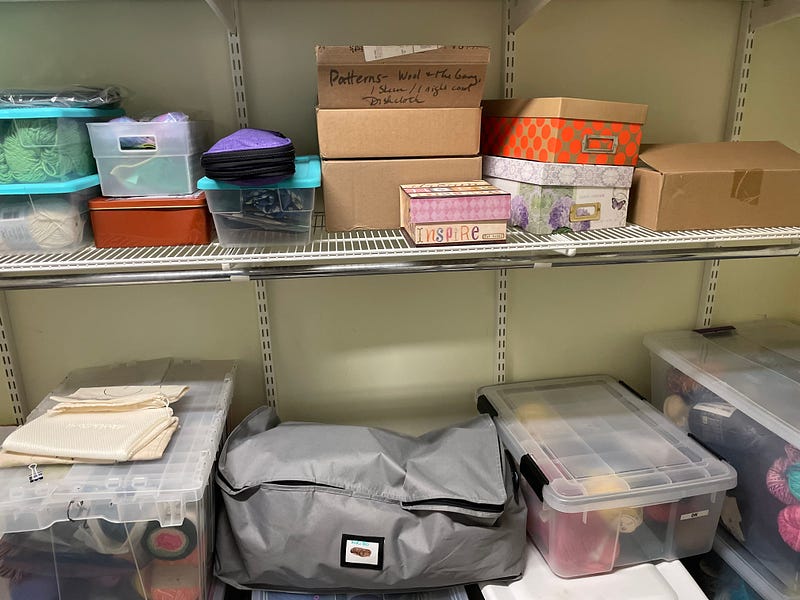
I cleaned out my knitting nook. Unlike any knitter ever, I buy more supplies than I’ll use in a lifetime. It’s a bulwark against death, profound optimism, and maybe some self-delusion. I don’t knit that fast. I have the same problem with books. Maybe I can make a deal with someone in that department to keep me going until all the books are read and the wonky hats knit.
Why, no, I’m not a professional photographer OR a professional organizer. Why do you ask?
Anyway, speaking of attention and vulnerability and artistry and whatnot, here: Poetic Outlaws
If you love quick hits of knock-your-socks-off writing, check this out.
So I might not find the right way to start these months in review, but ending in cake is always the way. As Vincent said in the above link, my mind is driven towards these things with an irresistible momentum.
So, tell me about your favorite library. Or your favorite cake. Or your favorite weirdo community.
Oh, the twitchy weirdness of not blasting this out the second March ended. Of course, I’m the only weirdo policing the time boundaries of my own monthly book roundups. What can I say? I like the snap of “March Reads” better than the soggy “What I Read March Through Mid-April 2024.”
But here we are, and this is how it’s going to be for a while and now I’m uniquely positioned as a mid-month book yammerer.
Market niches, folks.
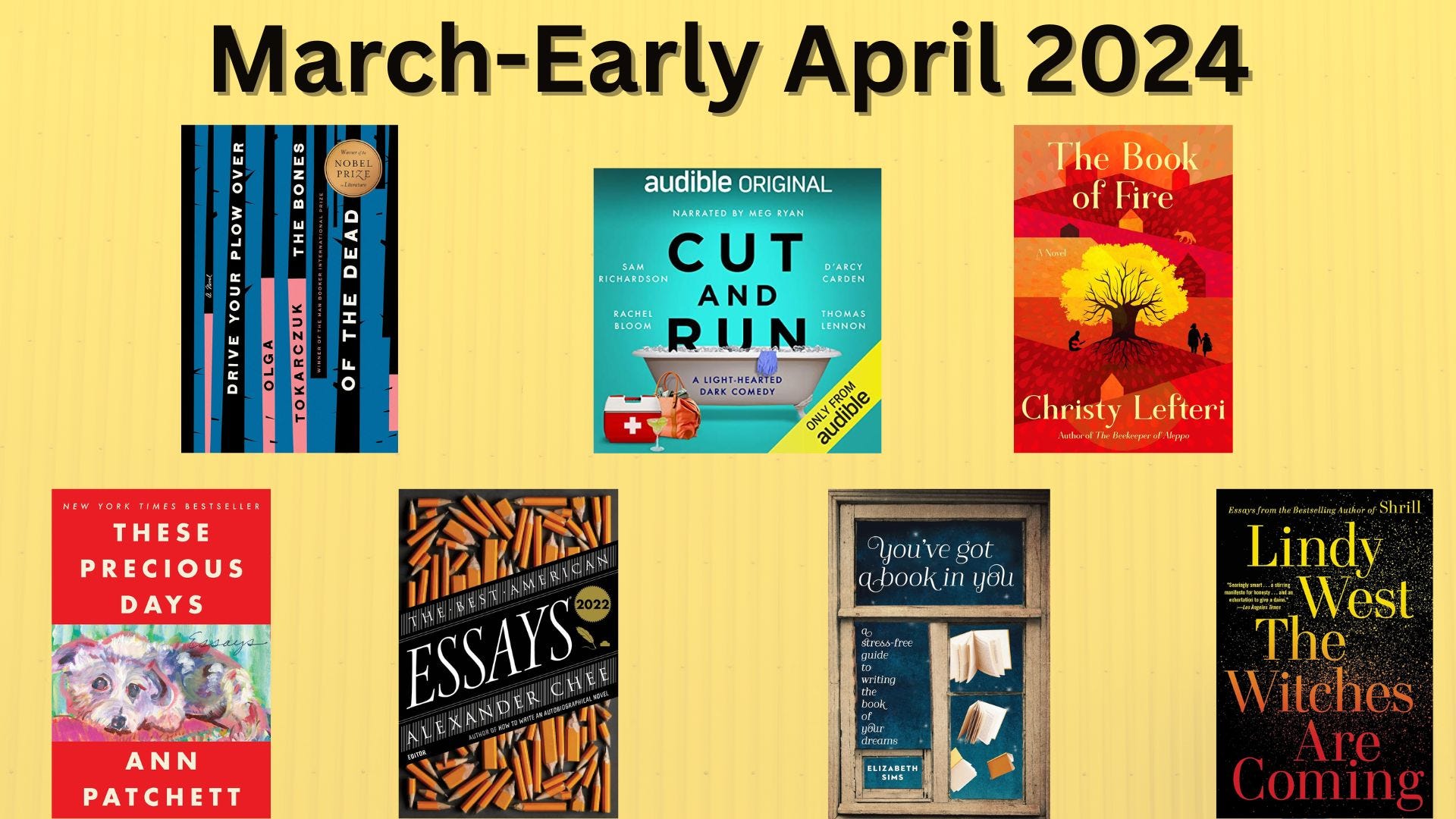
In the last five weeks or so, I’ve completed seven books.
Ahem.
I was set to roll out an unremarkable apologia, a grand harangue about life and reading and such.
Mad busy, that’s me.
A grand self-flogging, agonizing about feeling like a fraud for not being able to “keep up.” As if I’m somehow a slacker in the sacred arts of wordcraft and self-betterment.
Then I’d pivot, launch a counter-offensive on myself, get all gooey about the bliss of slow reading and how my own calendar is stuffed to the gills and my body is drafting strike plans.
I had all sides of this covered and an abundance of gems like “my relationship with reading has evolved” and “joy of discovery.” Flowcharts, highfalutin words, and not a few huffs and puffs.
But there’s something to be said for not doing that.
Let’s just get to the books in some particular order or other:
Ann Patchett excels at weaving tales loosely enough to let them breathe but tightly enough to make them work. Patchett’s explorations of love, loss, and friendship are patient, never slow. She once again pulls, surgically, from the everyday and it is glorious to look at how life squiggles under her microscope
I loved “Three Fathers” (which you can read here). There was a section about one of the fathers whose writing talent, perhaps, did not rise to the level of his eagerness, his effort, or his output. It was a good reminder to her (and me) that when we ask people to read our work, we ask them to give us their time. And time is a gift sometimes more precious than feedback.
I adored “A Talk to the Association of Graduate School Deans in the Humanities,” because it was about life in/of the Humanities. Bookstore Ownership! Theater Attendance! Staged readings of Our Town in the living room. Reading! Community! Oh, how I want all of that. Next, life, I suppose.
“Contrary to popular belief, love does not require understanding in order to thrive.” — Ann Patchett
This collection is a child of the pandemic. Each essay, no matter the theme, has an undercurrent of wearing a path in the carpet from pacing back and forth. The collection prowls and lies in wait.
As with any anthology, you will love some pieces more than others, but trust me, something will snag you, whether you’re reading as a fan or a scribe. Sublime craftsmanship.
From Chee’s introduction on sense memories and writing: “Was the writing wet? Could you feel the rain, the blood, the tears?”
Standouts for me were “Abusement,” “Ghosts,” and “China Brain.”
Every month I try to read a craft book or two. Sometimes I come across texts that are lush and gorgeous. Other times I come across things that are practical and fresh. This is more the latter, but there are dabs of the former.
I’m adding this to my I-only-need-to-lean-over-and-grab-it shelf.
It’s full of solid advice without being simplistic, repetitive, or useless.
It’s a reminder that we write because we love it. We may not love it all the time, but we need to commit to that love every time.
It’s “LET’S GOOOO!” across 280 pages.
This one hits at the right time. I think a year or so ago, when I thought all was well with my first novel, I’d have scoffed a little. Now I realize what a lifeline it is.
I especially like her sections on stormwriting.
“Open it up, write deeper, write long, write relaxed, write loose. And never ever worry about your finished product in the midst of all this messy glory.” — Elizabeth Sims
If you loved Shrill, you may very well love this, even though it covers some of the same territory. That’s probably the point, though. Have things really improved in the world since then? Nope.
I laughed and then didn’t – shouldn’t things be better? Especially if we can name them? Are we naming them correctly?
West is brilliant and the through-line in this book is similarly brilliant. She makes it look easy. It is not easy. That’s her gift.
“So fine, if you insist. This is a witch hunt. We’re witches, and we’re hunting you.” — Lindy West
I won this book in a Goodreads Giveaway, and wrote a longer review here, but for the purposes of this blog, here is a bit of that about this gorgeous book:
The novel is a study of grief, trauma, and guilt. The narrative unfolds in two timelines: one during the fire and the other weeks after. Third-person narration in one timeline adds an honest and heartbreaking layer of detachment.
This is an eco-murder mystery set in a Polish village. I almost quit after reading the first quarter. It’s…a little slow and I am feeling impatient these days. Thank goodness I didn’t quit.
The crafting of language, especially as this is a translation – and a deft one – kept me riveted.
Deep respect to translator Antonia Lloyd-Jones.
The main character’s devotion to Blake works nicely in this book that is a warning about the natural world getting revenge upon us all.
This is apparently a movie or something, although the BBC could have done a hell of a series. Then PBS could have found a home for it nestled amongst its other weird and cozy mystery series.
It is a genre-busting tale told by a character in every sense of the word, where we recognize the cruelty of these men in how they treat her, an aging woman, and how they treat animals in the world around them. So please read this and can we talk about how older women in society are treated? THANK YOU!
ANY BOOK WITH AN UNWITTING ORGAN DONOR IS FUNNY, RIGHT?
Possibly not, but this one is. Available exclusively as an audiobook on Audible, it nails the art of snappy banter and clever meta-commentary. The cast is made up of the finest in the business. *Waves to Ed Begley Jr.*



 Jackie Pick