OH, HERE WE GO. SHE’S DIFFICULT.
There are many ways to be a difficult woman. You can be too loud, too quiet, too emotional, too detached, too interested in the proceedings, or insufficiently grateful to have been invited to the proceedings in the first place. You can talk too much (bad), or too little, (suspicious). You can ask a question (too much!). You can ask a FOLLOW-UP question (an act of war). You can point out that the question itself is idiotic, (have your affairs in order before attempting this one).
And then it’s all OH, HERE WE GO. SHE’S DIFFICULT. LET’S GET RID OF THIS BROAD.
Getting rid of difficult women is a time-honored tradition of our species. We’ve tried drowning, burning, confinement, bogs, marriage, hysteria diagnoses, and ostracism. These days we also have text groups and PTAs, all of which save considerably on firewood.
We call her shrill. We call her angry. We call her difficult. A remarkably versatile little word, “difficult.” You don’t even have to specify what the woman has done. Everyone will automatically nod and scoot their chairs a little further away out of a vague sense of discomfort.
We could actually use more difficult people. Put them on every committee, board, corporate retreat, strategic planning session, HOA, task force, listening session, leadership summit, or anything that begins with an unironic icebreaker. Give her a Difficult Person Slide Whistle™ and the authority to blow it whenever somebody says something stupid. No appeals process.
I’ve got thoughts, clearly. Let me tell you, this was a heck of a month to go on a dangerous women reading kick.
These were, without question, the most Octobery reads I’ve had in a while. Spooky, yet not a zombie in the bunch, although plenty of ideas that should have died centuries ago keep digging themselves out of the ground. You can put away the plastic skeletons, eat the discount candy, and take down the fake cobwebs, but the oppression, lies, institutional rot, hatred, and hierarchies? Still here, asking if the cranberry sauce at Thanksgiving is homemade or from a can.
A cheery little assortment of books! Just the thing to curl up with while civilization does whatever it is doing to increase my ice cream consumption and under-blanket marathon sessions.
I waffled over my favorite this month. The Mother of All Questions or I Who Have Never Known Men? One is non-fiction, one is fiction, both are excellent, and I’m not industrious enough to write two full reviews. Read either or both books with my blessing.
Anyway, this month’s victims of my enthusiasm is…
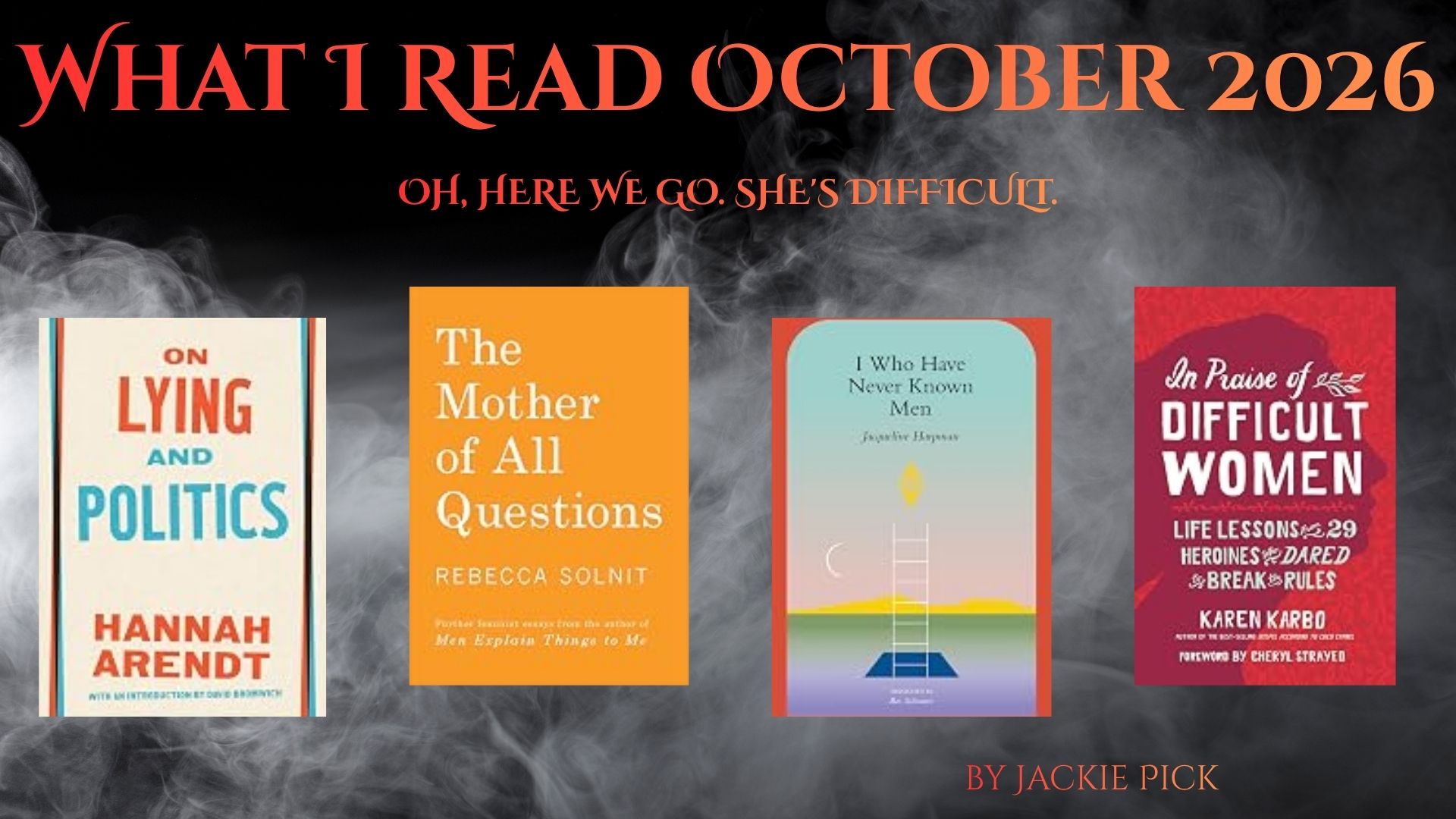
The Mother of All Questions by Rebecca Solnit
Solnit’s The Mother of All Questions tackles feminism, violence, silence, masculinity, and other sundry boxes into which we insist on stuffing women. It opens with Solnit recalling a lecture about Virginia Woolf during which audience members wanted to know whether Woolf had children (and whether she should have.) Here’s a woman with a formidable intellectual reputation whose writing changed the world, and somebody in this lecture thought, “You know what we haven’t covered in this academic discussion of Virginia Woolf? HER UTERUS.”
Solnit waxes brilliant on silencing, which doesn’t always involve telling someone to shut up. We’ve figured out how to make speaking so unpleasant that eventually a woman decides it’s not worth the trouble, and we say that it was her choice to stop. Punish women for speaking and then blame them for their silence. Brilliant and monstrous.
I loved this funny, rigorous book. Solnit has a gift for exposing the rot behind things we regard as perfectly normal.
Read this if you want analysis of oppressive systems that silence a lot of us and yet you want hope that we can unmake what we have made.
Honorable Mentions:
I Who Have Never Known Men by Jacqueline Harpman
Forty women locked in an underground bunker, watched, regulated, and denied everything that might make life worth living, including physical affection and any explanation of why they’re there. Thirty-nine remember a life before imprisonment. The fortieth, our narrator and the youngest in the group, remembers nothing. She has no idea what she’s missing, which is both a terrible thing and in a few horrific instances, a survival advantage.
Eventually the women escape, but outside the bunker the world is bleak and also without explanation, basic amenities, or hope. If Plato’s prisoners leave their cave and discover a larger reality, Harpman’s women leave theirs and discover that the larger reality is more of the same.
The narrator has never known men. She has never known most of the things by which we understand ourselves. We learn throughout the book what makes her human.
Harpman refuses to explain much, which is frustrating, and yet somehow that frustration is part of what makes the book extraordinary. It’s spare, unsettling, occasionally horrifying, and profoundly sad. This one will haunt me for a long time.
Read it if you’re interested in existential literature but don’t want to spend the weekend curled up with Kierkegaard.
In Praise of Difficult Women by Karen Karbo
I like to think I’m a difficult woman, although I also know there’s a fine line between challenging the status quo and being a general pain in the ass. (But if you set your mind to it, you can do both!) Karbo gives us twenty-nine women who were uninterested in making themselves more palatable and who had the audacity to act on their opinions, ambitions, and appetites. She writes that “sometimes the cost of being fully human is upsetting people.” AMEN. I skipped the Rowling chapter and considered DNFing because the profiles felt a little glossy, but I was stuck in a car for three hours with nothing else to read. So onward! The women were fascinating. I wanted more of their contradictions and insubordination. I wanted more excavation, less of an introduction to being difficult. Still, better than three hours of scrolling my phone.
Read if you want a solid introduction to some fantastically difficult women. Feel free to skip the Rowling chapter. Better yet, share this book with a young person who could use a launchpad for being difficult.
On Lying and Politics by Hannah Arendt
A slim volume of two essays about political deception, organized lying, and the crises they create. Arendt uses the word “defactualization” to describe what happens when facts lose their authority and those in power exploit the resulting confusion. What an excellent word! What a perfectly awful thing to need an excellent word for! Although Arendt wrote these essays more than fifty years ago, I kept wanting to check the publication date. Surely someone had slipped a few pages in the last year or so?. Despite what you may have heard, Arendt isn’t impossible to read, but she is impossible to skim. That’s a good thing. Slow down and attend. (Bonus points to David Bromwich and his introduction which bridges the decades, though, again, that distance is shorter than you might wish)
Read if you’d like to understand how we got here, although you may not particularly enjoy recognizing the scenery.
And there be the October books. Read anything good lately?
OH, HERE WE GO. SHE’S DIFFICULT.
There are many ways to be a difficult woman. You can be too loud, too quiet, too emotional, too detached, too interested in the proceedings, or insufficiently grateful to have been invited to the proceedings in the first place. You can talk too much (bad), or too little, (suspicious). You can ask a question (too much!). You can ask a FOLLOW-UP question (an act of war). You can point out that the question itself is idiotic, (have your affairs in order before attempting this one).
And then it’s all OH, HERE WE GO. SHE’S DIFFICULT. LET’S GET RID OF THIS BROAD.
Getting rid of difficult women is a time-honored tradition of our species. We’ve tried drowning, burning, confinement, bogs, marriage, hysteria diagnoses, and ostracism. These days we also have text groups and PTAs, all of which save considerably on firewood.
We call her shrill. We call her angry. We call her difficult. A remarkably versatile little word, “difficult.” You don’t even have to specify what the woman has done. Everyone will automatically nod and scoot their chairs a little further away out of a vague sense of discomfort.
We could actually use more difficult people. Put them on every committee, board, corporate retreat, strategic planning session, HOA, task force, listening session, leadership summit, or anything that begins with an unironic icebreaker. Give her a Difficult Person Slide Whistle™ and the authority to blow it whenever somebody says something stupid. No appeals process.
I’ve got thoughts, clearly. Let me tell you, this was a heck of a month to go on a dangerous women reading kick.
These were, without question, the most Octobery reads I’ve had in a while. Spooky, yet not a zombie in the bunch, although plenty of ideas that should have died centuries ago keep digging themselves out of the ground. You can put away the plastic skeletons, eat the discount candy, and take down the fake cobwebs, but the oppression, lies, institutional rot, hatred, and hierarchies? Still here, asking if the cranberry sauce at Thanksgiving is homemade or from a can.
A cheery little assortment of books! Just the thing to curl up with while civilization does whatever it is doing to increase my ice cream consumption and under-blanket marathon sessions.
I waffled over my favorite this month. The Mother of All Questions or I Who Have Never Known Men? One is non-fiction, one is fiction, both are excellent, and I’m not industrious enough to write two full reviews. Read either or both books with my blessing.
Anyway, this month’s victims of my enthusiasm is…
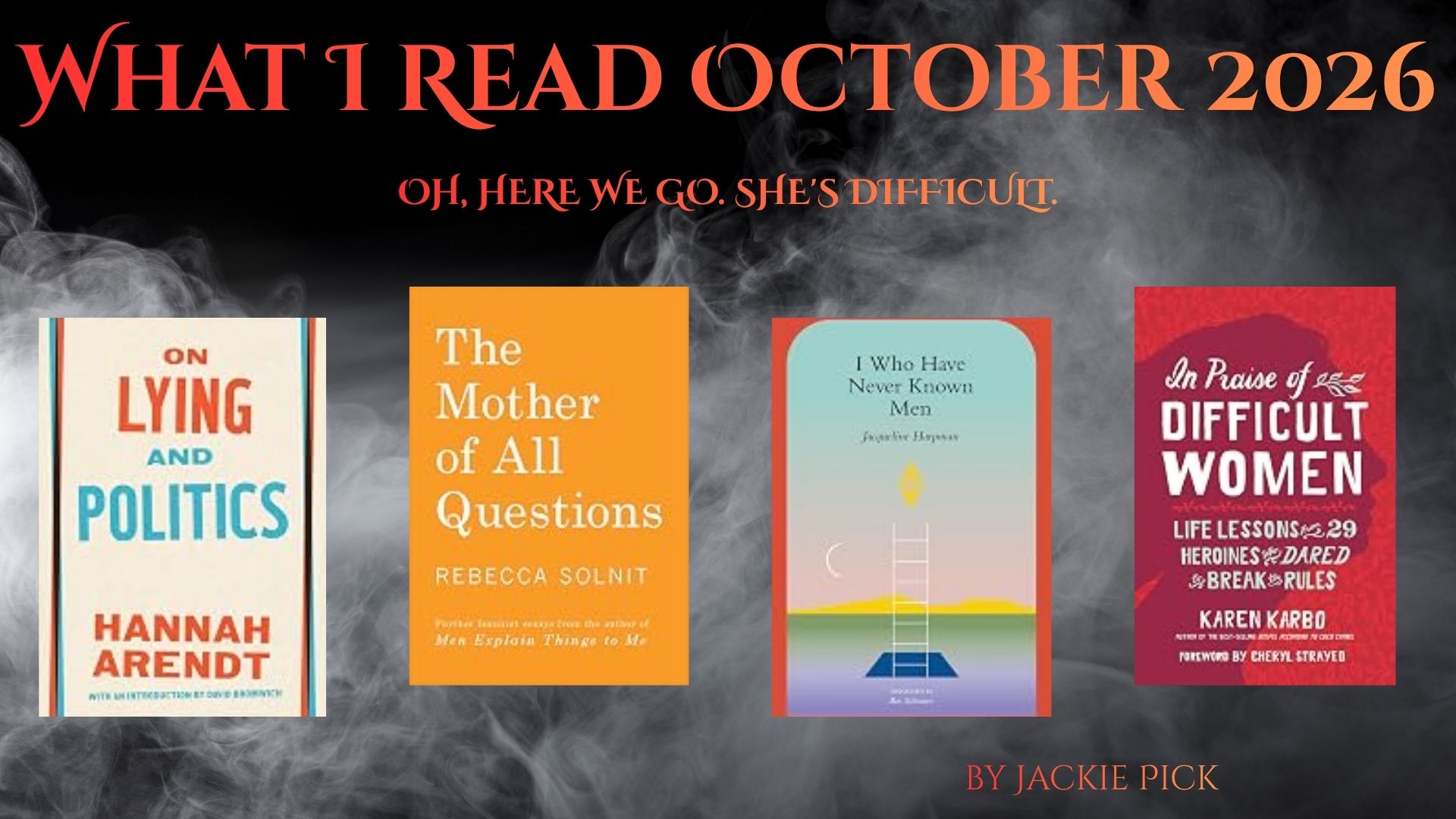
The Mother of All Questions by Rebecca Solnit
Solnit’s The Mother of All Questions tackles feminism, violence, silence, masculinity, and other sundry boxes into which we insist on stuffing women. It opens with Solnit recalling a lecture about Virginia Woolf during which audience members wanted to know whether Woolf had children (and whether she should have.) Here’s a woman with a formidable intellectual reputation whose writing changed the world, and somebody in this lecture thought, “You know what we haven’t covered in this academic discussion of Virginia Woolf? HER UTERUS.”
Solnit waxes brilliant on silencing, which doesn’t always involve telling someone to shut up. We’ve figured out how to make speaking so unpleasant that eventually a woman decides it’s not worth the trouble, and we say that it was her choice to stop. Punish women for speaking and then blame them for their silence. Brilliant and monstrous.
I loved this funny, rigorous book. Solnit has a gift for exposing the rot behind things we regard as perfectly normal.
Read this if you want analysis of oppressive systems that silence a lot of us and yet you want hope that we can unmake what we have made.
Honorable Mentions:
I Who Have Never Known Men by Jacqueline Harpman
Forty women locked in an underground bunker, watched, regulated, and denied everything that might make life worth living, including physical affection and any explanation of why they’re there. Thirty-nine remember a life before imprisonment. The fortieth, our narrator and the youngest in the group, remembers nothing. She has no idea what she’s missing, which is both a terrible thing and in a few horrific instances, a survival advantage.
Eventually the women escape, but outside the bunker the world is bleak and also without explanation, basic amenities, or hope. If Plato’s prisoners leave their cave and discover a larger reality, Harpman’s women leave theirs and discover that the larger reality is more of the same.
The narrator has never known men. She has never known most of the things by which we understand ourselves. We learn throughout the book what makes her human.
Harpman refuses to explain much, which is frustrating, and yet somehow that frustration is part of what makes the book extraordinary. It’s spare, unsettling, occasionally horrifying, and profoundly sad. This one will haunt me for a long time.
Read it if you’re interested in existential literature but don’t want to spend the weekend curled up with Kierkegaard.
In Praise of Difficult Women by Karen Karbo
I like to think I’m a difficult woman, although I also know there’s a fine line between challenging the status quo and being a general pain in the ass. (But if you set your mind to it, you can do both!) Karbo gives us twenty-nine women who were uninterested in making themselves more palatable and who had the audacity to act on their opinions, ambitions, and appetites. She writes that “sometimes the cost of being fully human is upsetting people.” AMEN. I skipped the Rowling chapter and considered DNFing because the profiles felt a little glossy, but I was stuck in a car for three hours with nothing else to read. So onward! The women were fascinating. I wanted more of their contradictions and insubordination. I wanted more excavation, less of an introduction to being difficult. Still, better than three hours of scrolling my phone.
Read if you want a solid introduction to some fantastically difficult women. Feel free to skip the Rowling chapter. Better yet, share this book with a young person who could use a launchpad for being difficult.
On Lying and Politics by Hannah Arendt
A slim volume of two essays about political deception, organized lying, and the crises they create. Arendt uses the word “defactualization” to describe what happens when facts lose their authority and those in power exploit the resulting confusion. What an excellent word! What a perfectly awful thing to need an excellent word for! Although Arendt wrote these essays more than fifty years ago, I kept wanting to check the publication date. Surely someone had slipped a few pages in the last year or so?. Despite what you may have heard, Arendt isn’t impossible to read, but she is impossible to skim. That’s a good thing. Slow down and attend. (Bonus points to David Bromwich and his introduction which bridges the decades, though, again, that distance is shorter than you might wish)
Read if you’d like to understand how we got here, although you may not particularly enjoy recognizing the scenery.
And there be the October books. Read anything good lately?