Category: Recommendations

What I Read July 2026

Now with less Geraldine

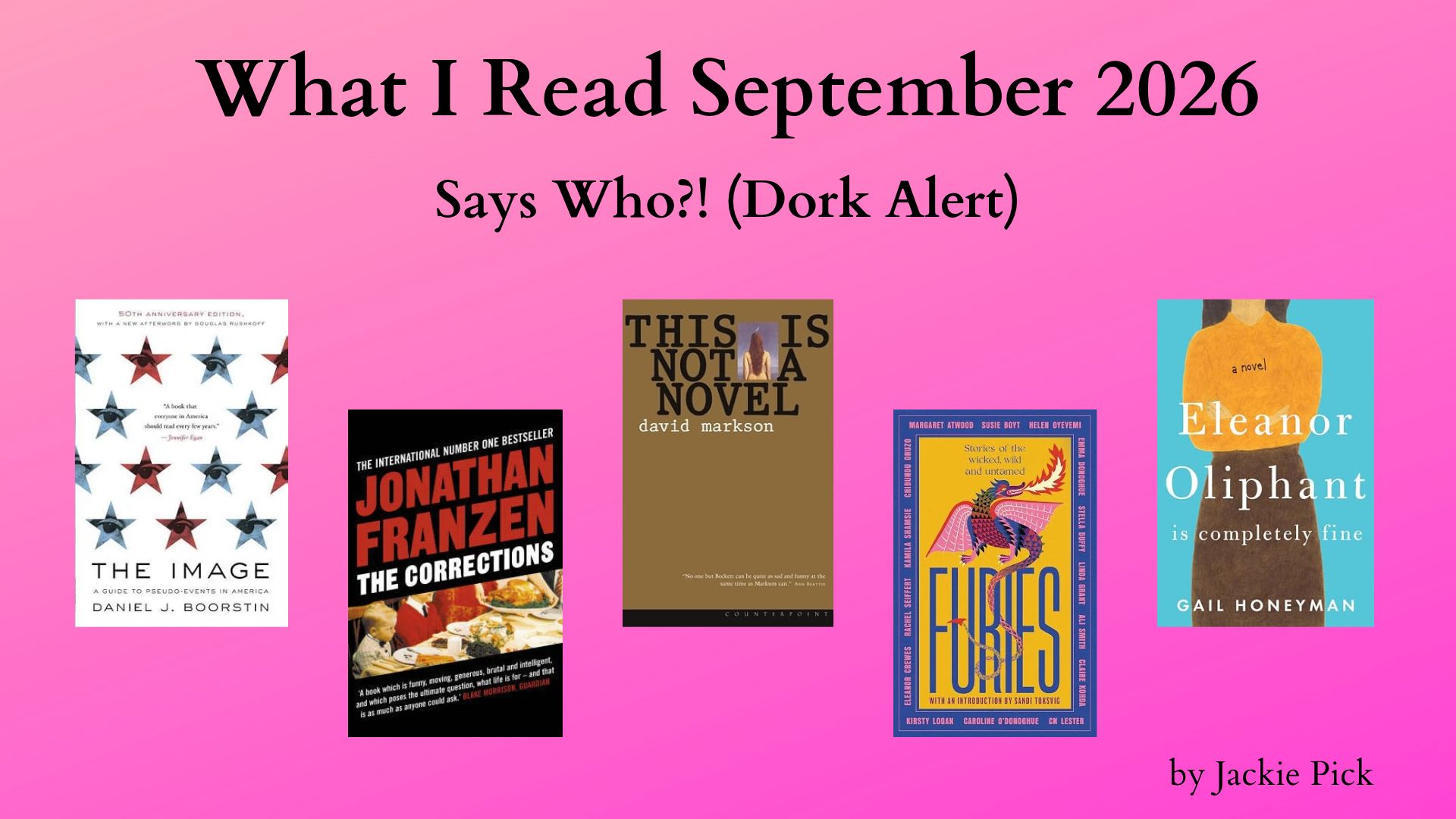
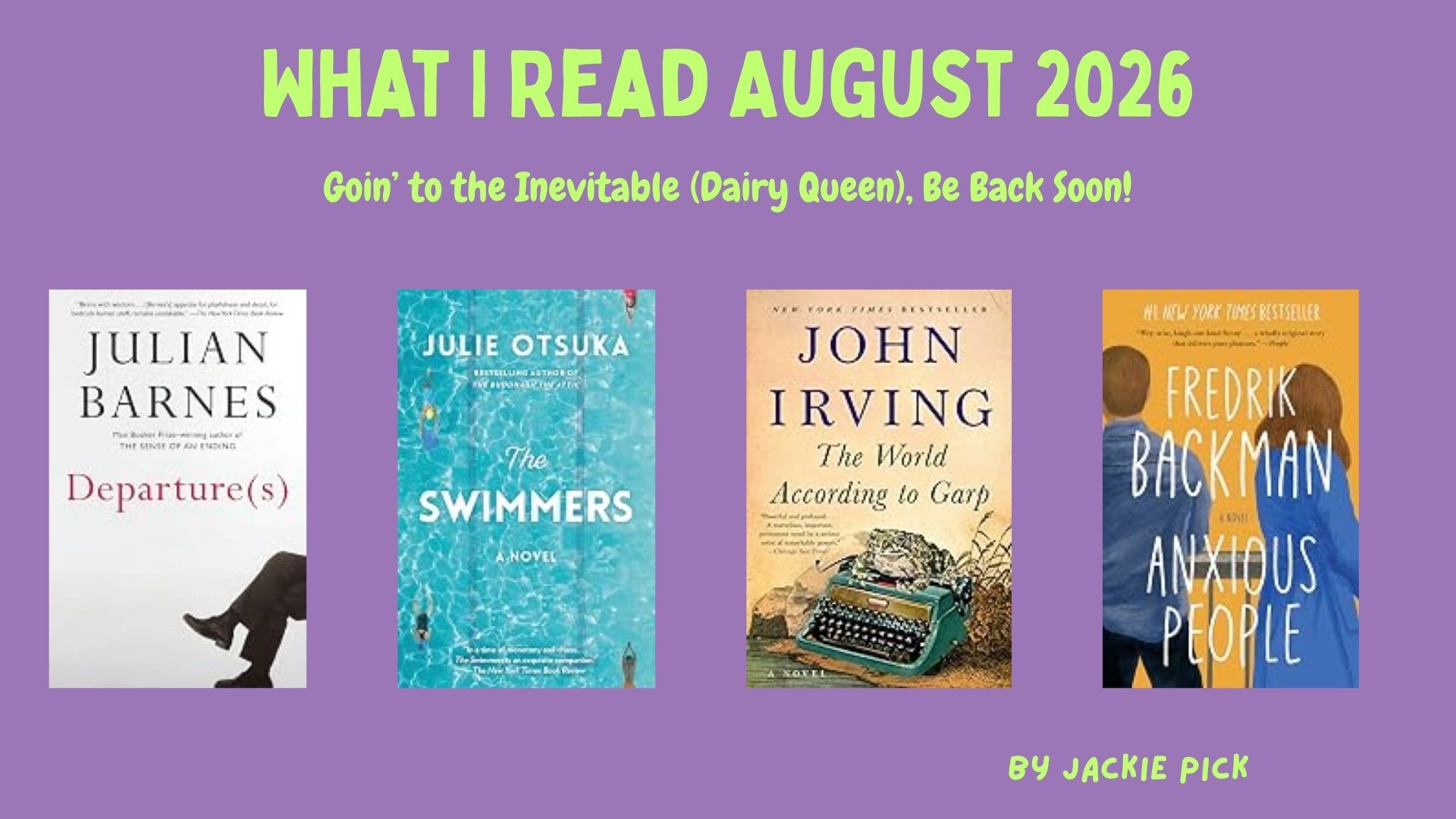
Graphic with the title "What I Read July 2026" and the subtitle "Now with less Geraldine." The featured book cover is When Women Were Dragons by Kelly Barnhill, with smaller covers of Vera, or Faith by Gary Shteyngart, Orbital by Samantha Harvey, and Joyful, Anyway by Kate Bowler below. "by Jackie Pick" appears in the lower right on a blue background.

When she was in nursery school, my daughter called me Geraldine. She would say “Ok, Geraldiiiiiiiine” when I told her it was time to clean up, take a bath, do chores, leave for school, come home, take medicine, and other unreasonable things.

Geraldine is the unfun part of me, the one in charge of things academic, rigorous, structured, and unwhimsical. She wants to be taken seriously and is one twitchy wrist away from saluting. Geraldine is the Assistant Vice President of Getting Stuff Done, Thank You. Geraldine is indispensable. One would not wish to tackle any sort of emergency without Geraldine nearby armed with a sharpened pencil. She is the keeper of outlines, the cataloger of margins. She is magnificent and exhausting. She is exactly who you want steering the ship through a storm and exactly who you do not want choosing the music afterward.

My point being that Geraldine has elbowed her way into more and more of these posts. Oh, sure, she lets Jackie come in all excited to tell you about what she’s reading and make occasional dumb jokes and do a lot of the heavy lifting. But Geraldine wants to make sure that the astute observation she had while reading makes it into the final draft. Geraldine has started interrupting my reading to administer pop quizzes on my own metacognition. “Are you reading in an Approved Literary Manner that can later be applied, however whimsically, to your posts?

I’m putting Geraldine on a reduced schedule. Mostly because I’m trying to add more mirth to my life, but also partly because I need to have fun reading the books and writing these posts. Otherwise I’ll end up resenting the writing, then the reading, and before you know it Geraldine and I will be on a performance improvement plan. I REFUSE.

I’m (re)turning this into more of a Book of the Month Club. Which is to say I’ll blarp about my new favorite book and then club you over the head with my enthusiasm.

The new format which I may or may not revisit depending on my hormones any given month:

  1. A full review of one book I can’t shut up about (possibly Very Smart, probably not).
  2. Honorable Mentions for other books I liked enough to finish.
  3. Tangents.

If this doesn’t work for you, please submit your complaint to management. Management is Geraldine.

Anyway, this month’s victim of my enthusiasm is…

When Women Were Dragons by Kelly Barnhill

Every woman has had at least one moment where she thought, “You know what? Now would be a great time to become an enormous fire-breathing creature.”

Usually it’s something small. An email. Someone asking where the ketchup is while standing directly in front of the ketchup. An interminable group text. DEFINITELY being told to smile.

We don’t have the luxury of actually becoming dragons. Most of us, anyway. Usually we sigh and maybe bitch a little in that group text, then we carry on participating in civilization.

Kelly Barnhill asked, “What if we didn’t?”

On April 25, 1955, in an alternate America, 642,987 women turned into dragons. And then no one talked about it.

Spectacle? YES! Subtle? NOT IN THE SLIGHTEST! Glorious? YES – GO TELL YOUR TEXT GROUP. I THINK THEY’RE STANDING IN FRONT OF AN OPEN FRIDGE.

Young Alex Green’s beloved aunt was one who dragoned. Alex’s family handled this in a way therapists would flag as “Whoa” by not talking about it. If everyone agrees something didn’t happen, did it, really? And how long can we repress it as a society? (see: Barnill’s mock research documents and Congressional testimonies).

Underneath all the scales and smoke, Barnhill writes about how societies pretend things didn’t happen. And if they did happen, CALM DOWN, LADIES.

Despite the title, this is a book about the impossible jobs women are routinely assigned. Be the mother. Be the sister. Be the shelter. Be the explanation. Be home. Be everything to everyone except yourself. Alex eventually learns that no one can be an entire village and surviving life is a group project. Those lessons, of course, come at a cost.

Yes, the dragons are obviously female rage, and they’re also grief. They are unrealized and directionless ambition. They’re the exhaustion of living as woman. And they are that awful and liberating moment when you realize you’ve spent years making yourself smaller so everyone else can stay comfortable. “Oh!” we say, “maybe it’s all this bending over backwards that makes my spine ache.”

One woman, in the middle of dragoning, offers perhaps the only necessary explanation for why the dragoning occurs:

“Everything is just too damn SMALL.”

If you’re hoping for a dragon-centered fantasy with detailed dragon lore and perhaps a helpful dragon appendix explaining dragoning and maybe some sort of cool hand-drawn old-timey dragon map this isn’t it. The dragons remain mysterious. They don’t explain themselves, and frankly, women shouldn’t have to, either

By the end of the novel, the dragons are still there, and we just care a whole lot more about the women they are. I hope the women in real life who have found everything too damned small find this book.

(P.S. I discovered When Women Were Dragons through Kari Bentley-Quinn’s wonderful Substack, The Long Climb. you can read that terrific post here Thank you, Kari!)


Honorable Mentions:

Orbital by Samantha Harvey

24 hours with six astronauts in the ISS. There is almost no plot and it is still one of the most most transporting novels I’ve read in years.

Read it if you enjoy books that blow your mind but also leave your resting pulse rate alone.

Joyful, Anyway by Kate Bowler

Living with suffering (aka “living”) and the refusal to pretend everything happens for a reason. Bowler selling joy-as-product or joy-as-reward. Thankfully.

Read it if you, too, believe joy is still worth noticing despite all evidence to the contrary.

Vera, or Faith by Gary Shteyngart

A struggling family in a near-future America where technology, politics, and consumer culture all mesh. No matter how many gadgets we invent, people still find new and exciting ways to lie to themselves and each other.

Read if you like cultural satire which doesn’t forget that people are actually real and tender.


And there be the July reads. Read any good books lately?

Glorious. Humane. Funny. Furious.

What I Read June 2026

Runs into blog carrying a stack of books.

Hi! Sorry I’m late. I know I’m not “the cavalry has missed the battle” late. But a little late.

…It’s just that this month has been…

Holds up one finger…

Hang on…

Several deep breaths.

…You know what? It doesn’t matter. Everybody’s month has been amonth. Nobody needs me filing an extension request with my own blog.

Sorry, just a second please…I seem to have overexerted myself…

One more deep breath.

Good grief. Sprinting into your own blog is a young person’s game.

Bends over and puts hands on knees.

Jeez, I’m out of shape.

Whew! Okay. This month: weird brilliant people doing weird, brilliant, consequential things.

Children, teenagers, writers, neighborhoods, eras, nations all trying to become something before they know exactly what that something is.

Grabs water bottle and chugs for a good 15 seconds.

Anyway, enough philosophizing and dramatically bolting into my own post. I’ve got five books to talk about, and if I don’t start now, this’ll become next month’s reading roundup.

Which is all just to say here are the books I enjoyed enough to finish this month.

  • The Greatest Sentence Ever Written by Walter Isaacson
  • The House on Mango Street by Sandra Cisneros
  • Slouching Towards Bethlehem by Joan Didion
  • Now Is Not the Time to Panic by Kevin Wilson
  • Persepolis by Marjane Satrapi

Note: For sanity and scale (mine, yours, and the internet’s), what follows are the openings of each review. Full versions are linked below.


THE GREATEST SENTENCE EVER WRITTEN by WALTER ISAACSON

The Greatest Sentence Ever Written takes the second sentence of the Declaration of Independence (“We hold these truths to be self-evident…”) and treats it as the protagonist in a story still unfolding.

Magnificent.

I mean, most sentences are not generally carrying the moral aspirations of an entire nation for the better part of two and a half centuries, and yet…this one has been drafted, edited, celebrated, weaponized, ignored, embroidered, recited by schoolchildren, shouted by abolitionists, borrowed by suffragists, quoted by civil rights leaders, and repeatedly forced to testify against the country that invented it. That’s a hell of a strong lift for thirty-something words.

(continued here)


THE HOUSE ON MANGO STREET by SANDRA CISNEROS

I read a lot of books that make me want to read more books.

The House on Mango Street made me want to write better.

I came to The House on Mango Street because my daughter sang its praises. She loved the language, the architecture of the storytelling, the way the novel gathered itself from brief, luminous pieces instead of long, sweeping chapters. For weeks she kept returning to it in conversation. So I read it. She makes excellent recommendations.

(continued here)


SLOUCHING TOWARDS BETHLEHEM by JOAN DIDION

The biggest risk I take reading Joan Didion is that by the end of every essay, I am absolutely convinced I should write like Joan Didion. This delusion lasts until I remember I do not think like Joan Didion, nor do I arrange the world into crystalline observations like Joan Didion. Her notebook, unlike mine, is probably not filled with things that say “Bananas???” and “My elbow is weird.” Didion and I are worlds apart, is what I’m saying, and my life is much less for it.

(continued here)


NOW IS NOT THE TIME TO PANIC by KEVIN WILSON

There are two things Americans love more than minding our own business:

  1. Not minding our own business.
  2. Convincing ourselves that a thing (that is usually none of our business) means something it does not mean.

Look, civilization is held together by a fragile social contract. Most of us agree not to panic about things. We agree not to form mobs. We agree to use our brains and our words when something unusual happens. Yet, all it takes is a sufficiently mysterious poster and enough people convinced that uncertainty is intolerable for that social contract to dissolve.

(continued here)


PERSEPOLIS by MARJANE SATRAPI

Somehow I had reached adulthood without ever reading Persepolis.

It is subtitled “the story of a childhood.” This is inadequate and also perfect. These types of contradictions make up the friction and the heart of this book.

(continued here)


And there be the June reads. As always, I welcome any recommendations! Read any good books lately?

Monster Songs and Other Survival Manuals: What I Read May 2026

graphic titled “Monster Songs and Other Survival Manuals: What I Read May 2026” with book covers for The Hitchhiker’s Guide to the Galaxy, Grendel’s Mother, Feminasty, and A Far Cry from Kensington on a bright green background.

The fact that I managed to read anything in May is clap-worthy. Not that clap. Regular clap. Keep it moving and behave yourself.

It’s been busy, is what I mean. So I, like anyone who read anything in May, deserve some sort of award. Not a major award. Just a tasteful certificate or a tasty pan pizza. Perhaps a small parade. Nothing extravagant, one small horse or large dog dragging me around town in a red wagon. Maybe we can be joined by a tuba player. Or maybe the dog can play the tuba while the horse drags me around. Look, I’ll sort out the logistics and report back.

And yet I ended up with a stack of books so good that I stopped treating reading like a little end-of-day reward and started ignoring actual responsibilities to read. Sorry to anyone who sent me an email, a text, a carrier pigeon, smoke signals, or did a cool semaphore flag routine in my backyard. I thought you were my parade and I was waiting for the tuba-playing dog.

These books were master classes on surviving broken systems. We’ve got intergalactic bureaucracy, Anglo-Saxon blood feuds, London publishing politics, and feminist rage. Basically, four very different ways of telling us that most systems are badly designed, the people running them are usually the least suited to the task, and women disproportionately suffer. Shocking.

This month’s reading was a refreshing reminder that humanity has, across centuries and galaxies, remained remarkably consistent and disappointing. Fertile ground for brilliant storytelling.

Which is all just to say, here are the books I finished this month:

  • The Hitchhiker’s Guide to the Galaxy by Douglas Adams
  • Grendel’s Mother by Susan Signe Morrison
  • Feminasty by Erin Gibson
  • A Far Cry From Kensington by Muriel Spark

Note: For sanity and scale (mine, yours, and the internet’s), what follows are the openings of each review. Full versions are linked below.


The Hitchhiker’s Guide to the Galaxy by Douglas Adams

Hitchhiker's Guide to the Galaxy

This book is absolutely ridiculous. I am obsessed with it.

Douglas Adams’s The Hitchhiker’s Guide to the Galaxy explains the universe using a towel, a depressed robot, and several increasingly terrible planning committees. It’s a madcap extravaganza about space, improbability, bureaucracy, bad timing, excellent timing, strange people, and one bewildered Englishman.

(continued here)


Grendel’s Mother by Susan Signe Morrison

You know the story. Big guy. Great hair probably. Sword. Mead hall full of dudes named something like Hrothgar son of Skullthumper, son of Other Skullthumper. Monster attacks. Hero flexes. History gets written by whichever man survives long enough to hire a bard. Classic.

But Susan Signe Morrison’s Grendel’s Mother walks straight into that testosterone-soaked corpse pile, picks up the narrative by its ankle, and drags it screaming into the deep water where it belongs.

This is, technically speaking, a retelling of Beowulf, which is itself a very old story about men hitting things with swords while suffering from what historians professionally refer to as “an absolutely catastrophic inability to process emotions.” Traditionally, the poem’s second monster, Grendel’s mother, is presented as a sort of swamp-adjacent horror woman lurking beneath a lake waiting to avenge her son, which everyone agrees is terribly unreasonable behavior, unlike, say, razing villages or hacking each other apart in ceremonial blood feuds.

(continued here)


Feminasty: The Complicated Woman’s Guide to Surviving the Patriarchy Without Drinking Herself to Death by Erin Gibson

Feminasty: The Complicated Woman's Guide to Surviving the Patriarchy Without Drinking Herself to Death

Erin Gibson’s Feminasty is a rage-song for the girls carrying keys between their knuckles.

It is sharp, furious, and profane. Thank God. Misogyny is not something women should have to discuss in a soft voice while reassuring everyone nearby that we’re still nice. Fortunately, Gibson has no interest in making patriarchy feel comfortable or palatable. There’s no “Now, to be fair…” or “Not all men” panic disclaimer tucked into the corners.

(continued here)


A Far Cry from Kensington by Muriel Spark

Set in 1950s London, A Far Cry from Kensington follows Mrs. Hawkins, a wartime widow working in publishing amid cliques, office politics, anonymous letters, fraud, paranoia, terrible writers, love affairs, blackmail, and other sinister and morally ugly behaviors. It is all tea trays and landladies and little typed notes, but underneath the upholstery there are wolves gnawing bones.

(continued here)


And there be the May reads. As always, I welcome any recommendations! Read any good books lately?