Category: Reading

What I Read September 2026

Says Who?! (Dork Alert)
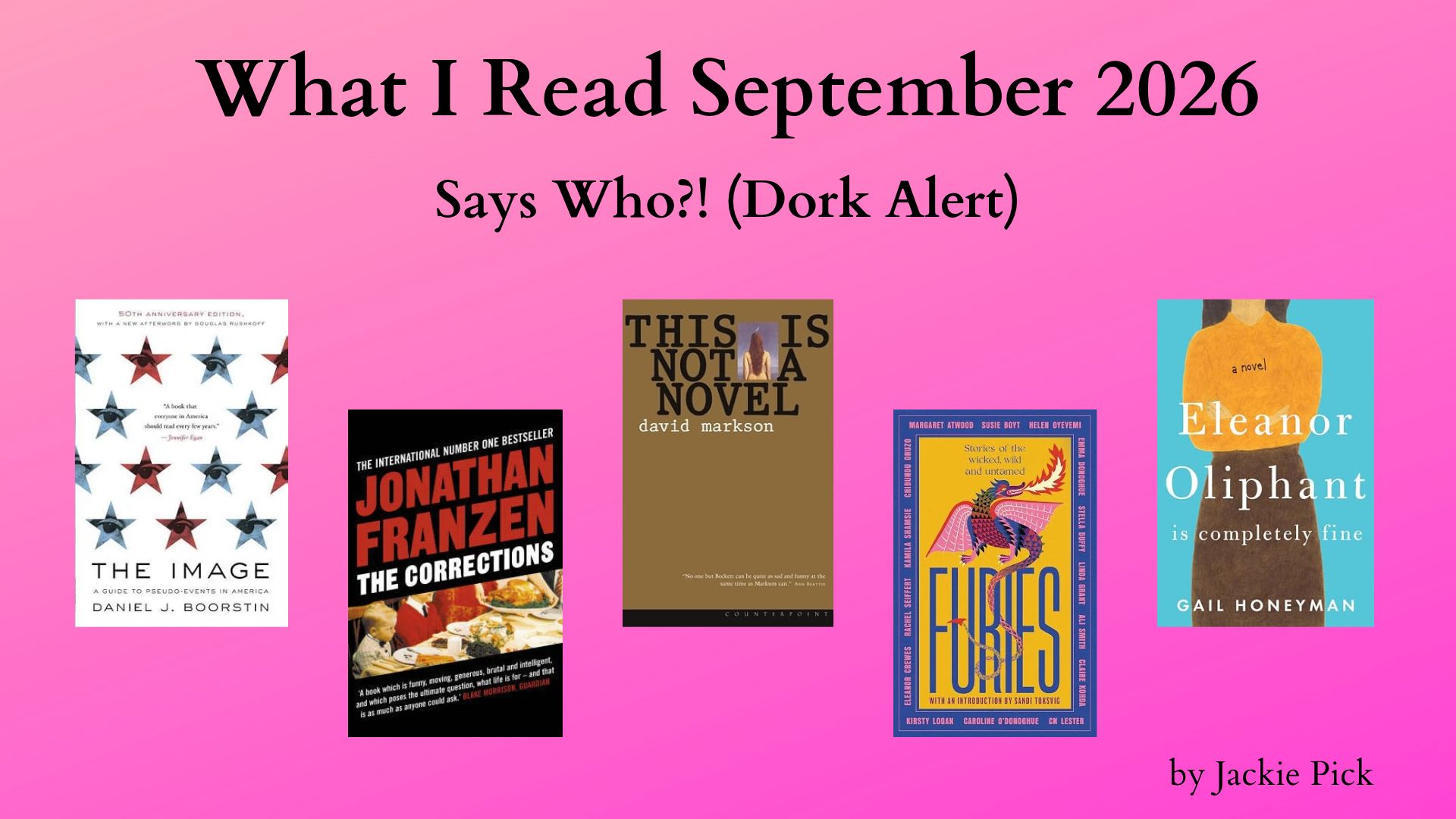
Graphic for “What I Read September 2026: Says Who?! (Dork Alert),” featuring the covers of five books reviewed this month on a bright pink background

Who defined what a novel is? Who decided which women were monsters and why? Who takes “I’m fine” at face value? Who gets corrected and by whom? And if somebody manufactures an image of a thing and shows it to enough people, at what point does the image eat the thing?

Humans LOVE categories. We make a category, invent some rules for it, forget we invented the rules, and then act like the category and the rules came from on high. And then, because we can’t leave anything along, we peel off the little labels we’ve stuck on everything to see what’s underneath.

Don’t get me wrong, labels are useful. “Please hand me the spoon,” saves considerable time over pointing at the drawer and shouting, “Gimme the small metal thing! No, the other one! No, the other other one.” But trouble begins when we name something and decide we have thus explained it. This month I read five books about that trouble.

Even though most of them were decidedly not postmodern, they organized into some sort of postmodern union behind my back. Did I sit around this month muttering about Derrida and the instability of meaning? NOT ANY MORE THAN USUAL. I sat around muttering about skepticism, mixed forms and genres, metafiction, unreliable narration, and self-reference. Bricolage, even! What a mutter!

All five books looked at the labels we’ve stuck on things and bellowed a mighty “SAYS WHO?”

I love a good SAYS WHO.

Anyway, this month’s victim of my enthusiasm is…

This is Not A Novel by David Markson

A novel has characters, plot, and narrative. It has description and meaning and metaphor and all the other things that appeared on laminated posters in my seventh-grade English classroom, right? David Markson says no. In another book he asks, “What is a novel in any case?” This Is Not a Novel seems determined to find out by getting rid of nearly all the things it is supposed to contain.

David Markson brings us a box of bones. Some are famous bones. Joyce bones. Byron bones. Beethoven bones. Some belonged to people who hated each other, slept with each other, misquoted each other, reviewed each other badly, died absurdly, died horribly, or simply died, because everyone in This Is Not a Novel is eventually going to do that. Also rattling around in the box: illnesses, insults, mistranslations, literary gossip, historical lint, quotations, coincidences, and Writer.

Writer, who is writing this book, would like us to understand that there is no character here. Writer would also like a book that is “nonlinear. Discontinuous. Collage-like. An assemblage.” None of the standard equipment..

DORK ALERT: It activated the part of my brain that once studied literary theory, so everybody gets to suffer now. (Still preferable to activating the part of my brain that remembers old commercial jingles.) This is Not a Novel gives Reader fragments until Reader fills them in and makes a book. There is a lot of theory about gaps in texts and Reader’s role in making meaning, and This Is Not a Novel is one enormous gap with famous dead people scattered throughout.

At first: fact, fact, insult, death, Writer, fact, death. Then, Reader’s brain starts laying track ahead of the train. Recurrences become motifs. Trivia acquires emotional weight. Writer, who is definitely not a character, looks suspiciously character-shaped.

Markson keeps handing us bones. He insists there is nothing to assemble while we are very obviously assembling this book. kneads that “between” with gusto. He removes the machinery of the novel and leaves us assembling it ourselves. We keep building the very thing he says isn’t there. By the end, even the ending reaches backward and rearranges what came before it.

Maybe it’s not a novel. Fine. But by the end I had experienced character, motif, development, rhythm, consciousness, and something I might even refer to as emotional movement.

This is a playful book. It’s funny and gossipy and strange. It has rhythm. It loses the rhythm. It finds another. I wanted, sometimes, to hear it read aloud, or set to music. Performed as poetry, performed as humor.

It soothed and unsettled me. I loved it.


Honorable Mentions:

Furies: Stories of the Wicked, Wild and Untamed by Margaret Atwood et al

Do you know what humanity has NEVER had enough of? WORDS FOR WOMEN WHO ARE furious, wild, and/or who refuse. (How even dare they?!) I’m sure you can think of half a dozen off the top of your head, because we’ve got an entire historical thesaurus. Of course, at no point did anyone spitting these words at an “unacceptable” woman think, “Hey, maybe she has a point.” That’s the playground for Furies, an anthology that hands those labels to women writers and says: Please return to sender! Have fun! The strongest pieces share sense that we are still explaining something that should have been settled THREE CENTURIES AGO. (Mostly our humanity, but there you go. Is that a spoiler?).

Read it if you like your female rage peppered with linguistic reclamation.

Eleanor Oliphant is Completely Fine by Gail Honeyman

I came to this one after hearing over and over that it was funny until it broke your heart. It did break my heart. I did not find it funny. Eleanor is strange, but at some point, laughing at her felt cruel. This is a trauma story about what happens after a child survives to adulthood and then is expected to just know how to function normally. It was a hard read for me.

Read it if you can handle a survival-by-kindness story.

The Corrections by Jonathan Franzen

The Lambert family has several problems, mostly each other. Franzen details their lives and their spectacular professional and personal disasters. Now matriarch Enid just wants everyone home for Christmas. The Corrections is enormous. The family is big, the ideas are big, the sentences are big, and it’s 500-plus pages. I didn’t LOVE LOVE LOVE it but I’d willingly surrendered to all of it again.

The Image: A Guide to Pseudo-Events in America by Daniel J. Boorstin (50th Anniversary Edition)

Reality is complicated and often ugly. Fortunately, humans invented the pseudo-event, an event created largely so it can be reported. (Think press conferences, ribbon-cutting ceremonies, staged commemoration, or a planned televised presidential debates.) The fallout is that reality itself is now sometimes indistinguishable from pseudo-events. Some of The Image has aged poorly, but an unnerving amount of it feels like Boorstin somehow got hold of the internet decades early.

Read it if you like the feeling of finding the smartest professor on campus, settling into a seat, and realizing about ten minutes in that you’d happily stay after class.


And there be the September books. Read anything good lately?
What I Read August 2026

Goin’ to the Inevitable (Dairy Queen), Be Back Soon!

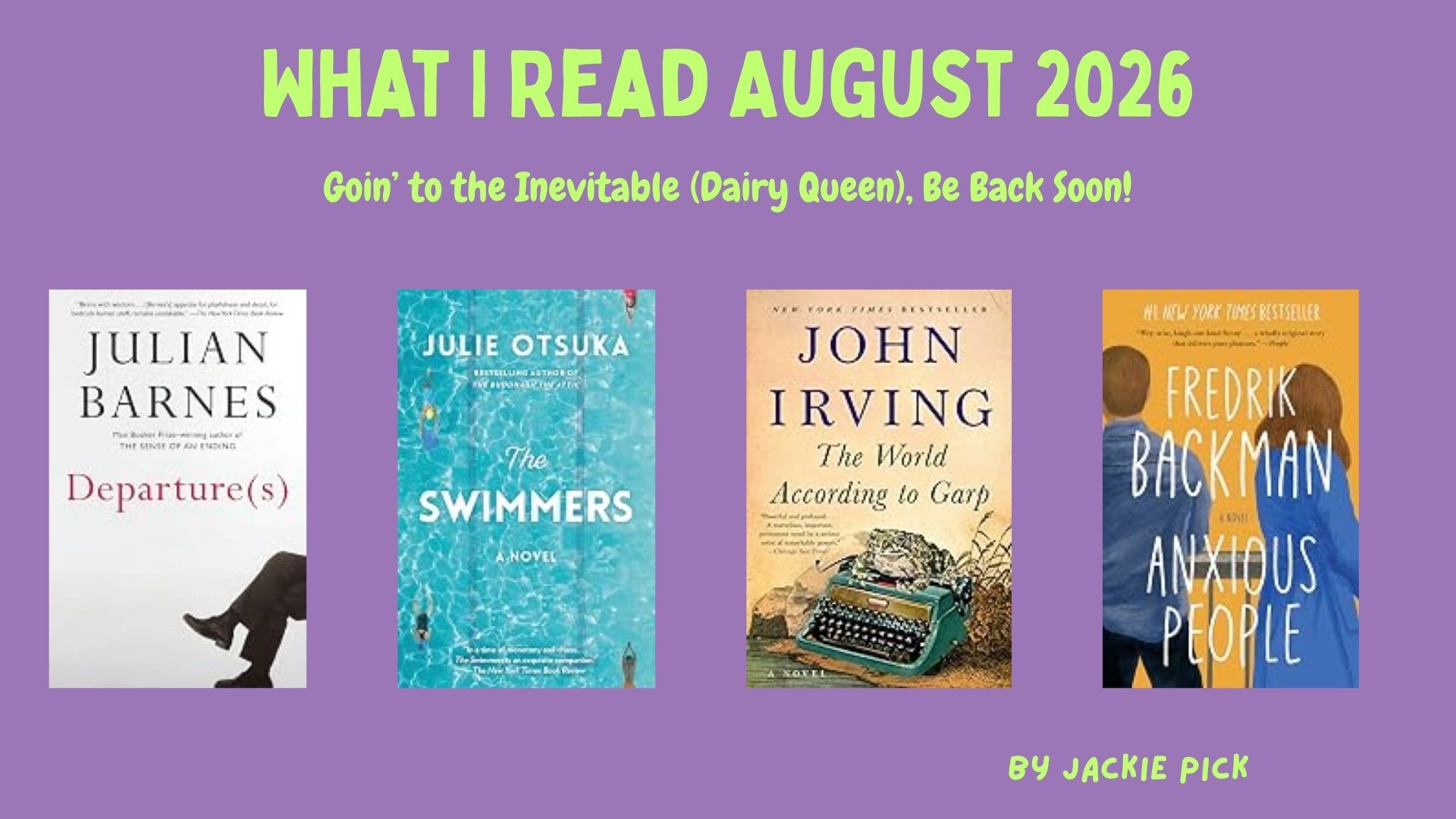
Purple graphic featuring the covers of Departure(s), The Swimmers, The World According to Garp, and Anxious People.

What IS August? Seriously, what is this month supposed to be? Because July knows what it is. July says, “It’s summer. Here’s a chair. Sit down. Have some watermelon and lemonade. Slow down for a moment.” Fine! THANK YOU, JULY. Clear mission statement. Excellent work.

There was, this year, a moreso-than-usual noticeable lack of exhaling in August. Maybe we did all our exhaling in July. Maybe we squandered it on evenings and perfectly ripe (non-diarrhea–causing) produce and the folly that time was passing at the normal rate.

August was a rush of prepping things, getting things ready, doing things, remembering other things while doing the first things, making lists of the things, consolidating those lists into master lists, losing the master lists, and making new lists called things like “EVERYTHING ELSE” and “OH SHIT, THAT TOO.”

(And then there’s writing. But I repeat myself.)

The August incantation was “abandon all routine, ye mighty, and despair,” and boy howdy, I did ever.

I love my routines, by the way. I love the small liturgy of them. Routines keep me from distractedly wandering into traffic or a Dairy Queen. Yet August took every routine I’ve spent the last eleven months carefully constructing, stuffed them into a cannon, and fired it toward Weehawken. Now I get to return to the proverbial domicile of my life and find the place ransacked.

I’m tired.

I can’t be tired. I don’t have time to be tired. It’s not on my list(s).

Introductory blathering aside, this is a brief post this month. I’m behind where I usually am when I’m behind at the end of August, which suggests the existence of several different levels/dimensions of behind and, somewhere, a version of me who finished this post last Thursday.

I tossed more than a few books back into the TBR. This was not their fault. August found me with certain specific parched patches, and I needed books that could get water directly to those patches without first requiring me to assemble the irrigation system myself. The others will be attempted again. They know what they did, which was nothing.

Everything I read this month was beautiful and heartbreaking and funny, which is quite the hat trick. Note that the humor is bone dry. Arid, even. Not a knee-slapper in the bunch. They are funny the way life gets funny sometimes. Laugh-or-cry funny. Then cry or laugh. Then laughter through tears (Oh, Dolly, hello). Lifefunny, as it were.

And that’s what I needed from books this August — stories that understand that beautiful, heartbreaking, and funny are not separate departments.

September has arrived and I exhale a quiet hallelujah. Then I breathe considerably faster because…September. In Julian Barnes’s Departure(s), he mentions Philip Larkin’s reported final words: “I am going to the inevitable.” Well, apparently so am I. According to my calendar, the inevitable is absolutely rammed through the third week of September. Join me there if you like. I’m keeping it on this side of the mortal coil but I can’t promise we’re staying out of Dairy Queen.

Anyway, this month’s victim of my enthusiasm is…

The World According to Garp by John Irving

The first time I read The World According to Garp, I was young and thought danger was an event. Something happens and the terrible thing arrives. There is a before and an after. Now I know better. The possibility of danger is a constant companion.

The World According to Garp is a strange, hungry, unruly, amazing novel about writers, wrestlers, marriage, mothers and children, sex, feminism, assassins, bears, terrible driving choices, wanting, breaking, changing, and an alarming number of body parts that become separated from the people to whom they were originally issued.

With all this, John Irving has written a book about the human desire to control our lives.

Garp would like to impose some order on his life. He’s a writer after all, and writers take the bloody animal of life and put sentences around it.

But Garp isn’t just a writer, he strives to be a serious writer. His mother, Jenny Fields, writes one book almost incidentally and becomes a feminist icon. Then strangers begin telling Jenny what Jenny means. And strangers begin telling Garp what Garp means.

This happens everywhere in Garp. People take other people’s lives and make something out of them. Everyone is forever grabbing someone else’s story, carrying it off, repurposing it, and then returning to explain what it all actually means. And that is out of Garp’s control, no matter how hard he tries.

Garp has roughly the same success controlling his family life.

He and his spouse Helen’s deep love for each other does not prevent them from making an impressive mess of their marriage. They sleep with other people. They lie and fume and forgive and fail to forgive. Garp is magnificently hypocritical about fidelity, which would almost be comedy if bodies in this book did not have such a terrible habit of turning metaphor into flesh.

Then Garp becomes a father and discovers on an even deeper level that loving someone gives you absolutely no additional power to keep them safe. He sees danger everywhere. The family calls that sense of impending danger and anxiety the Under Toad, a child’s misunderstanding of “undertow.” The Under Toad is the terrible thing waiting just out of sight.

The worst part is that Garp is right. The world is dangerous. Irving tells us so. Sometimes he practically points at the monster before it bares its teeth. You can know the Under Toad is there and love everybody enormously and still not be able to prevent disaster.

This beautifully written book should be emotionally unbearable. Instead, it is balanced. Funny, even. God, it is funny. After all, between the assassinations and adultery and grief and missing pieces of human anatomy, somebody has to make dinner and side-eye dogs. Somebody has to keep inhabiting their ridiculous, breakable bodies as though nobody has told them how this ends.

I read this book when I was young, and I loved it. I love it differently now. I dropped everything else to read one more page, which is about as much control over the situation as any of us gets.


Honorable Mentions:

Departure(s) by Julian Barnes

First there’s a life. Then a memory. Then a story. Barnes’s self-described final novel prowls around memory, mortality, love, writing, and what lies between what happened and the story we tell about what happened. He spends ample time considering what a writer owes the real people whose lives become material. It’s a hell of a question to save for your final book. It’s also at once remarkably pensive, funny, and unnerving.

Read it if you like your existential musings to be non-linear, melancholy, and sharp-toothed and/or if you wonder whether writers preserve people’s stories or are simply very articulate burglars.

The Swimmers by Julie Otsuka

Every day, a group of people finds refuge in an underground swimming pool. They stroke, breathe, turn, repeat, reach, and pace themselves. Then a crack appears at the bottom of the pool. Eventually the book narrows to one swimmer, Alice, who is losing her memory, and the daughter losing her. Otsuka’s prose is so lyrical and rhythmic that reading it feels a little like swimming: push off, breathe, turn, repeat until you realize you’ve gone somewhere much deeper than you intended.

Read it if you want a tiny-yet-enormous, lyrical book to help you swim out past where your feet can touch.

Anxious People by Fredrik Backman

A bank robbery goes wrong, an apartment viewing becomes a hostage situation, and everyone involved is trying very, very hard to be a person correctly. There are also police officers, a bridge, multiple meanings of what it means to be “from Stockholm,” and a rabbit. Backman gives us roomfuls of ridiculous people, gives us space to judge them, and then reveals their heartbreaking backstories.

Read it if you find people exhausting but love the idiots anyway, and/or if you appreciate a writer who practices the art of the reveal.


And there be the August reads. Read anything good lately?

What I Read July 2026

Now with less Geraldine

Graphic with the title "What I Read July 2026" and the subtitle "Now with less Geraldine." The featured book cover is When Women Were Dragons by Kelly Barnhill, with smaller covers of Vera, or Faith by Gary Shteyngart, Orbital by Samantha Harvey, and Joyful, Anyway by Kate Bowler below. "by Jackie Pick" appears in the lower right on a blue background.

When she was in nursery school, my daughter called me Geraldine. She would say “Ok, Geraldiiiiiiiine” when I told her it was time to clean up, take a bath, do chores, leave for school, come home, take medicine, and other unreasonable things.

Geraldine is the unfun part of me, the one in charge of things academic, rigorous, structured, and unwhimsical. She wants to be taken seriously and is one twitchy wrist away from saluting. Geraldine is the Assistant Vice President of Getting Stuff Done, Thank You. Geraldine is indispensable. One would not wish to tackle any sort of emergency without Geraldine nearby armed with a sharpened pencil. She is the keeper of outlines, the cataloger of margins. She is magnificent and exhausting. She is exactly who you want steering the ship through a storm and exactly who you do not want choosing the music afterward.

My point being that Geraldine has elbowed her way into more and more of these posts. Oh, sure, she lets Jackie come in all excited to tell you about what she’s reading and make occasional dumb jokes and do a lot of the heavy lifting. But Geraldine wants to make sure that the astute observation she had while reading makes it into the final draft. Geraldine has started interrupting my reading to administer pop quizzes on my own metacognition. “Are you reading in an Approved Literary Manner that can later be applied, however whimsically, to your posts?

I’m putting Geraldine on a reduced schedule. Mostly because I’m trying to add more mirth to my life, but also partly because I need to have fun reading the books and writing these posts. Otherwise I’ll end up resenting the writing, then the reading, and before you know it Geraldine and I will be on a performance improvement plan. I REFUSE.

I’m (re)turning this into more of a Book of the Month Club. Which is to say I’ll blarp about my new favorite book and then club you over the head with my enthusiasm.

The new format which I may or may not revisit depending on my hormones any given month:

  1. A full review of one book I can’t shut up about (possibly Very Smart, probably not).
  2. Honorable Mentions for other books I liked enough to finish.
  3. Tangents.

If this doesn’t work for you, please submit your complaint to management. Management is Geraldine.

Anyway, this month’s victim of my enthusiasm is…

When Women Were Dragons by Kelly Barnhill

Every woman has had at least one moment where she thought, “You know what? Now would be a great time to become an enormous fire-breathing creature.”

Usually it’s something small. An email. Someone asking where the ketchup is while standing directly in front of the ketchup. An interminable group text. DEFINITELY being told to smile.

We don’t have the luxury of actually becoming dragons. Most of us, anyway. Usually we sigh and maybe bitch a little in that group text, then we carry on participating in civilization.

Kelly Barnhill asked, “What if we didn’t?”

On April 25, 1955, in an alternate America, 642,987 women turned into dragons. And then no one talked about it.

Spectacle? YES! Subtle? NOT IN THE SLIGHTEST! Glorious? YES – GO TELL YOUR TEXT GROUP. I THINK THEY’RE STANDING IN FRONT OF AN OPEN FRIDGE.

Young Alex Green’s beloved aunt was one who dragoned. Alex’s family handled this in a way therapists would flag as “Whoa” by not talking about it. If everyone agrees something didn’t happen, did it, really? And how long can we repress it as a society? (see: Barnill’s mock research documents and Congressional testimonies).

Underneath all the scales and smoke, Barnhill writes about how societies pretend things didn’t happen. And if they did happen, CALM DOWN, LADIES.

Despite the title, this is a book about the impossible jobs women are routinely assigned. Be the mother. Be the sister. Be the shelter. Be the explanation. Be home. Be everything to everyone except yourself. Alex eventually learns that no one can be an entire village and surviving life is a group project. Those lessons, of course, come at a cost.

Yes, the dragons are obviously female rage, and they’re also grief. They are unrealized and directionless ambition. They’re the exhaustion of living as woman. And they are that awful and liberating moment when you realize you’ve spent years making yourself smaller so everyone else can stay comfortable. “Oh!” we say, “maybe it’s all this bending over backwards that makes my spine ache.”

One woman, in the middle of dragoning, offers perhaps the only necessary explanation for why the dragoning occurs:

“Everything is just too damn SMALL.”

If you’re hoping for a dragon-centered fantasy with detailed dragon lore and perhaps a helpful dragon appendix explaining dragoning and maybe some sort of cool hand-drawn old-timey dragon map this isn’t it. The dragons remain mysterious. They don’t explain themselves, and frankly, women shouldn’t have to, either

By the end of the novel, the dragons are still there, and we just care a whole lot more about the women they are. I hope the women in real life who have found everything too damned small find this book.

(P.S. I discovered When Women Were Dragons through Kari Bentley-Quinn’s wonderful Substack, The Long Climb. you can read that terrific post here Thank you, Kari!)


Honorable Mentions:

Orbital by Samantha Harvey

24 hours with six astronauts in the ISS. There is almost no plot and it is still one of the most most transporting novels I’ve read in years.

Read it if you enjoy books that blow your mind but also leave your resting pulse rate alone.

Joyful, Anyway by Kate Bowler

Living with suffering (aka “living”) and the refusal to pretend everything happens for a reason. Bowler selling joy-as-product or joy-as-reward. Thankfully.

Read it if you, too, believe joy is still worth noticing despite all evidence to the contrary.

Vera, or Faith by Gary Shteyngart

A struggling family in a near-future America where technology, politics, and consumer culture all mesh. No matter how many gadgets we invent, people still find new and exciting ways to lie to themselves and each other.

Read if you like cultural satire which doesn’t forget that people are actually real and tender.


And there be the July reads. Read any good books lately?