Goin’ to the Inevitable (Dairy Queen), Be Back Soon!
What IS August? Seriously, what is this month supposed to be? Because July knows what it is. July says, “It’s summer. Here’s a chair. Sit down. Have some watermelon and lemonade. Slow down for a moment.” Fine! THANK YOU, JULY. Clear mission statement. Excellent work.
There was, this year, a moreso-than-usual noticeable lack of exhaling in August. Maybe we did all our exhaling in July. Maybe we squandered it on evenings and perfectly ripe (non-diarrhea–causing) produce and the folly that time was passing at the normal rate.
August was a rush of prepping things, getting things ready, doing things, remembering other things while doing the first things, making lists of the things, consolidating those lists into master lists, losing the master lists, and making new lists called things like “EVERYTHING ELSE” and “OH SHIT, THAT TOO.”
(And then there’s writing. But I repeat myself.)
The August incantation was “abandon all routine, ye mighty, and despair,” and boy howdy, I did ever.
I love my routines, by the way. I love the small liturgy of them. Routines keep me from distractedly wandering into traffic or a Dairy Queen. Yet August took every routine I’ve spent the last eleven months carefully constructing, stuffed them into a cannon, and fired it toward Weehawken. Now I get to return to the proverbial domicile of my life and find the place ransacked.
I’m tired.
I can’t be tired. I don’t have time to be tired. It’s not on my list(s).
Introductory blathering aside, this is a brief post this month. I’m behind where I usually am when I’m behind at the end of August, which suggests the existence of several different levels/dimensions of behind and, somewhere, a version of me who finished this post last Thursday.
I tossed more than a few books back into the TBR. This was not their fault. August found me with certain specific parched patches, and I needed books that could get water directly to those patches without first requiring me to assemble the irrigation system myself. The others will be attempted again. They know what they did, which was nothing.
Everything I read this month was beautiful and heartbreaking and funny, which is quite the hat trick. Note that the humor is bone dry. Arid, even. Not a knee-slapper in the bunch. They are funny the way life gets funny sometimes. Laugh-or-cry funny. Then cry or laugh. Then laughter through tears (Oh, Dolly, hello). Lifefunny, as it were.
And that’s what I needed from books this August — stories that understand that beautiful, heartbreaking, and funny are not separate departments.
September has arrived and I exhale a quiet hallelujah. Then I breathe considerably faster because…September. In Julian Barnes’s Departure(s), he mentions Philip Larkin’s reported final words: “I am going to the inevitable.” Well, apparently so am I. According to my calendar, the inevitable is absolutely rammed through the third week of September. Join me there if you like. I’m keeping it on this side of the mortal coil but I can’t promise we’re staying out of Dairy Queen.
Anyway, this month’s victim of my enthusiasm is…
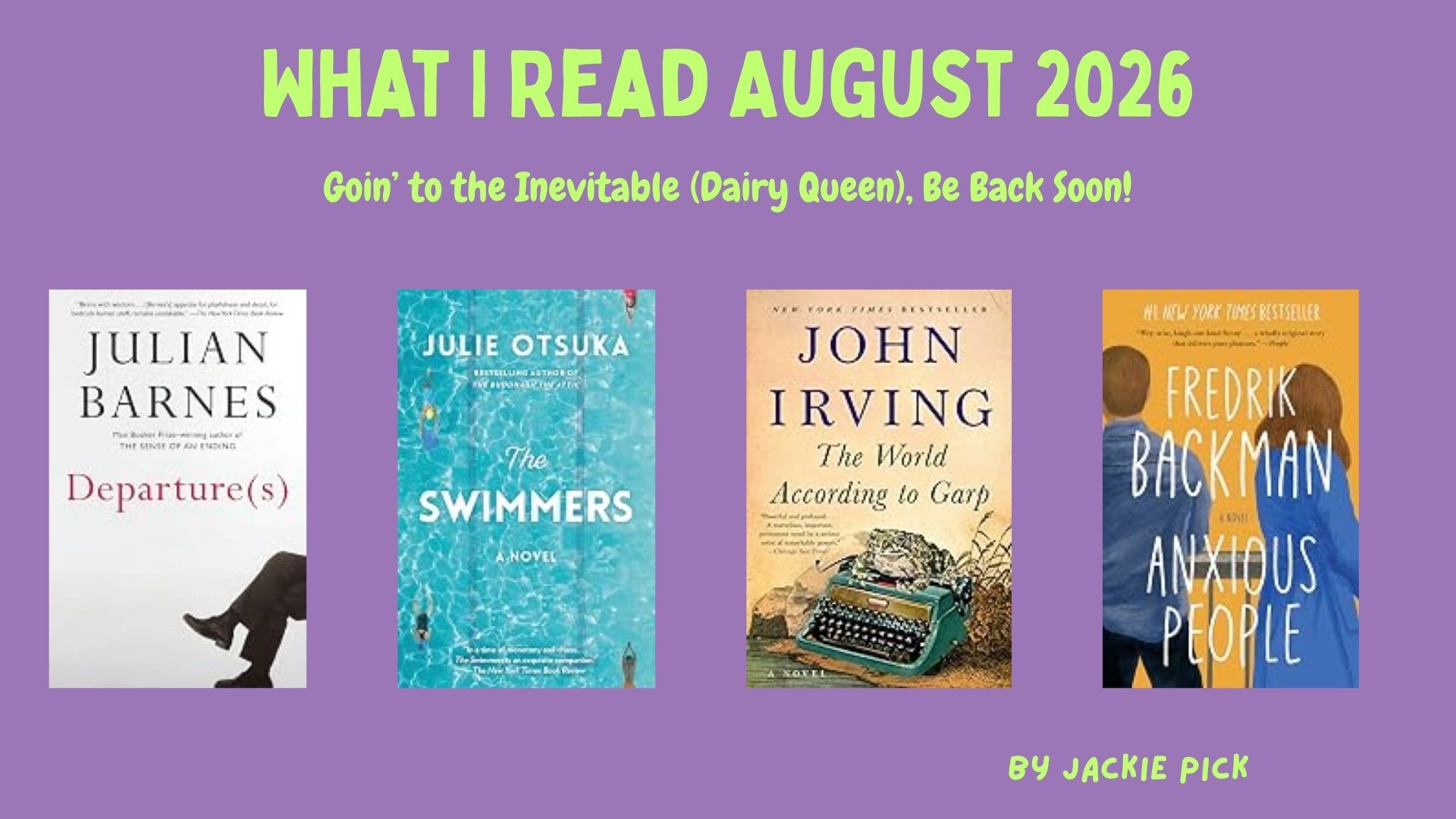
The World According to Garp by John Irving
The first time I read The World According to Garp, I was young and thought danger was an event. Something happens and the terrible thing arrives. There is a before and an after. Now I know better. The possibility of danger is a constant companion.
The World According to Garp is a strange, hungry, unruly, amazing novel about writers, wrestlers, marriage, mothers and children, sex, feminism, assassins, bears, terrible driving choices, wanting, breaking, changing, and an alarming number of body parts that become separated from the people to whom they were originally issued.
With all this, John Irving has written a book about the human desire to control our lives.
Garp would like to impose some order on his life. He’s a writer after all, and writers take the bloody animal of life and put sentences around it.
But Garp isn’t just a writer, he strives to be a serious writer. His mother, Jenny Fields, writes one book almost incidentally and becomes a feminist icon. Then strangers begin telling Jenny what Jenny means. And strangers begin telling Garp what Garp means.
This happens everywhere in Garp. People take other people’s lives and make something out of them. Everyone is forever grabbing someone else’s story, carrying it off, repurposing it, and then returning to explain what it all actually means. And that is out of Garp’s control, no matter how hard he tries.
Garp has roughly the same success controlling his family life.
He and his spouse Helen’s deep love for each other does not prevent them from making an impressive mess of their marriage. They sleep with other people. They lie and fume and forgive and fail to forgive. Garp is magnificently hypocritical about fidelity, which would almost be comedy if bodies in this book did not have such a terrible habit of turning metaphor into flesh.
Then Garp becomes a father and discovers on an even deeper level that loving someone gives you absolutely no additional power to keep them safe. He sees danger everywhere. The family calls that sense of impending danger and anxiety the Under Toad, a child’s misunderstanding of “undertow.” The Under Toad is the terrible thing waiting just out of sight.
The worst part is that Garp is right. The world is dangerous. Irving tells us so. Sometimes he practically points at the monster before it bares its teeth. You can know the Under Toad is there and love everybody enormously and still not be able to prevent disaster.
This beautifully written book should be emotionally unbearable. Instead, it is balanced. Funny, even. God, it is funny. After all, between the assassinations and adultery and grief and missing pieces of human anatomy, somebody has to make dinner and side-eye dogs. Somebody has to keep inhabiting their ridiculous, breakable bodies as though nobody has told them how this ends.
I read this book when I was young, and I loved it. I love it differently now. I dropped everything else to read one more page, which is about as much control over the situation as any of us gets.
Honorable Mentions:
Departure(s) by Julian Barnes
First there’s a life. Then a memory. Then a story. Barnes’s self-described final novel prowls around memory, mortality, love, writing, and what lies between what happened and the story we tell about what happened. He spends ample time considering what a writer owes the real people whose lives become material. It’s a hell of a question to save for your final book. It’s also at once remarkably pensive, funny, and unnerving.
Read it if you like your existential musings to be non-linear, melancholy, and sharp-toothed and/or if you wonder whether writers preserve people’s stories or are simply very articulate burglars.
The Swimmers by Julie Otsuka
Every day, a group of people finds refuge in an underground swimming pool. They stroke, breathe, turn, repeat, reach, and pace themselves. Then a crack appears at the bottom of the pool. Eventually the book narrows to one swimmer, Alice, who is losing her memory, and the daughter losing her. Otsuka’s prose is so lyrical and rhythmic that reading it feels a little like swimming: push off, breathe, turn, repeat until you realize you’ve gone somewhere much deeper than you intended.
Read it if you want a tiny-yet-enormous, lyrical book to help you swim out past where your feet can touch.
Anxious People by Fredrik Backman
A bank robbery goes wrong, an apartment viewing becomes a hostage situation, and everyone involved is trying very, very hard to be a person correctly. There are also police officers, a bridge, multiple meanings of what it means to be “from Stockholm,” and a rabbit. Backman gives us roomfuls of ridiculous people, gives us space to judge them, and then reveals their heartbreaking backstories.
Read it if you find people exhausting but love the idiots anyway, and/or if you appreciate a writer who practices the art of the reveal.
And there be the August reads. Read anything good lately?


 Jackie Pick