The Folio: What I Read in January 2025
Before we begin, quick question: Should I stick with monthly roundups of books, or post reviews as I finish them? Let me know in the comments!
Before I REALLY begin, I want to say that I’m acutely aware of what’s happening in the world right now (and, honestly, whenever you’re reading this, something is happening). Books are my lifeline in times like these, as are the arts in general. Maybe these reviews will help you discover something that locks the monsters in the closet, even if just for a few hours.
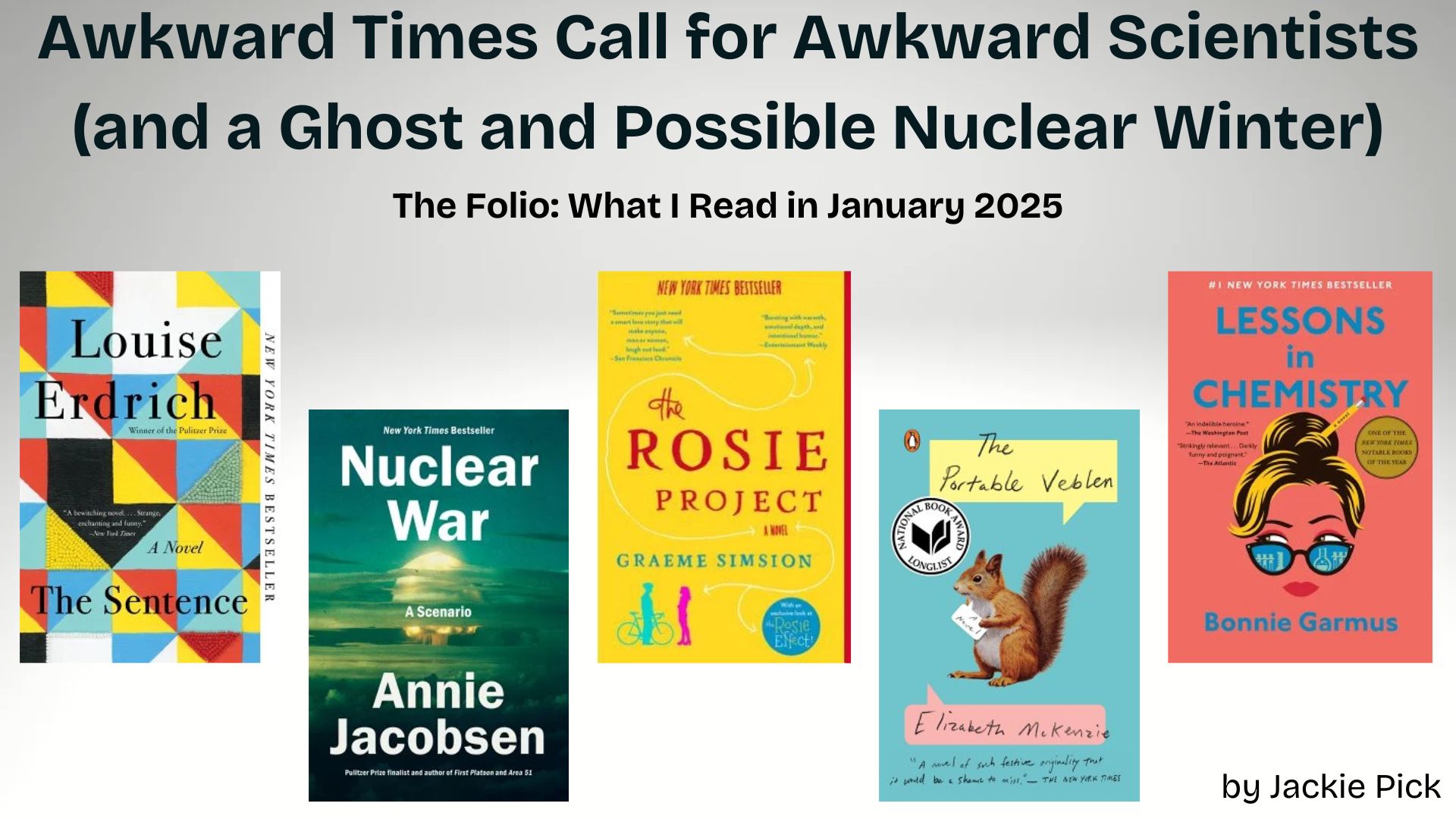
Anyhoodles, this month’s accidental theme was SCIENTISTS! (MOSTLY!) Three books feature fictional, socially awkward scientists. One features real-life scientists scaring the crap out of me. And then there was a book with a ghost who was far less frightening than the whole nuclear war scenario and was also not a scientist.
It all made me want to make a “ties that bind, ties that break” chemical bond pun, but that’s wordplay I haven’t earned this early in a post.
These books share an underlying question of respect. Just a little bit. Just a little bit.
I made the questionable choice to read Lessons in Chemistry and The Portable Veblen simultaneously, a juggling act that requires finesse. “Finesse” is not ever associated with me, so that little experiment had some issues. Both books feature untraditional female protagonists grappling with thorny relationships and mixed feelings about marriage, sharp critiques of societal norms, deliciously eccentric side characters, razor-sharp humor, partners who thrive (sometimes smugly) in more traditional spaces, and brilliant animal companions. Given the current firehose of everything, tackling these two literary powerhouses together was, in hindsight, a terrible idea. Definitely. But also worth it. Fire hoses sometimes clarify things. Or get the dirt out. Look, I don’t know. I don’t have the finesse for this paragraph.
I also freely admit that science is not my lane. What I know about it could fit in a 10 ml Erlenmeyer flask. But that was not prohibitive at all in reading this odd collection.
Which is all just to say these are the books that I enjoyed (?!) enough to finish in the last month:
- The Sentence by Louise Erdrich
- Nuclear War: A Scenario by Annie Jacobsen
- The Rosie Project by Graeme Simsion
- The Portable Veblen by Elizabeth McKenzie
- Lessons in Chemistry by Bonnie Garmus
The Sentence by Louise Erdrich
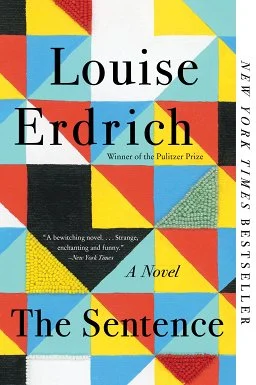
A woman makes mistake after mistake and struggles to forgive herself. It makes so many of us ache, especially when she hits middle-age and is still trapped in the cycle. Relatable to far too many of us.
The Sentence is a book about the pandemic, yes, but also about books — their power to make or break a person. It’s about love, about how pain can carry us far from ourselves. It’s about ghosts, it’s about place and time, it’s about living through history and not having a guidebook even when you are literally surrounded by books.
It’s about a lot.
What a world, what a world.
The Sentence isn’t what I’d consider a beach read. It’s phenomenal in its own deep, murky way. Louise Erdrich is a master at letting readers fill in the gaps. Her storytelling is dense, funny, sad, and sweet, skimming past exposition when needed but occasionally lingering on a breathtaking paragraph about a home, a community, or a character’s history.
This novel is packed with 2020 zeitgeist and a sprinkle of the paranormal. Not the kind of ghost story that screams “Take that book off the shelf and a Spirit Halloween will pop up in it’s place,” but one that’s almost natural, woven into the fabric of time, history, and a year where every boundary blurred: between the living and the dead, the personal and the political, the individual and the collective.
At The Sentence’s heart is Tookie, a Native American woman with a chaotic past. She spent ten years in prison for a crime so absurd it feels like a cosmic joke, one she committed because of trust and love. Now, she’s clawed her way back, finding solace at Birchbark Books, a sanctuary and second chance, but literal and figurative ghosts linger.
The story wrestles with identity, cultural appropriation, belonging, justice, redemption, grief, and the life-saving power of literature. It can feel unwieldy, like, “Which of these threads are we following now?” But that’s life. Especially in 2020, when everything happened at once, and there was no time for careful analysis never mind catching our breath. The ghost story sometimes feels like an escape hatch, but it’s symbolic and a beautiful shelf-companion to Beloved.
Erdrich balances humor and seriousness beautifully. Tookie is a vivid, unforgettable protagonist, and the secondary characters feel alive, created in a few key strokes and living fully in the pages (MORE POLLUX, PLEASE!). The pacing takes some adjustment: zippy at first, then nutrient-dense and slow before speeding up like a second draft overtaking the first. But I liked that. It mirrors how time warped and twisted during the pandemic.
The story’s threads tangle and fray, and Erdrich doesn’t tie them all neatly together. That’s life, too.
Would I want to work in a haunted bookstore? Probably. But having worked retail, I know how that world can get. There can be a gaping chasm between what’s on the shelves versus what’s in front of them.
Maybe, just maybe, the answer to what we do while the world burns is in places like this. Haunted, chaotic, full of books, and yet, still, simmering with hope.
Nuclear War: A Scenario by Annie Jacobsen
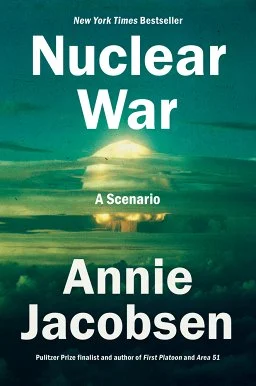
Hey, how’s your adrenal system? Because Annie Jacobsen’s latest will stress-test it. This may not be the book for you at this moment. That’s okay. Put it on your TBR pile if you need.
The reality, the looming dread, and the anxiety of nuclear war didn’t vanish along with Smurfs, Teddy Ruxpins, or the extremely-80s-even-for-the-80s Chess King store. Much like Teddy Ruxpin, Annie Jacobsen beautiful work will haunt you. She’s here to grab you by the shoulders and remind you explicitly, directly, vividly, and with a mountain of receipts that nuclear war remains a terrifyingly real possibility.
Nuclear War: A Scenario is not speculative fiction, though it reads like it should be. It’s not science fiction, though the premise feels catastrophically implausible until you realize it isn’t. Jacobsen walks us through a nuclear conflict initiated by a North Korean missile strike, minute by horrifying minute. This is a reality check.
Drawing from declassified documents and insider interviews, Jacobsen meticulously reconstructs the minutes, hours, and years after such an event, leading to one grim conclusion: the systems we rely on to prevent catastrophe are fragile, and our fate lies in the hands of flawed, pressured, fallible people.
The “ticking clock” pacing gives the book the feel of a geopolitical thriller, but it hits harder than any fiction ever could. The prose, though occasionally heavy on description, remains accessible, ensuring this harrowing reality reaches a broad audience. And it should. The catastrophic harms Jacobsen outlines wouldn’t end in days or weeks — they’d linger for millennia. And yet, her novel-like pacing keeps you hooked and horrified, unable to look away even as the dread mounts. You know how this ends, but you can’t stop reading and wondering “Where could we stop this? This moment? That moment?”
This isn’t a book you enjoy so much as survive (and then, boy, are you grateful for any sense of survival). Equal parts “I had no idea” and “Oh God, why do I know this now?” it’s a full-body panic attack: sobering, terrifying, and essential reading for anyone willing to face the stakes of our world and consider in whose hands lies its fate.
Perhaps the best nuclear deterrence strategy is to read this book and hope its pages remain hypothetical.
Look upon our works, ye mighty, and despair.
The Rosie Project by Graeme Simsion
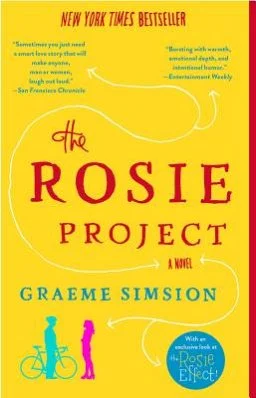
Ack. I‘m all over the place with this one. Yes, I just said “Ack.”
The Rosie Project is a rom-com that collides with wickedly sharp writing and starts smelling faintly of spreadsheets and awkward silences. Meet Don Tillman, a geneticist who approaches life with the precision of a lab experiment. Timetables, optimized meal plans (hello, Lobster Tuesdays*), and meticulously tested hypotheses keep his world running as smoothly as possible for a man who struggles to decode the nuances of human connections.
At 39, Don decides it’s time to find a wife so he institutes “The Wife Project,” which includes a lengthy, detailed, ridiculous screening questionnaire for potential mates. Don’s approach to finding a life partner works about as well as you’d expect, which is to say, not at all. Everyone in the book seems to know this. You know it. I know it. But Don? Don’s testing his theory, come what may.
Enter (breathlessly) Rosie Jarman, a free-spirited bartender and grad student on a quest to find her biological father. When Don gets roped into Rosie’s “Father Project,” their unexpected partnership forces him to step outside his comfort zone. Rosie’s spontaneity and warmth challenge Don’s rigid worldview, while Don’s quirks and brilliance unexpectedly win Rosie over. Rosie fails nearly every criterion of Don’s Wife Project questionnaire, yet somehow she delightfully disrupts his carefully calibrated world. From her entrance we can see where this relationship is headed.
Simsion writes with a sparkling wit and a knack for pacing that feels effortless, no doubt honed by the book’s origins as a screenplay. The dialogue crackles, the humor lands, and the depiction of academia is as brutal as it is hilarious. Watching Don apply logic to love is both hilarious and heartbreaking, highlighting not just his brilliance but also his interpersonal limitations.
While Rosie is vibrant and compelling, she occasionally feels more like a narrative device than a fully realized character. Simsion does work to avoid reducing her to an archetype, but at times she seems to function primarily as a catalyst to unravel Don’s rigid patterns and show that love defies logic. Their chemistry works, but I would have loved to get some more of Rosie’s depth. More dialogue from her about her attraction to Don could have enriched their romance, though the telling of the story from Don’s perspective understandably limits our insight into her feelings.
Then there’s Don himself. Simsion has said he intentionally avoided labeling Don’s behaviors, which strongly suggest neurodivergence, to allow readers to interpret him individually. While understandable, this choice leaves certain questions unresolved. Don’s social struggles often fuel the humor, but at times it wobbles between empathetic comedy and laughing at his expense. This tension may leave readers wonder if we are meant to laugh with Don, or at him? Is it a celebration of individuality, or does its pursuit of humor sometimes risk reducing individuality to a punchline?
Hence my “ack.”
Despite its flaws, I did happily read this book to the end. The contrast between precision and chaos underscores the love story. Simsion is a hell of a writer, and this book was a nice reset of my adrenals after reading Nuclear War: A Scenario.
A little messy, but worth it. Much like Lobster Tuesdays.
*lobster, mango and avocado salad with wasabi-coated flying fish roe and crispy seaweed and deep-fried leek garnish
The Portable Veblen by Elizabeth McKenzie
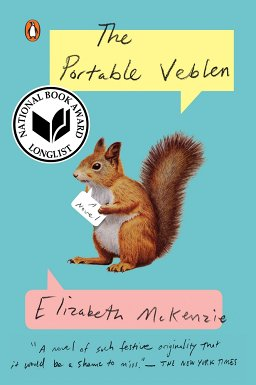
The Portable Veblen brings a chittering glitter cannon to a philosophy conference in the best possible way.
Elizabeth McKenzie wrote a playful, brainy novel packed with existential dread, and big questions about modern life. It’s not your typical lit fic, contemporary fic, romance, magical realism lit, or humor, and honestly? Bless it for that.
The Portable Veblen dissects absurdities of contemporary existence through Veblen Amundsen-Hovda and her fiancé, Dr. Paul Vreeland, a neurologist whose clinical precision doesn’t always extend to human relationships. Veblen, named after the anti-consumerist economist Thorstein Veblen, is a free-spirited woman whose quirks are more survival mechanism than affectation. A point made crystal clear once we are introduced to her parents.
Veblen’s approach to life doesn’t challenge Paul outright, but it quietly forces him to confront the contradictions in his ambition-fueled, family-fractured existence. Their relationship teeters under the weight of family baggage, corporate greed, and the chaos of wedding planning.
There’s a squirrel. Possibly sentient, functioning either as Veblen’s life coach or doorman (door-rodent?) to some sort of dissociative state. The squirrel’s role as both a confidant for Veblen and a burr in Paul’s proverbial sock adds another Wes-Anderson-esque layer to an already offbeat story. Eccentric side characters pop in and out, adding humor and pathos as Veblen and Paul try to figure out whether their love can survive their vastly different worlds.
With dry, delicious humor, McKenzie tackles big themes (capitalism, ambition, family dysfunction) while maintaining emotional heft.
The quirk factor is dialed up. The squirrel subplot is either charmingly surreal or distractingly odd, depending on your tolerance for whimsy. Paul is fine. His and Veblen’s dynamic works, but Paul occasionally feels more like a foil than a true partner. Veblen’s mother? Definitely a foil and quite frankly, if she were my parent, I’d be talking to squirrels, too.
The book does meander, much like the titular squirrel darting around a tree. Some detours into Veblen’s family history and philosophical musings are worthwhile while others stretch the story thin.
All that said, The Portable Veblen is a delightfully weird little book — smart, funny, inventive, and completely unafraid to be its peculiar self.
(Fun Fact: I apparently read this book nine years ago. I didn’t remember it, so it was like reading it for the first time. The first time, I was neutral on it, but now not so much. So, in book selection as in life — and pinball — timing is everything.)
Lessons in Chemistry by Bonnie Garmus

I didn’t pick up Lessons in Chemistry because of the buzz — because, let’s face it, buzz has burned me before. I picked it up because women I adore and respect raved about it. Oh, Lessons in Chemistry, you bold, fiery little book. You walk into the room, dressed like an unserious vixen, grab a lab coat, and proceed to calmly and brilliantly roast systemic sexism over a Bunsen burner.
This is the story of Elizabeth Zott, a chemist too fiercely brilliant for the cigar-smoke-filled labs of her time. Elizabeth doesn’t “lean in”; she kicks the door off its hinges — except the world keeps bolting new ones in her way. She’s got a fiercely loyal dog named Six-Thirty, a precocious daughter, and the love of her life in Calvin Evans, an equally brilliant scientist whose unconventionality somehow fits him better than it fits her. Still, Elizabeth fights on, armed with blazing beakers and a spatula, turning a cooking show into a feminist manifesto that teaches women chemistry and challenges the suffocating norms of the era. A+ for gumption and execution.
Bonnie Garmus writes with enough heat to turn the patriarchy into a puddle of goo. The book is laugh-out-loud funny, but it has real teeth, too. It tackles big, hairy topics — sexism, ambition, motherhood, love — with style and smarts. It’s no wonder Lessons in Chemistry has earned its beloved bestseller status. I get it. It’s deep yet accessible, sharp yet breezy, a balancing act that feels effortless.
I’ll admit, though, I’m a sucker for secondary characters, and I wanted more Harriet Sloane. Harriet’s the kind of person I need in my life — or, more realistically, the kind of person I aspire to be (minus the unhappiness). The language throughout is playful, but the mix of quirk and trauma can be tough at times. Elizabeth is sidelined, dismissed, and deeply traumatized, and the hardest part is seeing how much we’ve two-stepped back into those same dynamics today.
Elizabeth is amazing — almost too amazing. She’s so extraordinary that she teeters on the edge of perfection. Yes, she’s flawed, but those flaws feel faint, like a distant planet we’re told exists but can’t quite see. And the villains? Fun to hate but a little cartoonish, twirling their mustaches on the way to oblivion. One “villain,” however, managed to surprise me, which was a welcome twist. Occasionally, the book holds its themes up like a megaphone in your face — effective, sure, but not always subtle.
Then there’s Six-Thirty, Elizabeth’s dog. The switch to his point of view was jarring at first (he’s a dog, after all), but not enough to take me out of the story. And honestly, if you’re going to have a canine narrator, Six-Thirty is the one to have. If my own dog were narrating a story, it would be a series of broken thoughts, endless neediness, and occasional pauses to sniff his own butt.
But subtlety is overrated when you’re taking a flamethrower to societal norms. Lessons in Chemistry is big, bold, and unapologetically feminist, with a beating heart and enough laughs to carry it. It’s the kind of book that grabs you by the collar and shouts, “You’re better than this world lets you be!” And honestly, we probably all need that right now.
Let this one light your inner Bunsen burner of righteous indignation. While its cover might suggest a romance novel — which it’s not — you’ll fall in love with it all the same.
And to the women I adore who recommended it: thank you.
That was a lot (ACK!)
Did you read anything this month that made your neurons fire or your heart rate spike? Share your findings!
 Jackie Pick
Before I comment, I mean, REALLY comment, let me say, yes, continue reviewing.
Before I keep comment, I mean, REALLY, REALLY comment, let me say, reading your reading list is both inspiring and intimidating. Gee, I thought the goal of 12 books a YEAR was a worthy pursuit. And, it is! Yet…
Because of your scientific risk, am more intrigued by the possibility of engaging other genres than my traditional biography, history, leadership and faith library. Something nasty…dangerous… like, finishing one of those books I was supposed to read in high school. Or, pilfering something off the banned books list to find out why it’s for sore eyes only!
Anyway, thanks for the encouragement. And the reviews. As I wean off social realms and my objective news choices are taken away, I’m glad to have these alternatives from which to Pick.
LikeLiked by 1 person
Before I reply, THANK YOU.
Before I really, really reply, THANK YOU AGAIN.
I read because, honestly, my life is small right now and the books enlarge it. Also, it’s my job, which is great but also sometimes means I don’t savor as much as I’d like.
And 12-100000000 books. Doesn’t matter. It’s the opening of heart. It’s the filling our hearts with words and then being able to empty our hearts where they are needed (that is a terrible paraphrase of what someone else said, but I think you get it.)
I would love to know what’s on your to-read list!
I’m currently reading Othello because I never read it, and that’s one from high school!
Carrying on…
LikeLike
A prescient discovery today, this reply of yours from January. I HAVE been reading much lately…but not here. Yet, but a few moments ago I told my wife we must trade a TV-hour for a book hour. Your life is small, ours expansive. Short takes:
1. I read a bevy of books depending on project, personal growth or fun. I prefer ink and paper, but lately challenge myself on Kindle. I just began my 3rd attempt at a perfect month badge. I missed by one day in both January and February. January i erred on the 4th.
LikeLike
February I erred on the 24th. Still, i have a 54-week streak going, which in this era, for me, is a feat.
2. Am currently reading “The Measure of a Man,” Sidney Poitier’s second autobiography (hardcover); “Improv Wisdom” (Kindle), and “My Utmost for His Highest,” Oswald Chambers, a daily pocket devotional. I just finished “The Deadliest Election in America” by Dana Bush. It’s about the 1876 presidential election with such eerie 2020-24 parallels by BP monitor has been off the charts. So, I have returned to “Royko.” I need laughs.
3. Finally, #TheMrs & I began a TV & media fast yesterday. 40 days. A goal includes supplanting a TV hour with a book. Easier for me. When we met she was a Developmental Editor, and an inveterate reader of mysteries. Then came the Internet, our daughter, parental caretaking, sibling caretaking, smartphones and sleep. Her mystery, now, is how to find time to read. So, i removed to TV from our bedroom (per her request). Now, if she will only get her eyes examined.
Alas, I must be off. There is trash to take to the curb, and on my fiction shelf to reread. Thanks for the prompt.
LikeLike
I’m so grateful for your comments, thank you. Keep me posted on how it goes (the reading. The trash removal is, I assume, largely uneventful overall).
LikeLiked by 1 person