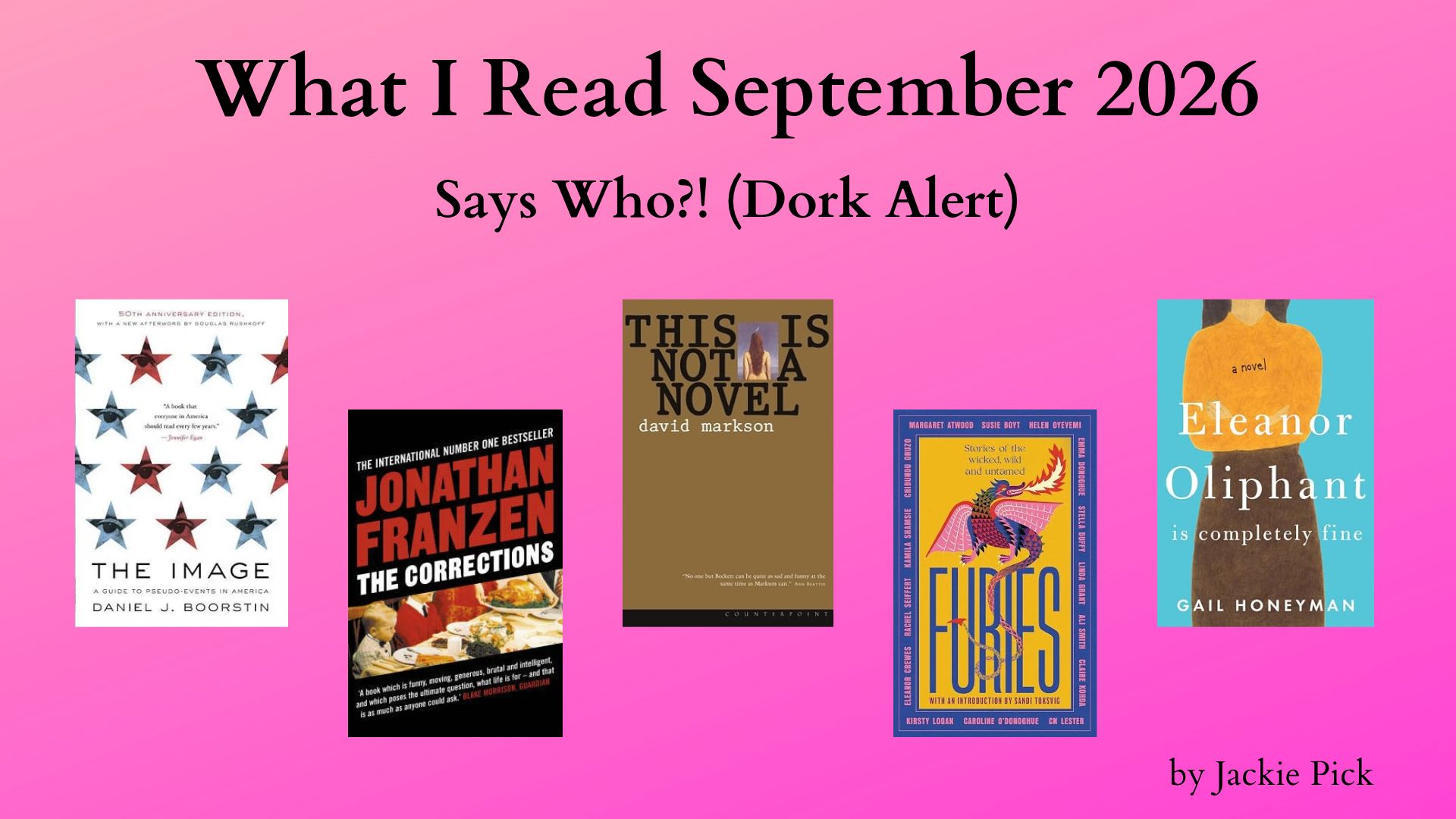
Who defined what a novel is? Who decided which women were monsters and why? Who takes “I’m fine” at face value? Who gets corrected and by whom? And if somebody manufactures an image of a thing and shows it to enough people, at what point does the image eat the thing?
Humans LOVE categories. We make a category, invent some rules for it, forget we invented the rules, and then act like the category and the rules came from on high. And then, because we can’t leave anything along, we peel off the little labels we’ve stuck on everything to see what’s underneath.
Don’t get me wrong, labels are useful. “Please hand me the spoon,” saves considerable time over pointing at the drawer and shouting, “Gimme the small metal thing! No, the other one! No, the other other one.” But trouble begins when we name something and decide we have thus explained it. This month I read five books about that trouble.
Even though most of them were decidedly not postmodern, they organized into some sort of postmodern union behind my back. Did I sit around this month muttering about Derrida and the instability of meaning? NOT ANY MORE THAN USUAL. I sat around muttering about skepticism, mixed forms and genres, metafiction, unreliable narration, and self-reference. Bricolage, even! What a mutter!
All five books looked at the labels we’ve stuck on things and bellowed a mighty “SAYS WHO?”
A novel has characters, plot, and narrative. It has description and meaning and metaphor and all the other things that appeared on laminated posters in my seventh-grade English classroom, right? David Markson says no. In another book he asks, “What is a novel in any case?” This Is Not a Novel seems determined to find out by getting rid of nearly all the things it is supposed to contain.
David Markson brings us a box of bones. Some are famous bones. Joyce bones. Byron bones. Beethoven bones. Some belonged to people who hated each other, slept with each other, misquoted each other, reviewed each other badly, died absurdly, died horribly, or simply died, because everyone in This Is Not a Novel is eventually going to do that. Also rattling around in the box: illnesses, insults, mistranslations, literary gossip, historical lint, quotations, coincidences, and Writer.
Writer, who is writing this book, would like us to understand that there is no character here. Writer would also like a book that is “nonlinear. Discontinuous. Collage-like. An assemblage.” None of the standard equipment..
DORK ALERT: It activated the part of my brain that once studied literary theory, so everybody gets to suffer now. (Still preferable to activating the part of my brain that remembers old commercial jingles.) This is Not a Novel gives Reader fragments until Reader fills them in and makes a book. There is a lot of theory about gaps in texts and Reader’s role in making meaning, and This Is Not a Novel is one enormous gap with famous dead people scattered throughout.
At first: fact, fact, insult, death, Writer, fact, death. Then, Reader’s brain starts laying track ahead of the train. Recurrences become motifs. Trivia acquires emotional weight. Writer, who is definitely not a character, looks suspiciously character-shaped.
Markson keeps handing us bones. He insists there is nothing to assemble while we are very obviously assembling this book. kneads that “between” with gusto. He removes the machinery of the novel and leaves us assembling it ourselves. We keep building the very thing he says isn’t there. By the end, even the ending reaches backward and rearranges what came before it.
Maybe it’s not a novel. Fine. But by the end I had experienced character, motif, development, rhythm, consciousness, and something I might even refer to as emotional movement.
This is a playful book. It’s funny and gossipy and strange. It has rhythm. It loses the rhythm. It finds another. I wanted, sometimes, to hear it read aloud, or set to music. Performed as poetry, performed as humor.
Do you know what humanity has NEVER had enough of? WORDS FOR WOMEN WHO ARE furious, wild, and/or who refuse. (How even dare they?!) I’m sure you can think of half a dozen off the top of your head, because we’ve got an entire historical thesaurus. Of course, at no point did anyone spitting these words at an “unacceptable” woman think, “Hey, maybe she has a point.” That’s the playground for Furies, an anthology that hands those labels to women writers and says: Please return to sender! Have fun! The strongest pieces share sense that we are still explaining something that should have been settled THREE CENTURIES AGO. (Mostly our humanity, but there you go. Is that a spoiler?).
Read it if you like your female rage peppered with linguistic reclamation.
I came to this one after hearing over and over that it was funny until it broke your heart. It did break my heart. I did not find it funny. Eleanor is strange, but at some point, laughing at her felt cruel. This is a trauma story about what happens after a child survives to adulthood and then is expected to just know how to function normally. It was a hard read for me.
Read it if you can handle a survival-by-kindness story.
The Lambert family has several problems, mostly each other. Franzen details their lives and their spectacular professional and personal disasters. Now matriarch Enid just wants everyone home for Christmas. The Corrections is enormous. The family is big, the ideas are big, the sentences are big, and it’s 500-plus pages. I didn’t LOVE LOVE LOVE it but I’d willingly surrendered to all of it again.
Reality is complicated and often ugly. Fortunately, humans invented the pseudo-event, an event created largely so it can be reported. (Think press conferences, ribbon-cutting ceremonies, staged commemoration, or a planned televised presidential debates.) The fallout is that reality itself is now sometimes indistinguishable from pseudo-events. Some of The Image has aged poorly, but an unnerving amount of it feels like Boorstin somehow got hold of the internet decades early.
Read it if you like the feeling of finding the smartest professor on campus, settling into a seat, and realizing about ten minutes in that you’d happily stay after class.
And there be the September books. Read anything good lately?
Goin’ to the Inevitable (Dairy Queen), Be Back Soon!
What IS August? Seriously, what is this month supposed to be? Because July knows what it is. July says, “It’s summer. Here’s a chair. Sit down. Have some watermelon and lemonade. Slow down for a moment.” Fine! THANK YOU, JULY. Clear mission statement. Excellent work.
There was, this year, a moreso-than-usual noticeable lack of exhaling in August. Maybe we did all our exhaling in July. Maybe we squandered it on evenings and perfectly ripe (non-diarrhea–causing) produce and the folly that time was passing at the normal rate.
August was a rush of prepping things, getting things ready, doing things, remembering other things while doing the first things, making lists of the things, consolidating those lists into master lists, losing the master lists, and making new lists called things like “EVERYTHING ELSE” and “OH SHIT, THAT TOO.”
(And then there’s writing. But I repeat myself.)
The August incantation was “abandon all routine, ye mighty, and despair,” and boy howdy, I did ever.
I love my routines, by the way. I love the small liturgy of them. Routines keep me from distractedly wandering into traffic or a Dairy Queen. Yet August took every routine I’ve spent the last eleven months carefully constructing, stuffed them into a cannon, and fired it toward Weehawken. Now I get to return to the proverbial domicile of my life and find the place ransacked.
I’m tired.
I can’t be tired. I don’t have time to be tired. It’s not on my list(s).
Introductory blathering aside, this is a brief post this month. I’m behind where I usually am when I’m behind at the end of August, which suggests the existence of several different levels/dimensions of behind and, somewhere, a version of me who finished this post last Thursday.
I tossed more than a few books back into the TBR. This was not their fault. August found me with certain specific parched patches, and I needed books that could get water directly to those patches without first requiring me to assemble the irrigation system myself. The others will be attempted again. They know what they did, which was nothing.
Everything I read this month was beautiful and heartbreaking and funny, which is quite the hat trick. Note that the humor is bone dry. Arid, even. Not a knee-slapper in the bunch. They are funny the way life gets funny sometimes. Laugh-or-cry funny. Then cry or laugh. Then laughter through tears (Oh, Dolly, hello). Lifefunny, as it were.
And that’s what I needed from books this August — stories that understand that beautiful, heartbreaking, and funny are not separate departments.
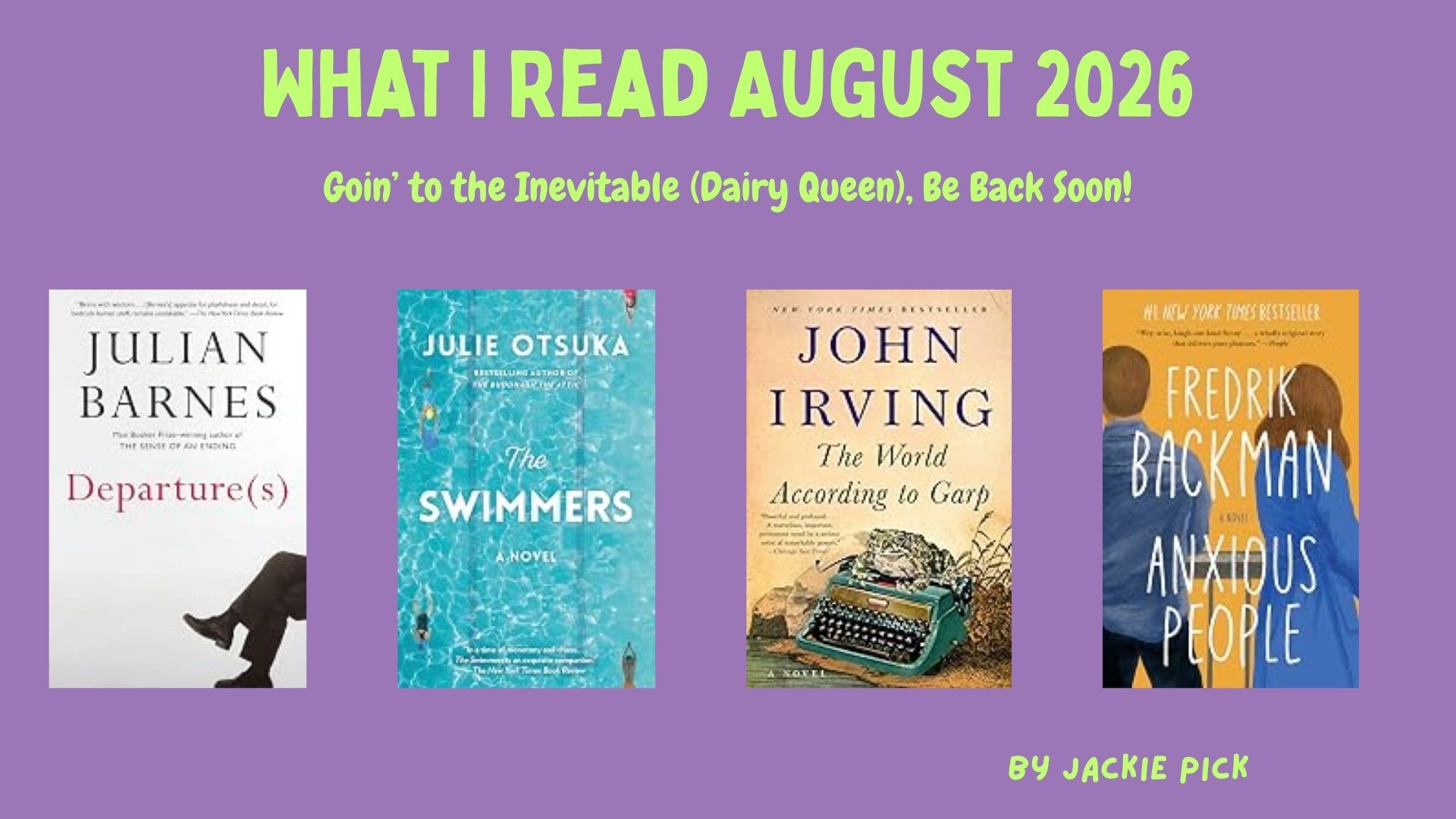
September has arrived and I exhale a quiet hallelujah. Then I breathe considerably faster because…September. In Julian Barnes’s Departure(s), he mentions Philip Larkin’s reported final words: “I am going to the inevitable.” Well, apparently so am I. According to my calendar, the inevitable is absolutely rammed through the third week of September. Join me there if you like. I’m keeping it on this side of the mortal coil but I can’t promise we’re staying out of Dairy Queen.
The first time I read The World According to Garp, I was young and thought danger was an event. Something happens and the terrible thing arrives. There is a before and an after. Now I know better. The possibility of danger is a constant companion.
The World According to Garp is a strange, hungry, unruly, amazing novel about writers, wrestlers, marriage, mothers and children, sex, feminism, assassins, bears, terrible driving choices, wanting, breaking, changing, and an alarming number of body parts that become separated from the people to whom they were originally issued.
With all this, John Irving has written a book about the human desire to control our lives.
Garp would like to impose some order on his life. He’s a writer after all, and writers take the bloody animal of life and put sentences around it.
But Garp isn’t just a writer, he strives to be a serious writer. His mother, Jenny Fields, writes one book almost incidentally and becomes a feminist icon. Then strangers begin telling Jenny what Jenny means. And strangers begin telling Garp what Garp means.
This happens everywhere in Garp. People take other people’s lives and make something out of them. Everyone is forever grabbing someone else’s story, carrying it off, repurposing it, and then returning to explain what it all actually means. And that is out of Garp’s control, no matter how hard he tries.
Garp has roughly the same success controlling his family life.
He and his spouse Helen’s deep love for each other does not prevent them from making an impressive mess of their marriage. They sleep with other people. They lie and fume and forgive and fail to forgive. Garp is magnificently hypocritical about fidelity, which would almost be comedy if bodies in this book did not have such a terrible habit of turning metaphor into flesh.
Then Garp becomes a father and discovers on an even deeper level that loving someone gives you absolutely no additional power to keep them safe. He sees danger everywhere. The family calls that sense of impending danger and anxiety the Under Toad, a child’s misunderstanding of “undertow.” The Under Toad is the terrible thing waiting just out of sight.
The worst part is that Garp is right. The world is dangerous. Irving tells us so. Sometimes he practically points at the monster before it bares its teeth. You can know the Under Toad is there and love everybody enormously and still not be able to prevent disaster.
This beautifully written book should be emotionally unbearable. Instead, it is balanced. Funny, even. God, it is funny. After all, between the assassinations and adultery and grief and missing pieces of human anatomy, somebody has to make dinner and side-eye dogs. Somebody has to keep inhabiting their ridiculous, breakable bodies as though nobody has told them how this ends.
I read this book when I was young, and I loved it. I love it differently now. I dropped everything else to read one more page, which is about as much control over the situation as any of us gets.
First there’s a life. Then a memory. Then a story. Barnes’s self-described final novel prowls around memory, mortality, love, writing, and what lies between what happened and the story we tell about what happened. He spends ample time considering what a writer owes the real people whose lives become material. It’s a hell of a question to save for your final book. It’s also at once remarkably pensive, funny, and unnerving.
Read it if you like your existential musings to be non-linear, melancholy, and sharp-toothed and/or if you wonder whether writers preserve people’s stories or are simply very articulate burglars.
Every day, a group of people finds refuge in an underground swimming pool. They stroke, breathe, turn, repeat, reach, and pace themselves. Then a crack appears at the bottom of the pool. Eventually the book narrows to one swimmer, Alice, who is losing her memory, and the daughter losing her. Otsuka’s prose is so lyrical and rhythmic that reading it feels a little like swimming: push off, breathe, turn, repeat until you realize you’ve gone somewhere much deeper than you intended.
Read it if you want a tiny-yet-enormous, lyrical book to help you swim out past where your feet can touch.
A bank robbery goes wrong, an apartment viewing becomes a hostage situation, and everyone involved is trying very, very hard to be a person correctly. There are also police officers, a bridge, multiple meanings of what it means to be “from Stockholm,” and a rabbit. Backman gives us roomfuls of ridiculous people, gives us space to judge them, and then reveals their heartbreaking backstories.
Read it if you find people exhausting but love the idiots anyway, and/or if you appreciate a writer who practices the art of the reveal.
And there be the August reads. Read anything good lately?
Hello and other pleasantries to new followers and the brave souls who have been tolerating my nonsense for quite some time.
A reminder and an announcement. I produce two categories of posts:
A sort of high-octane humor that usually ends with me typing in all caps and you wondering whether you’ve accidentally subscribed to the ramblings of an unusually literate honey badger.
Book reviews.
Book reviews are published monthly as “The Folio.” They begin with an attempt at a witty introduction and segue into a more measured discussion. These reviews are longer than advisable, and this, I am aware, can be a turn-off.
Am I trying to turn you on? Certainly, but only to using your library card. Anything else would be unseemly.
I am attempting to keep the reviews aligned with my predilection toward absurdity. Who doesn’t love a slightly deranged, funny book review? PUT YOUR HANDS DOWN. THIS IS THE INTERNET. I CAN’T SEE YOU AND ALSO IT WAS A RHETORICAL QUESTION.
Yes, occasionally, seriousness is unavoidable, especially for the sake of basic human decency. For example, books about war, grief, trauma, or any of the Chicken Soup for the Soul series.
But Writing Reviews That Must All Be Taken Seriously is not always enjoyable. If I must always be properly serious, I’ll run around the town square bellowing “LOOK UPON MY CREDENTIALS, YE MIGHTY!” (which is, incidentally, the fastest way to clear a town square).
Generally, I see no reason to pretend that book reviews should be written in the hushed tone of someone narrating a documentary about endangered sea turtles.
Instead, I’m determined to write the kind of book reviews I’d want to read. Irreverent, digressive, somewhat useful, and not especially academic. When writing these pieces starts feeling like homework, I suspect reading them feels the same. (See review of Terry Pratchett’s book below.)
This is a process. I must first declare independence from the Good Scholar mindset, which is as persistent as mildew and probably smells like it as well.
We’ll see if this works. Forecast: probably not, but to be fair, optimism and I maintain a long-distance relationship.
Anyway, welcome. Or welcome back. Or Welcome Back, Kotter.
Signed, Epstein’s Mother.
I attempted hedonism with my reading this month, which is a pretentious way of saying I tried to read purely for pleasure. Most of the books cooperated. Not Fever Dream, which was an absolute miscalculation on the “fun!” reading scale. It was alarming, but, to be fair, exactly as alarming as promised. (I mean, the title isn’t Sweet Dreams and No Trauma Here.)
This was supposed to be my no-apocalypse month. And while there wasn’t a climate disaster in the bunch (I’ve tended to accidentally read a lot of those this year, if one can accidentally read anything to the end), Fever Dream did slip in poisoned groundwater and the creeping suspicion that everything is contaminated.
As in every month, I tried to find a coherent, unifying thread to connect the books I’d read. Something elegant and unassailable, like a particularly clever (and attractive!) spiderweb. Something that would make me sound like I’d been preparing a rigorous syllabus rather than just reading while eating toast.
The toast, for the record, was not entirely uninspirational.
At first, I thought the unifying theme was “Overthinking,” which is my preferred pastime. Every narrator here is the sort of person who can transform an ordinary moment into an ontological exploration through sheer sustained attention. These are books about people who can’t let a single thought pass unexamined. I recognized them immediately. I am Spartacus.
Just as I was congratulating myself on having found a thesis, another potential theme popped into mind. These books are also about “The Not-Necessarily-Horrific Coming Apart of the Well-Ordered Life.” Which, okay, wordy. All these books involve trying to build a manageable life, only to discover that order is a losing battle. Even the simplest lives can turn chaotic if you pay them too much attention. Or not enough. These books have both.
I spent significant time trying to choose which of these themes to highlight. Overthinking? Everyday order derailment? Eventually, I remembered this is not English Lit 201: Advanced Book Review Blogging and Merriment. No one is grading me. No one even asked for this. (Why didn’t you ask for this, by the way?)
So consider this month’s selections a set of reminders: that our minds are weird and perilous places, that “normal” is perhaps a myth, and that occasionally you will read something so funny, real, and/or unsettling that you won’t even care about the toast crumbs taking up residence down your shirt.
Which is all just to say here are the books I enjoyed enough to finish this month:
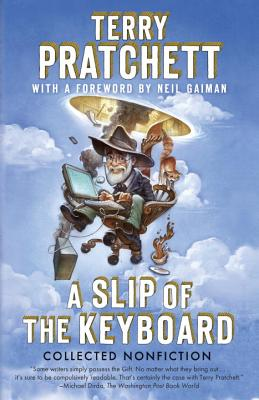
A SLIP OF THE KEYBOARD: COLLECTED NON-FICTION BY TERRY PRATCHETT
Terry Pratchett calls writing “the most fun you can have by yourself.” It’s a throwaway line, but like much that Pratchett lobbed at the world, it is three things at once: it’s funny, it’s self-deprecating, and it’s true.
This collection includes essays, speeches, introductions, and odd bits of reflection. It covers everything from fantasy literature to mushroom picking to Alzheimer’s. It’s brimming with the idea that the ordinary world is weird and interesting. There’s also a bracing indignation aimed squarely at deserving targets, yet even his fury is grounded in compassion.
Here you’ll find Pratchett in fine form, gleefully pricking the balloon of literary snobbery. “Where do you get your fantastic ideas from? You steal them,” he writes. “You steal them from reality. It outstrips fantasy most of the time.”(N.B. This is why writers keep notebooks: to record all the implausible things real people say and do). And you get the sense that saying this felt like slipping a whoopee cushion onto the seat of every Very Serious Writer at some awards banquet.
One of the pleasures of this collection is watching him circle the same conviction again and again: writing, for all its challenges, is meant to be enjoyed. In Chapter 12, he advises writers to amuse ourselves first, because if you’re not having a good time, your readers won’t either. (It sounds obvious until you remember how many books seem to be written purely as acts of flagellation, self or otherwise.) This spirit thrums through every piece. There’s a giddy undercurrent that never tips into preciousness or stupidity. It’s radically sincere and radically human.
Of course, the book isn’t all winks and asides. The essays move into the time after his Alzheimer’s diagnosis, and there is a sharpening. The humor stays, although it can get a little dark, but there’s an urgency, especially as he discusses assisted dying and the politics of autonomy. He had no intention of squandering any of his time on politeness or bromides.
It’s also worth noting how nimble he is. Pratchett can write equally brilliantly about dismantling the idiocy of genre snobbery as he can about daiquiris, and it all feels grounded in what is very clearly his voice and worldview. If you could distill a giggle, a guffaw, a groan, a raised eyebrow, and a perfectly aimed lightning bolt into a single human being, I’d like to think we’d get something very close to Terry Pratchett.
Standouts are most of them, but I particularly loved: “2001: The Vision and the Reality”, “The God Moment”, “Doctor Who?,” and “A Week in the Death of Terry Pratchett.”
Highly recommended. You don’t have to be a Discworld devotee to appreciate this. (I haven’t read them yet.) But you probably should care about books and stories and people and the planet. And if there’s an afterlife with any good sense, may it have a library big enough for him, a comfortable chair, and a hat no one is foolish enough to pinch.
Some of us (ME!) want the laugh. As a child, I’d sneak VHS tapes of Monty Python and Saturday Night Live, memorize sketches, and reassign myself all the best roles. I mentally cast myself as Madeline Kahn in everything she ever did.
So when beauty queen and I Love Lucy-obsessed Barbara Parkerrealized she’d rather have the punchline than the pedestal, I got it. She wanted to be in the room where the funny happened. Correction: she wanted to be the funny happening. And good for her. Beauty was/is a far more economically efficient trait.
Nick Hornby’s Funny Girl follows Barbara as she abandons the pageant world and reinvents herself as Sophie Straw, a comedically ambitious, photogenic young woman determined to become the next Lucille Ball. She moves to London, lands a lead in a new BBC sitcom almost immediately, and finds herself at the center of a cultural moment. This may sound like the setup for a frothy star-is-born tale, and it is. It’s also well done.
At its best, it’s a warm backstage novel with plenty of nostalgia for 1960s London and classic, frothy sitcoms. The first section snaps. Sophie’s introduction to the world of television is filled with biting dialogue, insecure creatives, and writing-room banter (which is arguably the best part of the book). Hornby nails the way brilliance and bitterness coexist in a creative team, as well as the cranky machine that seems to have been the BBC. I would happily read an entire novel that never left that room.
Once the sitcom takes off and Sophie settles into her role as national darling, the narrative zooms out. We get more focus on her coworkers: writers Bill and Tony, who steal scene after scene (especially Bill!). They embody one of the novel’s central tensions: should comedy comfort or provoke?
The “funny” dissipates into complexity, and it mostly works. Hornby’s wonderful at dialogue, even better at capturing the feeling of being slightly out of sync and by being ahead of your time. Funny Girl is like one of those rubber playground balls: bouncy and liable to knock you in the face when you least expect it. Hornby captures much of the texture of 1960s television: the starchy formality, creative constraints, looming cultural shifts.
What I loved most — and what I wanted more of — was the joy of collaboration, the weird alchemy of making something funny with other people. That’s where the book shines. Not in fame or romance or the idea of being “the one girl,” but in the magic of a room full of smart, neurotic misfits trying to make each other laugh.
If there’s a flaw, it’s the one that afflicts many long-running series. Eventually, there’s a sense that a wrap-up should have come sooner. Also, the book never quite reckons with the sexism it documents. That might have been thrilling as well, but a book cannot be all things to all readers.
When this book lands, it lands. It gets the weird intimacy of artistic collaboration. It gets the rush of writing a good bit. It gets the long slide from being new and bold to just being there.
Perfect for summer. It’s sweet and tart like lemonade, and just as delightful.
Most of us were raised on a diet of artificially flavored found-family stories. That most cherished of modern fables in which a group of charming misfits (orphans, strays, emotionally stunted baristas, etc.) band together and discover that what really matters isn’t who raised you. (See also: The Brady Bunch, those sunny-eyed avatars of family bliss. Fictional. Sanitized. Immortalized on lunch boxes.) Somewhere along the way, these found families become closer than real families.
Cue the swelling music. Hugs all around.
Enter Run for the Hills, Kevin Wilson’s contribution to the genre, which, thankfully, avoids nearly all of the above. It is not randomly peopled with inexplicably irrepressible eccentrics who “just need each other.” What it is, instead, is a not-saccharine-yet-still-positive, more ambivalent version of found family.
It starts with Mad Hill, a woman living a self-contained life on her mother’s farm, doing a great job avoiding the complicated legacy of her absentee father and minding her emotional business like a professional. That is, until her half-brother Reuben shows up. His plan is to track down the man who abandoned them both, and see if a couple of other step-siblings are up for meeting, if not joining the adventure. The sudden reveal of a half-brother, his PT Cruiser, other siblings, and this whole nutty scavenger hunt is…a lot for Mad to take in. Mad does not want to go. She says yes anyway. This is what we call family obligation, and also improv training, which sadly has no place in this book at all.
What unfolds is a road trip that’s more emotional audit than grand adventure. Wilson isn’t interested in big plot mechanics or over-processed closure. These siblings don’t know each other. All they have is blood and disappointment and a half-formed instinct to care. Over the miles, something resembling a bond starts to form because they decided to try.
The entire trip is a glorious, laugh-out-loud exercise in restrained dysfunction among truly good people.
Wilson writes with enormous empathy and just the right amount of weirdness. The book is emotionally resonant, highly enjoyable without begging for a laugh track or a piped in “awwww.”
After a carefully paced journey, the final pages may feel slightly soft, a quiet, gentle roll to a stop for some readers. Look, sometimes road trips end and sometimes they just keep going.
So, no, this is not the Brady Bunch. It is not about the ideal family, or even the fully-healed one. It’s about the possibility that choosing to remain in proximity to others, despite discomfort or history, is its own kind of commitment. And there is a lot of fun to be had in that.
Most people will do almost anything to avoid being alone with their thoughts. They will join clubs. They will cultivate elaborate social obligations. They will distract themselves with devices whose primary purpose is to obliterate solitude (see: iPhone, pickleball). Claire-Louise Bennett’s Pond is a testament to the opposite impulse: the deliberate, even defiant choice to pay attention to one’s mind. Where a banana left out becomes memento mori.
Reading Pond feels like showing up ten minutes late to a strange, luminous experimental film. You stand there, half-certain you’ve missed the part that explained everything, until you realize there is no part like that. You are simply inside someone else’s mind, and you get to stay.
In her debut collection, Claire-Louise Bennett assembles 20 fragments, vignettes, and near-monologues narrated by a semi-reclusive woman living alone on the edge of a village in the west of Ireland. She is never named; she is quite selective about what she shares about her exterior life. What she does share with abandon is a torrential, exhilarating interiority. Our narrator has a mind exquisitely tuned to its thoughts. This isn’t stream-of-consciousness, it’s a waterpark.
What is Pond about? Well, there isn’t much about here. No driving plot, no clear progression. But I’d argue there’s a lot of “there” there. There is an astonishing amount of noticing. Jeannine Ouellette (among others, but I like her approach very much) talks about paying attention as a radical act, an act of devotion, an act of “the most powerful writing practice you can cultivate for yourself.” Pond proves that. Each piece zooms in on a moment, an object, a mood. “Morning, Noon, & Night,” for example, imbues the most basic of breakfast foods with something close to rapture. Bennett’s descriptions are precise and saturated with significance. It’s Walden if Thoreau were a woman living alone in Ireland, interested in cooktop knobs, and quite possibly happier for it.
Bennett sounds like a dear friend who overshares with deep self-awareness while you sit and watch her “do her thing.” Take this line:
“English, strictly speaking, is not my first language by the way. I haven’t yet discovered what my first language is so for the time being I use English words in order to say things.”
This book requires a carving out of uninterrupted time. (Which is to say, this is probably not the book to read in five-minute increments between checking email.) But it is unmistakably alive . Prickly, even. It is also, in its way, a challenge: Who among us is willing to be this honest about what goes on in our heads when no one is looking? Most people can’t stand a single unscheduled thought. This book contains nothing but.
If you want to be reminded that noticing is itself an art form, then I say yes and yes again.
This is a book you absorb, like a symphony or a toxin, depending. It’s short, disorienting, beautifully written, and unpleasant in the best way.
It is called Fever Dream, which is helpful, as the entire experience reads like the kind of dream you’d have after eating something you should not have eaten at a charity luncheon.
At first glance, this slim, unassuming volume looks harmless. You think, “Oh good, I can read this in a day.” Which you can. What you won’t expect is to spend the evening staring at your water glass, wondering if it has ever tasted quite so chemical.
The premise is simple: Amanda is dying. A boy named David (or perhaps a child-shaped presence named David), who may be real or may be the embodiment of Amanda’s crippling maternal worry or the result of illness, interrogates her as she drifts in and out of narrative coherence. She is trying to explain what happened. He is trying to hurry her along.
Early on, Amanda introduces the concept of “rescue distance” — the invisible, ever-changing rope between her and her daughter that represents how far her daughter can be while Amanda is still able to keep her safe.. She recalculates the rescue distance constantly depending on terrain, proximity, and possible threat. The “rope” tugs or goes slack, and both states feel awful for different reasons. It is one of the best metaphors for motherhood I’ve ever read, a reminder that parenthood is mostly the exhausting calculation of invisible risks.
Something is wrong, not just in Amanda’s mind, but in the rural Argentine town she’s visiting. The land is poisoned. Children are sick. Animals are dying. There’s a woman who might be a witch, and a boy whose soul might have been split or transformed. Or perhaps he was just traumatized. Schweblin doesn’t lean too hard into explaining the supernatural elements that vibrate in the background. That’s not where the horror lives.
The horror is in the groundwater and the gossip and the things the residents agree to pretend not to see. This town is rotting.
Structurally, the book is a conversation braided with memory, braided with something that may or may not be happening in real time. Whether David is present or imagined is irrelevant in this claustrophobic fever-dream-within-a-fever-dream. One minute you’re in a waiting room with Amanda, the next, you’re on a farm with Amanda and dead animals and sick children.
Megan McDowell’s translation carries it beautifully. It’s sparse, urgent, and devoid of unnecessary hand-holding.
As for the ending: it puzzles with an elegant disregard for the readers’ expectations.
Fever Dream is an exquisitely crafted conjoining of anxiety, dread, and maternal devotion. It is disorienting and unforgettable.
It’s motherhood rewritten as slow-burn horror.
And thus went June. I’m excited for my July reads, and as always, I welcome any recommendations! What’s in your TBR pile?