Once upon a time, a woman went online shopping for the end of the world.
Perhaps she should have scrolled for armor, or a sword hammered from the bones of a dead god, or a palette of freeze-dried beef stroganoff.
She shopped for pants. Velour pants with a 28” inseam because she was willing to confront the forces of darkness but not with muddy cuffs. Maybe a matching sweatshirt. A complete velour tracksuit.
She sat in a parking lot, awaiting the return of her child from one of the many activities required of modern children. The woman was exhausted. She was weepy, but not beautifully so. Crosby, Stills, Nash & Young’s So Far played.
She’d been scrolling. The scrolling disgorged the usual monsters as well as new species. Brotherhoods, Two-headed Chieftain Beasties, Keepers of Things, Couriers, and Tribunals, all bowing to His Most Blameless Majesty, while casting truth into the moat. Pactum Virorum.
(There were lesser demons, of course, that wouldn’t devour the kingdom but merely infest every corner of it. For example, those who insist on calling sandwiches “handhelds.”)
The woman had slain none of these monsters, though not for lack of trying.
She had, however, become extremely tired of them, so she looked at velour tracksuits. Then her algorithm offered up fleece capes. Fleece capes possess neither the grandeur of a cloak nor the practical advantages of withstanding a direct assault by a collapsing institution, but she could be a little comfortable. And yet, and yet, comfort is not consolation, and neither one is repair.
The woman considered this and considered her life and her algorithm. She glanced up, trying to catch a glimpse of her child at practice or rehearsal or a meet or a match or in conversation. Safe, for now. She considered this as well.
Perhaps the woman could become a witch, she thought. Not one of the beautiful witches, with their flowing black hair and rings of moonstone. A different sort. A Richard Simmons witch, if you will, but one who had all but abandoned the cardio.
She would stand before the monsters and say their true names. LIAR. COWARD. FRAUD. SANDWICH.
The woman sat in her car, waiting for her daughter, listening to music and welling up (again! still!) from loving a world determined to destroy its own better qualities. Although she was not languishing, she was tired of the monsters devouring everything and everyone, then demanding gratitude for doing so.
And so the Velour Tracksuit Witch of the Fleece Cape, wearing neither cape nor velour tracksuit, considered the many ways the kingdom described its troubles in elaborate think-pieces bewailing the decline of civility (and by all means, please ignore the dragon in the mead hall). Elegant chronicles all.
The woman had lately become inclined toward a less elegant description. Everything Is Horseshit.
Yet the Witch Woman Who Was Not a Witch, sitting in a parking lot, listening to Crosby, Stills, Nash & Young, waiting for her daughter, contemplating a fleece cape, conceded that every proper account of monsters must also acknowledge the possibility of something good surviving.
She made a comprehensive list That Which is Not Horseshit:
Who defined what a novel is? Who decided which women were monsters and why? Who takes “I’m fine” at face value? Who gets corrected and by whom? And if somebody manufactures an image of a thing and shows it to enough people, at what point does the image eat the thing?
Humans LOVE categories. We make a category, invent some rules for it, forget we invented the rules, and then act like the category and the rules came from on high. And then, because we can’t leave anything along, we peel off the little labels we’ve stuck on everything to see what’s underneath.
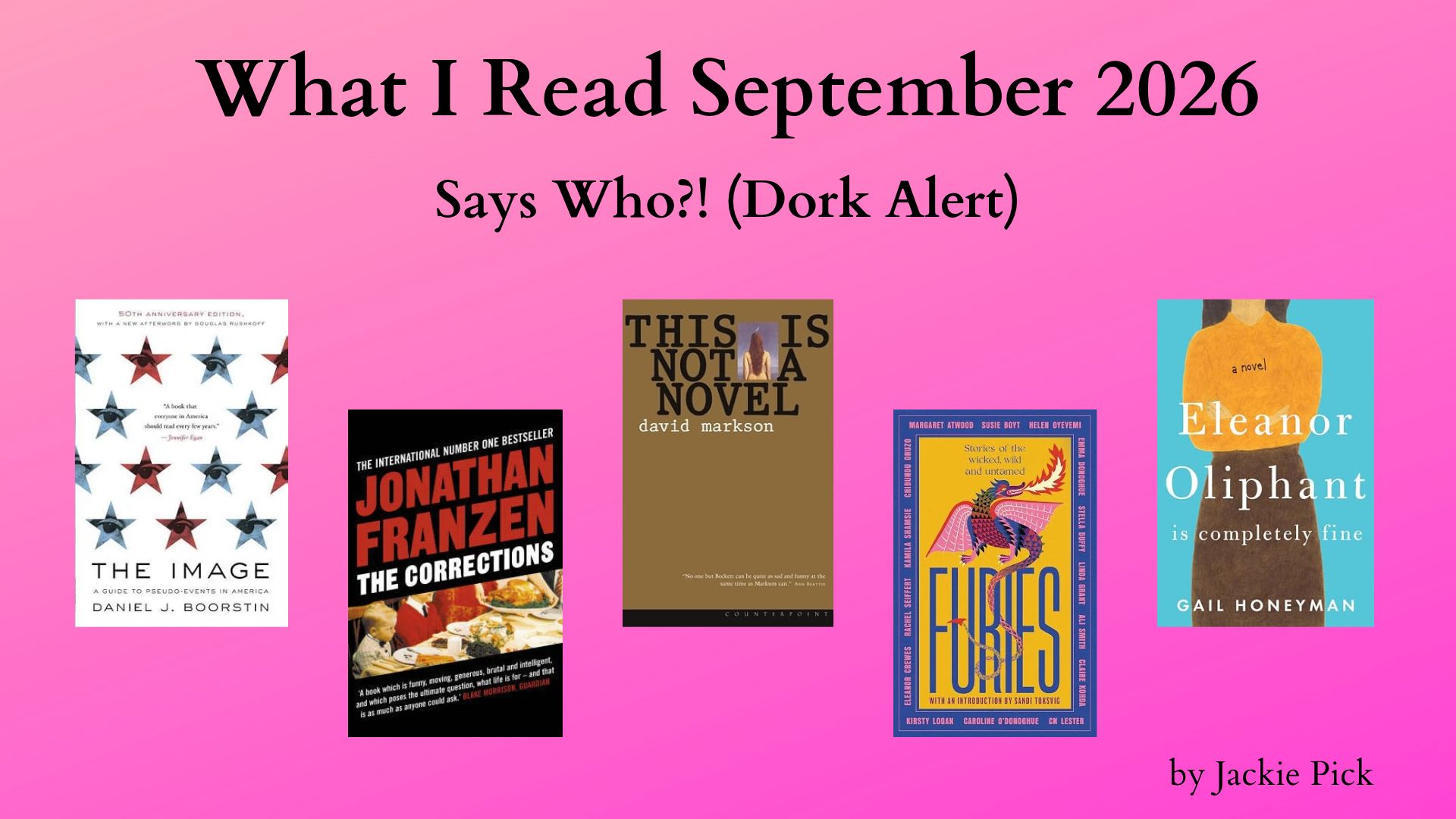
Don’t get me wrong, labels are useful. “Please hand me the spoon,” saves considerable time over pointing at the drawer and shouting, “Gimme the small metal thing! No, the other one! No, the other other one.” But trouble begins when we name something and decide we have thus explained it. This month I read five books about that trouble.
Even though most of them were decidedly not postmodern, they organized into some sort of postmodern union behind my back. Did I sit around this month muttering about Derrida and the instability of meaning? NOT ANY MORE THAN USUAL. I sat around muttering about skepticism, mixed forms and genres, metafiction, unreliable narration, and self-reference. Bricolage, even! What a mutter!
All five books looked at the labels we’ve stuck on things and bellowed a mighty “SAYS WHO?”
A novel has characters, plot, and narrative. It has description and meaning and metaphor and all the other things that appeared on laminated posters in my seventh-grade English classroom, right? David Markson says no. In another book he asks, “What is a novel in any case?” This Is Not a Novel seems determined to find out by getting rid of nearly all the things it is supposed to contain.
David Markson brings us a box of bones. Some are famous bones. Joyce bones. Byron bones. Beethoven bones. Some belonged to people who hated each other, slept with each other, misquoted each other, reviewed each other badly, died absurdly, died horribly, or simply died, because everyone in This Is Not a Novel is eventually going to do that. Also rattling around in the box: illnesses, insults, mistranslations, literary gossip, historical lint, quotations, coincidences, and Writer.
Writer, who is writing this book, would like us to understand that there is no character here. Writer would also like a book that is “nonlinear. Discontinuous. Collage-like. An assemblage.” None of the standard equipment..
DORK ALERT: It activated the part of my brain that once studied literary theory, so everybody gets to suffer now. (Still preferable to activating the part of my brain that remembers old commercial jingles.) This is Not a Novel gives Reader fragments until Reader fills them in and makes a book. There is a lot of theory about gaps in texts and Reader’s role in making meaning, and This Is Not a Novel is one enormous gap with famous dead people scattered throughout.
At first: fact, fact, insult, death, Writer, fact, death. Then, Reader’s brain starts laying track ahead of the train. Recurrences become motifs. Trivia acquires emotional weight. Writer, who is definitely not a character, looks suspiciously character-shaped.
Markson keeps handing us bones. He insists there is nothing to assemble while we are very obviously assembling this book. kneads that “between” with gusto. He removes the machinery of the novel and leaves us assembling it ourselves. We keep building the very thing he says isn’t there. By the end, even the ending reaches backward and rearranges what came before it.
Maybe it’s not a novel. Fine. But by the end I had experienced character, motif, development, rhythm, consciousness, and something I might even refer to as emotional movement.
This is a playful book. It’s funny and gossipy and strange. It has rhythm. It loses the rhythm. It finds another. I wanted, sometimes, to hear it read aloud, or set to music. Performed as poetry, performed as humor.
Do you know what humanity has NEVER had enough of? WORDS FOR WOMEN WHO ARE furious, wild, and/or who refuse. (How even dare they?!) I’m sure you can think of half a dozen off the top of your head, because we’ve got an entire historical thesaurus. Of course, at no point did anyone spitting these words at an “unacceptable” woman think, “Hey, maybe she has a point.” That’s the playground for Furies, an anthology that hands those labels to women writers and says: Please return to sender! Have fun! The strongest pieces share sense that we are still explaining something that should have been settled THREE CENTURIES AGO. (Mostly our humanity, but there you go. Is that a spoiler?).
Read it if you like your female rage peppered with linguistic reclamation.
I came to this one after hearing over and over that it was funny until it broke your heart. It did break my heart. I did not find it funny. Eleanor is strange, but at some point, laughing at her felt cruel. This is a trauma story about what happens after a child survives to adulthood and then is expected to just know how to function normally. It was a hard read for me.
Read it if you can handle a survival-by-kindness story.
The Lambert family has several problems, mostly each other. Franzen details their lives and their spectacular professional and personal disasters. Now matriarch Enid just wants everyone home for Christmas. The Corrections is enormous. The family is big, the ideas are big, the sentences are big, and it’s 500-plus pages. I didn’t LOVE LOVE LOVE it but I’d willingly surrendered to all of it again.
Reality is complicated and often ugly. Fortunately, humans invented the pseudo-event, an event created largely so it can be reported. (Think press conferences, ribbon-cutting ceremonies, staged commemoration, or a planned televised presidential debates.) The fallout is that reality itself is now sometimes indistinguishable from pseudo-events. Some of The Image has aged poorly, but an unnerving amount of it feels like Boorstin somehow got hold of the internet decades early.
Read it if you like the feeling of finding the smartest professor on campus, settling into a seat, and realizing about ten minutes in that you’d happily stay after class.
And there be the September books. Read anything good lately?
My computer crashed while I was writing this post. Windows announced that it had encountered a problem and needed to restart. Oh, YOU’VE encountered a problem, Windows? Fascinating. I was under the impression I was the one with the problem, seeing as you just deleted my work.
Then Windows started collecting information about the problem. WHAT INFORMATION? You’ve destroyed the document! There’s your information! What else do you need? Witness statements? Perhaps I can identify missing paragraphs from a lineup.
And before anyone writes to explain the importance of saving one’s work, THANK YOU. I was hoping to lose an entire draft and receive a lecture about it. Two birds, one stone.
The computer took its time rebooting, presumably readying a report that would establish that the problem had been me all along. I had a choice between pounding my head against a hard surface or putting away laundry. I chose the latter despite the considerable appeal of the former.
This series of ambitious attempts to think interrupted by opportunities to fold underpants is an accurate representation of my writing life.
Would fridge magnets stick to him?
Yeah, so let’s step into the confessional. For a while this past year, I stopped writing my novel.
I’d been working on a novel for several years. Hundreds of thousands of words came and went. That’s a lot of words. You could fill several perfectly good books with that many words, provided you arranged them in a different order and replaced most of them with better ones. Eventually, I stopped enjoying writing the novel. Then I stopped enjoying the novel. Then I stopped enjoying the person writing the novel.
Oh, I could still enjoy the work of people whose brains apparently hadn’t gone on indefinite leave, but mine had become a rather joyless place. I could still write my own shorter pieces, and did so here on the ol’ blog. That machinery was functioning and often amused me. But I’d lost the part of my brain that wanted to play in longer form, generating ideas that led to other connected ideas. I’d stopped entertaining myself, which is a nasty thing when you’re a writer. You spend hours a day inside your own head. Might as well enjoy being there.
Many other writers seem to have approximately eleven bajillion ideas at the ready. Ideas in saecula saeculorum! I had that one idea, and it flopped around for years. Was it a bad idea or was it a good idea that I was bad at writing? The distinction seemed important until I realized that both explanations ended with me feeling stupid and also not writing.
Eventually, I started a different novel. I’ve written so extensively about my difficulties writing these novels that I may have inadvertently completed a different book. Thank you for your continued support of this franchise.
Yes, I felt like a failure. Yes, I know all the old chestnuts, no need to cite the Deep Magic to me. “You’re not a failure. You’re learning how to write this book. You only fail if you quit. Show up to the page. You’re not too old. Trust the process.”
It’s entirely possible the process is a bastard. The process requires one to show up, and showing up requires time. Writing is my JOB. And yet life insists on treating it as something I can squeeze in between other things. (What other job do you squeeze in? Surgery? “Keep that chest open, Frank, I’ll be back Monday. October at the latest.”)
Is he dishwasher-safe?
Summer was spent working, parenting, recovering from a medical procedure (all is well), enjoying the final guaranteed summer with all my children at home, and fulfilling various obligations. There was also a construction site approximately twenty-five feet from my office that required every power tool ever invented.
When I could find a few minutes to write, I couldn’t write. There was no Zone to even approach, never mind get into.
Had I lost something essential? Had the part of me that had once been curious and inventive and occasionally gloriously stupid decided it had endured enough? Perhaps it had gone into the woods to live in a small cottage, eating the occasional unfortunate traveler.
Does he come with attachments? Like a dough hook or something?
AND YET.
A few weeks ago, I started listening to my writing playlist again. I started occasionally cowriting again and I welcomed new ideas as one might welcome returning birds after an unpleasant winter, even if the birds turn out to be pigeons.
A glimmer.
If his son climbed into his suit and they jumped up two floors, would he need an elevator permit?
But I knew I was really getting back to it when I resumed ruining terrible movies for my husband.
Hear me out. Human civilization has reached the extraordinary point where we can access an almost limitless entertainment (countless videos about drywall anchors!) at the touch of a button. Despite this, last week my husband chose to watch the 2014 remake of RoboCop, thereby demonstrating the heroic tolerance for nonsense that has sustained him throughout our marriage.
I had excellent questions. I voiced those questions, mostly during major plot points. I was delighted. My husband was less delighted.
Needless to say, I was entertaining myself.
My brain is revving up again, which makes not being able to sit down and just WRITE on a SCHEDULE of SOME SORT particularly infuriating. I’ve got ideas. I’ve got things I want to say. I’ve got a book poking me in the noggin and a renewed appetite for doing the work.
But, you know, September in all of its double-stuffedness.
Can my writing brain be a little more patient? MAYBE. But patience is a virtue extolled by satisfied people. Or maybe dissatisfied people. Definitely folks not in a hurry to get to the good stuff.
Anyway, I’ve got a novel to write and some questions about RoboCop’s extended warranty.