As the school year whips by us like homework excuses in a tornado, we find ourselves on the cusp of that most cherished of all educational adventuring: the field trip, where learning and relentless searches for bathrooms are disguised as off-site fun.
You, dear parents, have been chosen (read: volunteered, or at least volun-told) to chaperone.
This isn’t a drill. Nor is it a walk in the park—even if your field trip is actually to a park. This is a tactical obstacle course where you and they will run, cry, fall, climb, carry, and “Why did I volunteer for this?” your way through the day.
Here’s a briefing, because sharing is part of the healing:
I’m not surprised. My own February was all about the aboutness. The aboutness of these books, my writing, and my little spheres. More on that in an upcoming post.
In my previous post, I mentioned it feels as though my reads become a snapshot of that month. Is this synchronicity? Narrative Psychology? Searching for meaning where there is none? Hermeneutics? Dianetics? A sign I’m playing too much Connections?
MAYBE.
February’s reads were about equilibrium and paradoxes in unstable systems, power structures, and belonging.
Without further ado, here are a few words about the books I finished in February, and also some bonus items I enjoyed this month that were not books. If you’d like to talk more about any of these, let me know in the comments!
How do you survive in a society that actively seeks to harm you? One option is to detach your identity from your physical body and redefine “human.” Another option is to violently reject that society by breaking all of its taboos.
Welcome to Earthlings, where our main characters do that and more.
Our protagonist, Natsuki, believes she is alien — to her own family, this society, and her own humanity. To survive, she stumbles through life with an 11-year-old’s emotional capacity to connect, capable of articulating the grosses of abuses only as “It’s really hard to put into words things that are just a little bit not okay.”
This keeps her alive but not living.
This book is a caboodle of content warnings, loneliness, sorrow, and shame.
It’s a cruel book and a tender one.
Natsuki is lost and disconnected, and like a few of our other narrators this month, her disaffection and abjection are extreme, but not entirely alien to us.
Like all of us, she is in a state of hide and seek, with only other damaged souls calling “Olly olly oxen free.”
She finds sanctuary in outer/inner space.
As I told a friend, proceed at your own risk. Then with abandon.
As I wrote in my review (which you can read HERE), “Goldenberg has picked up the baton of biblical fiction and proves she deserves it. She challenges herself to tell a story rooted in the everyday lives of women in the Middle Bronze Age — lives of service, heartache, and not a great amount of agency. But what is there? Sisterhood. Add to this Deborah’s connection with God, and Goldenberg gives us a beautifully crafted character study, told exquisitely.”
Even if you don’t think you’re a fan of Biblical fiction, try this imaginative retelling of the matriarchs and patriarchs of the Book of Genesis.
This book by the godfather of Dirty Realism reads like a Shrinky Dink mid-bake.
This addled temptress was almost indigestible. I wondered if it were an academic exercise designed to alienate and re-engage the reader. “Is this a joke? Am I not getting the joke? Am I the joke?”
Post Office oozes hostility and misogyny, swinging from bawdy to gross. And it’s funny. I feel dirty for reading it.
The book works best in its howlingly funny and bleak depictions of the Post Office’s workings, the longest relationship for the narrator, albeit one built on damage.
With a to-be-read list miles long, I doubt I will seek out more Bukowski, but who knows, because lines like this hit just right:
“In the morning it was morning and I was still alive.
Poststructuralism, unlike me, developed in France in the 1960s and explores how language describes & constructs our world
This slim book demystifies the critical theory, explores the interplay among knowledge, meaning, and reality, considers the role of language, power, and communication in crafting our sense of identity. It’s a nice dive into what it means to be human.
Some of LeGuin’s earth-bound stories, mostly about people resigned to crumbling desolate places or seeking escape from them. Some hidden gems, some well-known gems, and others that, even in their middling levels, are LeGuin, which is to say, remarkable masterclasses in writing. Come for “The Diary of the Rose,” stay for “Buffalo Gals, Won’t You Come Out Tonight.”
A story of uncovering secrets and uncovering self, how much we choose to be who we are, how much that is forced upon us, and how much is imprinted. At its heart, though, a story of family.
(MINI-RANT: The audiobook confounded me. There are two narrators of this tale, the author and his mother. The mother’s family came to the country from Poland when she was two, and she was raised primarily in Virginia, which is why the narrator uses…a heavy Borscht-belt “Jewish” accent that is parodic and upholds some weird inapplicable stereotypes?
I turned it off, which was tragic also because J.D. Jackson, who narrated the other chapters, is a complete dream. End rant)
Read, don’t listen to, the book and allow yourself to slow down and savor passages like this:
“It was always so hot, and everyone was so polite, and everything was all surface but underneath it was like a bomb waiting to go off. I always felt that way about the South, that beneath the smiles and southern hospitality and politeness were a lot of guns and liquor and secrets.”
Things made February a little less WTF and more WTG
(Look, as Ms. LeGuin said: “I don’t know anything about reality, but I know what I like”)
My daughter closing in on my height. My sons closing in on their father’s height.
January. We race to be the people we vowed to be back when 2024 was fresh. The stuff of ball drops and champagne.
But the grinding. But the January.
Glorious unbroken periods to think and work and create? NO.
Edginess to everything, poking and prodding and mushing us along, impaling us on time thieves? YES.
January is all swales and brambles, baby.
(I was going to say “copse” but “copse” is too close to “corpse” and lord knows January already nudges us to Zombieville.)
It’s not forever, for sure. Hopefully, we are in the waning period and life’s edges will smooth out just enough to still be interesting and also tolerable
For now, folks are stressed and tired.
I can see this in the traffic. If my commute every day is any indication, I am in exactly the wrong place, going exactly the wrong speed at any moment. This is, of course, according to the lane weavers, the tailgaters, the capricious turn-signalers, the spacially ungifted, and the phone-up-to-the-face-while-the-car-is-in-motion drivers. I assume they’re looking up the Rules of the Road, but what do I know?
It requires extra attention. It wasn’t so long ago that driving allowed for a certain “autopilot” and conversations or deeper thoughts than “Holy cow that dude’s a maniac!” Now it’s predicting the next bad behavior. My poor adrenals. (And sympathy to anyone in the car who is subjected to the noise my family refers to as “Mom’s Driving Gasp.”)
My audiobook listening has taken a hit. Hypervigilance about distracted drivers leads to distracted audiobook listening, the one benefit of multiple one-hour round-trip daily commutes.
I lose the plot, quite literally.
Which is to say, interestingly, these books made it through the cracks.
I find the books I need at any given moment. The ones I finish, therefore the ones I respond to, are a snapshot of my life and needs at that time (as are, I suppose, the ones I do not finish, but I only write about stinkers if the book actively harms.)
They are a snapshot.
They are my story.
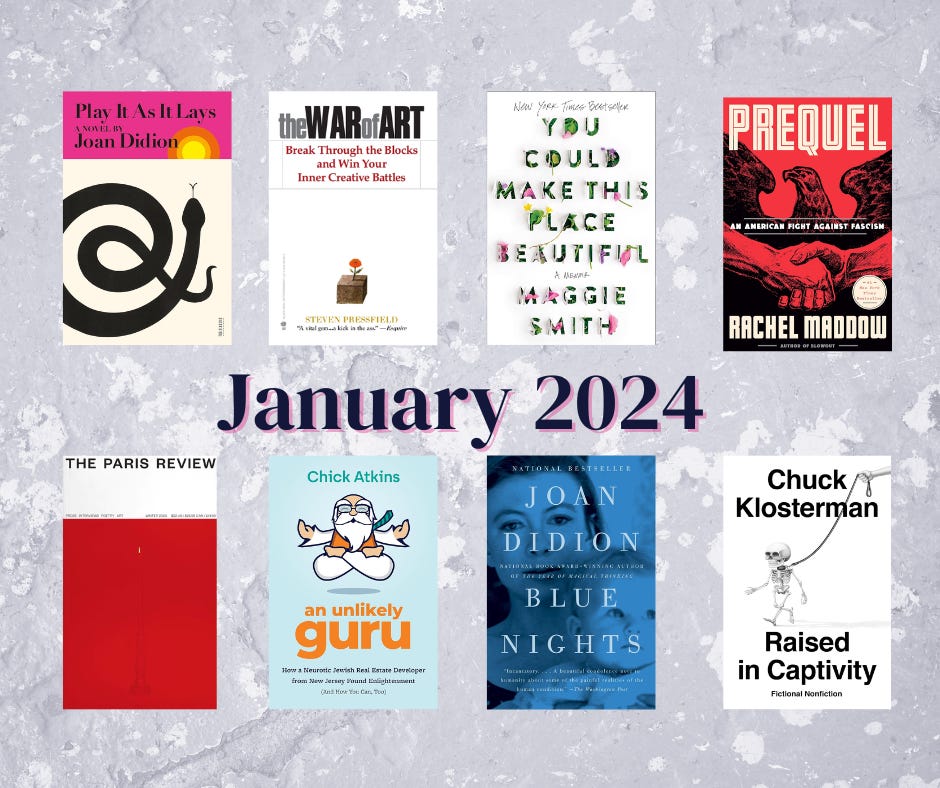
This month, fittingly, some were about being on an edge, some about going through the edginess, some offered respite from that, and some on how to actively seek and preserve your peace.
And in between the driving and the writing and the reading and the living and the lane changers, there is a trying. Some moments flash a sense of purpose and swerve around a very boring, utterly typical life. Is that what books are for? MAYBE. I DON’T KNOW.
Perhaps I’m just supposed to make some sort of learned-person comment about constant motion, fragmentation, and the struggle to find mental space for growth and art amidst chaos and eternal laundry. MAYBE. I ALSO DON’T KNOW THIS.
“Are you a born writer? Were you put on earth to be a painter, a scientist, an apostle of peace? In the end the question can only be answered by action.
Do it or don’t do it.” — Steven Pressfield
One of those “read it because it keeps coming up in various writing communities” go-to recommendations.
They were right. (Although I preferred Parts 1 & 2 to Part 3, any artist should consider giving this a thumb-through.)
Brutal. Almost hostile. Maybe that’s the existential despair and ennui talking. It’s bleak. It’s fragmented. Short-tempered. This one, for me, isn’t Didion’s best, but it is not to be dismissed.
A rare miss for me in terms of most of the fiction. Edgy in some ways that made me bristle, which then made me feel crotchety. I do not like feeling crotchety. Redeemed by the poetry and the interview with Louise Glück.
Chuck Klosterman knows how to enter a story. He finds the trap doors, he floats down in a bubble like Glenda the Good Witch, he bursts through walls like the Kool-Aid man. His pieces are distinctive, hilarious, and often swerve into mildly disturbing. Excellent if a little uneven.
Aging, parenting, disillusionment, regret, grief, and the accompanying sense of fragility, presented with the calm of deep grief.
She slices and dices so keenly, so precisely that it takes a while to realize she is splayed open. Had she been any more nostalgic, any less crisp, the book would have veered into sensation rather than stark intimacy.
In Chapter 19, she talks about the struggle to put words on the page with precision and alacrity.
She names this “Frailty.”
Which is another word for what is underneath all of this in our Januarys. Perhaps we’re trying to speed and weave and tailgate to escape that as well.
At least that frailty fades. If it must reappear each January, maybe we can do better and buffer it with soft things and soft people and soft kindness.
Fortunately, January has rolled into the rearview mirror.



 Jackie Pick