Category Archives: Under 750

Wrestling with Mary Oliver on My Birthday

Warning: This piece contains an unreasonable number of cheese references.

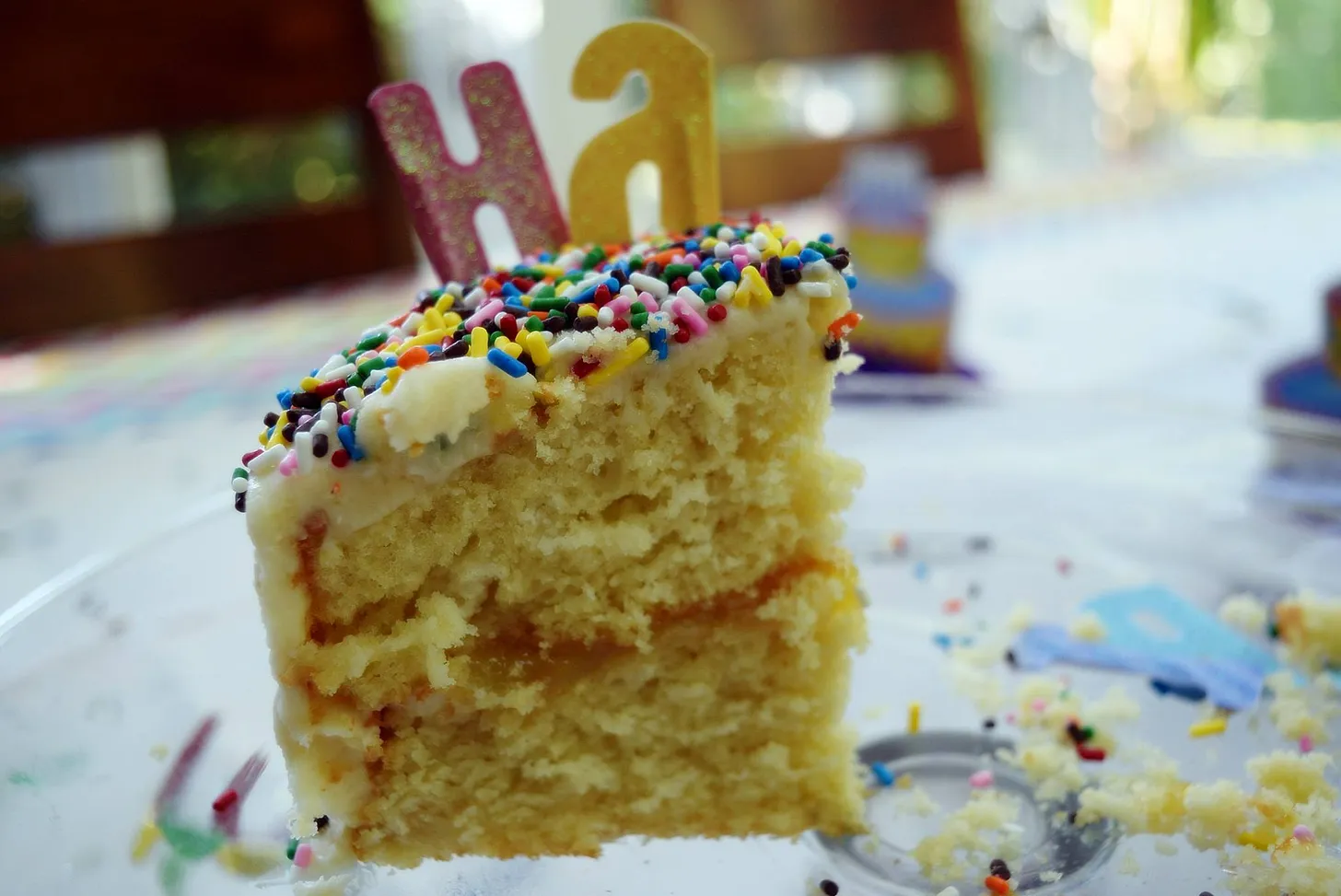
A close-up of a sprinkle-covered slice of birthday cake with the candle letters "Ha" on top, sitting on a crumb-covered plate.

Permit me a wildly self-indulgent post. It is my birthday, and if a woman can’t spelunk into the gooey cavern of her own feelings on the anniversary of her arrival, then when can she?

“Tell me, what is it you plan to do with your one wild and precious life?”

I started this day as I do most days, forcing myself to wrestle with Mary Oliver.

For a while now, I’ve worked on carving out little havens for myself. Small sanctuaries filled with beautiful sounds and words and things to gaze upon and hold dear. I’ve tried to fill them with people, too. People who smile and cry, as needed. People who are an honor to stand with, or curl up next to, or double over in laughter with in the great messy queue of existence. And people who will, crucially, refrain from being grammar assholes over this entire paragraph.

And then I’ve worked on showing up in those havens, which is harder than you’d think. You’d think once you’ve carved out a space, you’d want to be in it, like a cat claiming a cardboard box. BUT NO. My instinct is to show up everywhere else first.

Those everywhere else spaces need people like me — people who are loud and unsoft in public. The spaces where people like me are asked to stand at the front and project their voices like a malfunctioning foghorn. The spaces where I need to show up (and shut up) so no one else has to be brave alone.

Those spaces can take your skin. Those spaces can be harsh and loud and brisk. I like none of those things.

Being unsoft in public isn’t easy. None of us is unsoft at all times. Even under-bridge trolls need an occasional snuggle and a nap. And I refuse to grow callouses. Callouses are for people who enjoy hiking or receiving constructive criticism, neither of which interests me.

But I go to the places I choose, and dwell among people I choose. Still, my unsoft places sometimes grow raw around the edges. Like a cheese that has been handled too enthusiastically at a village fête.

I want to be brave in this one wild and precious life, the kind of brave that requires ferocity and a willingness to occasionally be the cheese that stands alone. Sometimes I am the kind of brave that is also vulnerable. Different cheese, same position. But lots of people like cheese, I’ve learned. Somewhere out there are the people who love the exact cheese that is me.

I digress. I am also hungry for cheese.

Birthdays involve audits. Spiritual, emotional, sometimes literal, if you also store your things in creative locations and now want to use them to get your special birthday cookie at Crumbl. I use this day to ask myself: Am I who I want to be? Am I surrounded by marvelous, strong, brilliant, delightful people? Is the work mighty? Brave? Honest? (Is it occasionally funny, because bonus points for that.)

This past year has been…well, let’s say it has tested us all in ways that rattle our molars and make us long to burrow under blankets and just stay there for a good chunk of this wild and precious life.

But this is a new year. Every day can be a new year. This is why I wrestle with Mary Oliver and her profoundly, annoyingly inspirational poem.

I’m grateful for my people and our co-carved spaces, and the fact that I have the energy to carve them, and also for the baffling email from my insurance agency wishing me a happy birthday as if we’ve been through something together.

And I’m grateful for the privilege of being invited into some of your spaces.

Because at the end of the day, I hope to ease into another part of that poem: “Tell me, what else should I have done?” and know the answer is

“Nothing more.”

Thank goodness.

Thank goodness.

Gross and Fallible (Me). Brilliant and Difficult (Books).

What I Read October 2025


I spent much of October being ill in the manner of a faintly tragic Victorian governess. Nothing grave, just an assortment of mortal inconveniences that showed my body is not so much a temple as it is a structurally unsound system of tubes and liquids, gross and fallible.

It should be noted that there is no angle from which this type of Camille-on-the-chaise illness is alluring. You cannot smoulder while blowing your nose.

By end of month, I expected some turn-of-the-century doctor with a pince-nez to prescribe a restorative stay by the sea. I would have gone. Gladly. I’d have even covered my pasty ankles for decency’s sake.

Still, between the tissues and the intermittent Byronic languor, I managed to read four books by people who are very good at doing the writing thing. (Also, SPOILER: Between illnesses, I GOT TO SEE COLSON WHITEHEAD LIVE! I’ll save that for another post when I have regained the ability to write about it in complete sentences that are more than “!!!!!!!!!!!”)

I haven’t written the individual reviews; those will eventually arrive (crosses fingers, appeals to the mercy of time gods). So for now, some thoughts on the books as a group. This is, by the way, not me asking the books to do group work. Group work is a scourge. I’m noticing what they did when they sat in the same room in my brain.

The books:

  • The Underground Railroad by Colson Whitehead
  • Breakfast of Champions by Kurt Vonnegut
  • A Stroke of the Pen by Terry Pratchett
  • Missing a Beat by Seymour Krim

Wildly different in form and structure, but all perform the same literary judo: they force a reader to look at history, absurdity, brutality, and ego-masquerading-as-culture. Three of them probe indelicately at the grand American myth that everything is fine and glorious, which is to say, the bootstrapped bald eagle stories America tells about itself in order to sleep.

By far the most…important, I think I want to say…of these books (and the best, I definitely want to say) was The Underground Railroad. Whitehead refuses to euphemize our history and natures. Vonnegut satirizes. Pratchett pokes at our soft spots, and Krim interrogates his disappointments in some sort of New Journalism version of an Individual and Society 101 course.

All four share an obsession with the ideas of story-as-power and language never being neutral. Who gets to define things? Whose suffering counts? Who gets to say what happened? Whose foolishness becomes legend? Whose story gets believed?

Moreover, what do we gain and lose by accepting these myths?

Pratchett regards myth as something humans compulsively produce to keep us comforted in our belief that we’re terribly wise or terribly tragic or, at the very least, the Main Character. A sort of psychological bubble wrap. The other three books, though, scrutinize the rather large and rickety myth called America, one shaped by power, violence, and selective memory. Race is a central pressure point in those three books, and the authors address it with varying degrees of authority, clarity, and moral handholds.

Whitehead writes starkly about the historical and ongoing realities of systemic racism, refusing euphemism or safe distance. His work is both expansive and claustrophobic. Violence often arrives without warning, as it does in life. It is brutal and brilliant and essential reading.

Vonnegut has characters use racial slurs to expose and criticize racist American thinking, and it lands sharply. It was unpleasant. Intentionally so. Yet that intention does not make the experience easy. Also intentional. There is a lot to unwrap in this book about racism, free will, and people-as-machines.

In several essays in this collection, Krim writes about Black culture from the outside, with a mix of admiration, projection, and longing that reveal (and sometimes perhaps widen) the gaps in his understanding and the limits of his perspective.

So, yeah, if I’m slow on getting the reviews out, it’s because I don’t want to just toss off some half-baked take while my skull is hosting a demolition derby. These books deserve deep analysis. I want to show up for that like a person who still has a functioning cortex.

Both my health and this blog are back on track. *Looks at calendar, sees what’s advancing over the horizon at an impolite jog* Well. Right. Onward, then. Let’s just agree to continue to do our best with as much dignity as we can reasonably fake.

The Human Exclamation Point

This is, hopefully, the final installment in my (also hopefully extremely limited) series, “Why Am I Like This?”


Illustration of a white frosted cake on a wooden stand, topped with a bright pink-and-yellow exclamation mark. The cake appears inside a Zoom call window. Text above reads “The Human Exclamation Point,” and “by Jackie Pick” appears in pink at the bottom corner.

Writers are cautioned not to overuse exclamation points. If we must use them at all, we are told to ration them. No Serious Writer™ uses more than three exclamation points per novel. I use three before breakfast. No Serious Writer™ would dare rely on punctuation to do the emotional heavy lifting. No Serious Writer™ would employ exclamation points unless something truly calls for excitement. I have been alive for some time, and few things ever truly call for excitement. Except cake.

But some of us are Excitement Folks. I myself am a human exclamation point. Out of the house, my natural register becomes Jack Black impersonating Judy Garland while spinning plates. I greet people like we’ve survived a maritime disaster together. I smile as if paid by the watt.

Mind you, this is not my natural state, but it is often my public one.

I have long aspired to become awoman of repose. I have tried, truly, to be someone who radiates calm, who says “hmm” instead of “OH MY GOD, YESSSSS,” who does not tell your dog I love him the very first time I meet him.

Alas, my attempts at composure resemble Animal from The Muppets being shot out of a confetti cannon directly into a line of cymbals.

Women of repose give the impression that they read Smithsonian Magazine in the bathtub. I give the impression that I clap when planes land.

Enthusiasm is a peculiar human response to the otherwise bleak recognition of existence. It manifests as sudden bursts of unsolicited and often alarming cheerfulness. Enthusiasm is socially contagious but has an inconvenient half-life of twelve minutes and a regrettable tendency to startle normal people.

For a while, I managed something approaching serenity. My public self finally matched my private one. My resting heart rate was no longer espresso.

Then came Zoom, a technology that brought people together by separating them entirely.

Staring into a camera instead of human faces, it’s hard to catch social cues unless someone types LOL or You are a dork in the chat. Since we’re all deprived of feedback, I overcompensate as speaker and listener. I nod violently and try to show you that I’M WITH YOU AND I LIKE YOUR VIBE AND ALSO I’M TURNING MY CAMERA OFF BECAUSE I’M SHOVING AN ENTIRE COSTCO TUXEDO CAKE IN MY FACEHOLE AND YOU DESERVE BETTER BUT I’M STILL HERE NODDING PROMISE.

We can call that enthusiasm. Or nightmare fuel. Whatever.

Then the meeting ends, and I power down like a droid in Star Wars.

Is this growth or regression? Is my at-home, off-camera restraint maturity the real me, or just battery depletion? Am I even seeing myself accurately? Because, honestly, the only time I see myself is on Zoom.

Both versions of me feel real, but they can’t coexist. I’m trying to find the midpoint between “!!!” and “…”

Maybe an em dash, that modern-day punctuatio non grata.

Definitely not a period though, because I prefer to do things not with a whimper but (wait for it!) with an interrobang.