Category Archives: Recommendations

Awkward Times Call for Awkward Scientists (and a Ghost and Possible Nuclear Winter)

The Folio: What I Read in January 2025

Before we begin, quick question: Should I stick with monthly roundups of books, or post reviews as I finish them? Let me know in the comments!

Before I REALLY begin, I want to say that I’m acutely aware of what’s happening in the world right now (and, honestly, whenever you’re reading this, something is happening). Books are my lifeline in times like these, as are the arts in general. Maybe these reviews will help you discover something that locks the monsters in the closet, even if just for a few hours.
Anyhoodles, this month’s accidental theme was SCIENTISTS! (MOSTLY!) Three books feature fictional, socially awkward scientists. One features real-life scientists scaring the crap out of me. And then there was a book with a ghost who was far less frightening than the whole nuclear war scenario and was also not a scientist.

It all made me want to make a “ties that bind, ties that break” chemical bond pun, but that’s wordplay I haven’t earned this early in a post.

These books share an underlying question of respect. Just a little bit. Just a little bit.

I made the questionable choice to read Lessons in Chemistry and The Portable Veblen simultaneously, a juggling act that requires finesse. “Finesse” is not ever associated with me, so that little experiment had some issues. Both books feature untraditional female protagonists grappling with thorny relationships and mixed feelings about marriage, sharp critiques of societal norms, deliciously eccentric side characters, razor-sharp humor, partners who thrive (sometimes smugly) in more traditional spaces, and brilliant animal companions. Given the current firehose of everything, tackling these two literary powerhouses together was, in hindsight, a terrible idea. Definitely. But also worth it. Fire hoses sometimes clarify things. Or get the dirt out. Look, I don’t know. I don’t have the finesse for this paragraph.

I also freely admit that science is not my lane. What I know about it could fit in a 10 ml Erlenmeyer flask. But that was not prohibitive at all in reading this odd collection.

Which is all just to say these are the books that I enjoyed (?!) enough to finish in the last month:

  • The Sentence by Louise Erdrich
  • Nuclear War: A Scenario by Annie Jacobsen
  • The Rosie Project by Graeme Simsion
  • The Portable Veblen by Elizabeth McKenzie
  • Lessons in Chemistry by Bonnie Garmus

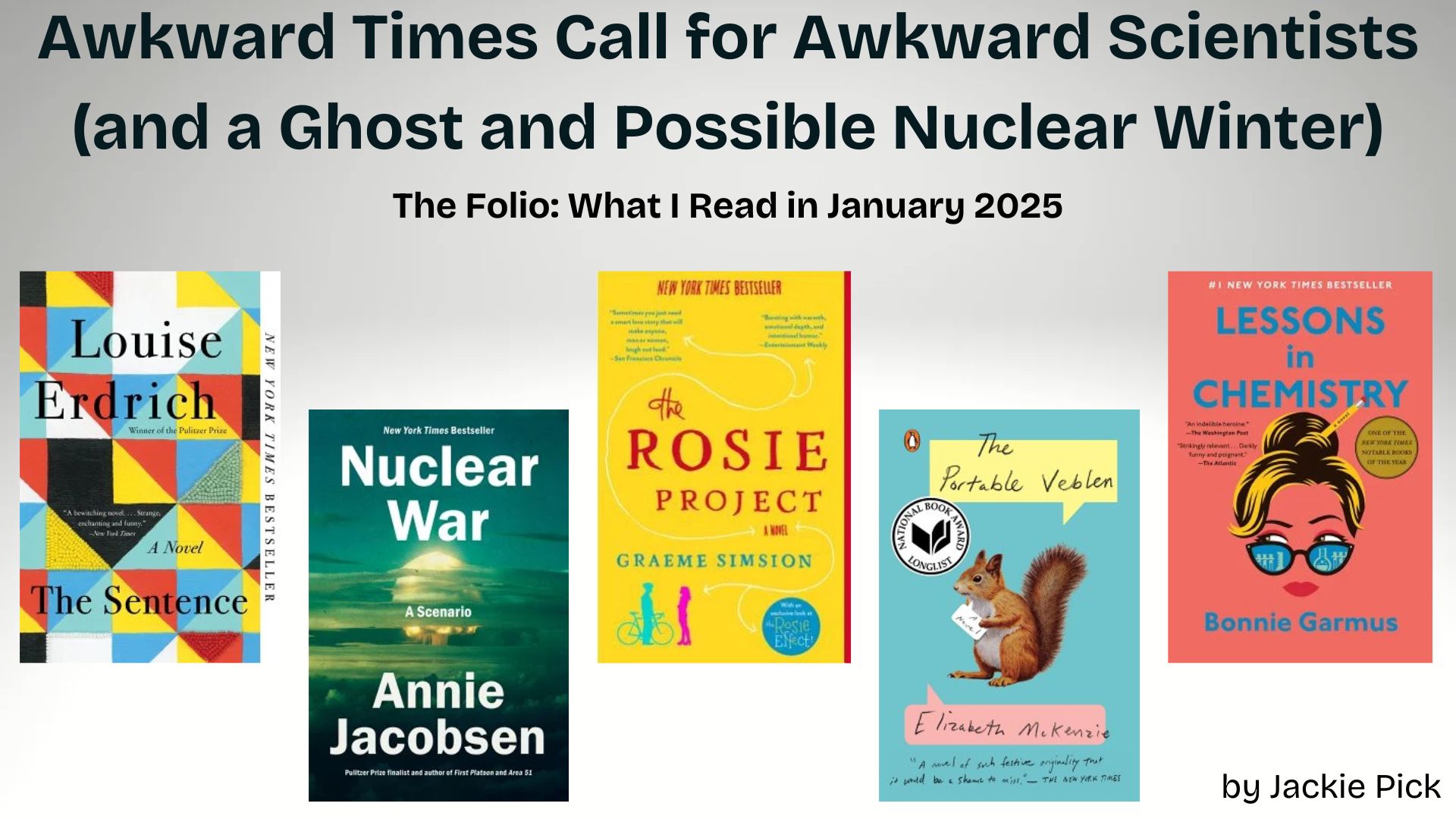
The Sentence by Louise Erdrich
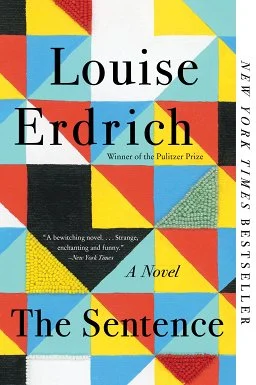
A woman makes mistake after mistake and struggles to forgive herself. It makes so many of us ache, especially when she hits middle-age and is still trapped in the cycle. Relatable to far too many of us.

The Sentence is a book about the pandemic, yes, but also about books — their power to make or break a person. It’s about love, about how pain can carry us far from ourselves. It’s about ghosts, it’s about place and time, it’s about living through history and not having a guidebook even when you are literally surrounded by books.

It’s about a lot.

What a world, what a world.

The Sentence isn’t what I’d consider a beach read. It’s phenomenal in its own deep, murky way. Louise Erdrich is a master at letting readers fill in the gaps. Her storytelling is dense, funny, sad, and sweet, skimming past exposition when needed but occasionally lingering on a breathtaking paragraph about a home, a community, or a character’s history.

This novel is packed with 2020 zeitgeist and a sprinkle of the paranormal. Not the kind of ghost story that screams “Take that book off the shelf and a Spirit Halloween will pop up in it’s place,” but one that’s almost natural, woven into the fabric of time, history, and a year where every boundary blurred: between the living and the dead, the personal and the political, the individual and the collective.

At The Sentence’s heart is Tookie, a Native American woman with a chaotic past. She spent ten years in prison for a crime so absurd it feels like a cosmic joke, one she committed because of trust and love. Now, she’s clawed her way back, finding solace at Birchbark Books, a sanctuary and second chance, but literal and figurative ghosts linger.

The story wrestles with identity, cultural appropriation, belonging, justice, redemption, grief, and the life-saving power of literature. It can feel unwieldy, like, “Which of these threads are we following now?” But that’s life. Especially in 2020, when everything happened at once, and there was no time for careful analysis never mind catching our breath. The ghost story sometimes feels like an escape hatch, but it’s symbolic and a beautiful shelf-companion to Beloved.

Erdrich balances humor and seriousness beautifully. Tookie is a vivid, unforgettable protagonist, and the secondary characters feel alive, created in a few key strokes and living fully in the pages (MORE POLLUX, PLEASE!). The pacing takes some adjustment: zippy at first, then nutrient-dense and slow before speeding up like a second draft overtaking the first. But I liked that. It mirrors how time warped and twisted during the pandemic.

The story’s threads tangle and fray, and Erdrich doesn’t tie them all neatly together. That’s life, too.

Would I want to work in a haunted bookstore? Probably. But having worked retail, I know how that world can get. There can be a gaping chasm between what’s on the shelves versus what’s in front of them.

Maybe, just maybe, the answer to what we do while the world burns is in places like this. Haunted, chaotic, full of books, and yet, still, simmering with hope.


Nuclear War: A Scenario by Annie Jacobsen
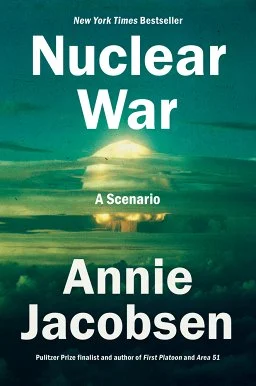
Hey, how’s your adrenal system? Because Annie Jacobsen’s latest will stress-test it. This may not be the book for you at this moment. That’s okay. Put it on your TBR pile if you need.

The reality, the looming dread, and the anxiety of nuclear war didn’t vanish along with Smurfs, Teddy Ruxpins, or the extremely-80s-even-for-the-80s Chess King store. Much like Teddy Ruxpin, Annie Jacobsen beautiful work will haunt you. She’s here to grab you by the shoulders and remind you explicitly, directly, vividly, and with a mountain of receipts that nuclear war remains a terrifyingly real possibility.

Nuclear War: A Scenario is not speculative fiction, though it reads like it should be. It’s not science fiction, though the premise feels catastrophically implausible until you realize it isn’t. Jacobsen walks us through a nuclear conflict initiated by a North Korean missile strike, minute by horrifying minute. This is a reality check.

Drawing from declassified documents and insider interviews, Jacobsen meticulously reconstructs the minutes, hours, and years after such an event, leading to one grim conclusion: the systems we rely on to prevent catastrophe are fragile, and our fate lies in the hands of flawed, pressured, fallible people.

The “ticking clock” pacing gives the book the feel of a geopolitical thriller, but it hits harder than any fiction ever could. The prose, though occasionally heavy on description, remains accessible, ensuring this harrowing reality reaches a broad audience. And it should. The catastrophic harms Jacobsen outlines wouldn’t end in days or weeks — they’d linger for millennia. And yet, her novel-like pacing keeps you hooked and horrified, unable to look away even as the dread mounts. You know how this ends, but you can’t stop reading and wondering “Where could we stop this? This moment? That moment?”

This isn’t a book you enjoy so much as survive (and then, boy, are you grateful for any sense of survival). Equal parts “I had no idea” and “Oh God, why do I know this now?” it’s a full-body panic attack: sobering, terrifying, and essential reading for anyone willing to face the stakes of our world and consider in whose hands lies its fate.

Perhaps the best nuclear deterrence strategy is to read this book and hope its pages remain hypothetical.

Look upon our works, ye mighty, and despair.


The Rosie Project by Graeme Simsion
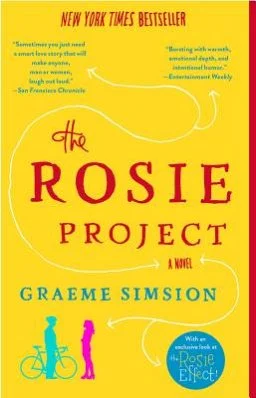
Ack. I‘m all over the place with this one. Yes, I just said “Ack.”

The Rosie Project is a rom-com that collides with wickedly sharp writing and starts smelling faintly of spreadsheets and awkward silences. Meet Don Tillman, a geneticist who approaches life with the precision of a lab experiment. Timetables, optimized meal plans (hello, Lobster Tuesdays*), and meticulously tested hypotheses keep his world running as smoothly as possible for a man who struggles to decode the nuances of human connections.

At 39, Don decides it’s time to find a wife so he institutes “The Wife Project,” which includes a lengthy, detailed, ridiculous screening questionnaire for potential mates. Don’s approach to finding a life partner works about as well as you’d expect, which is to say, not at all. Everyone in the book seems to know this. You know it. I know it. But Don? Don’s testing his theory, come what may.

Enter (breathlessly) Rosie Jarman, a free-spirited bartender and grad student on a quest to find her biological father. When Don gets roped into Rosie’s “Father Project,” their unexpected partnership forces him to step outside his comfort zone. Rosie’s spontaneity and warmth challenge Don’s rigid worldview, while Don’s quirks and brilliance unexpectedly win Rosie over. Rosie fails nearly every criterion of Don’s Wife Project questionnaire, yet somehow she delightfully disrupts his carefully calibrated world. From her entrance we can see where this relationship is headed.

Simsion writes with a sparkling wit and a knack for pacing that feels effortless, no doubt honed by the book’s origins as a screenplay. The dialogue crackles, the humor lands, and the depiction of academia is as brutal as it is hilarious. Watching Don apply logic to love is both hilarious and heartbreaking, highlighting not just his brilliance but also his interpersonal limitations.

While Rosie is vibrant and compelling, she occasionally feels more like a narrative device than a fully realized character. Simsion does work to avoid reducing her to an archetype, but at times she seems to function primarily as a catalyst to unravel Don’s rigid patterns and show that love defies logic. Their chemistry works, but I would have loved to get some more of Rosie’s depth. More dialogue from her about her attraction to Don could have enriched their romance, though the telling of the story from Don’s perspective understandably limits our insight into her feelings.

Then there’s Don himself. Simsion has said he intentionally avoided labeling Don’s behaviors, which strongly suggest neurodivergence, to allow readers to interpret him individually. While understandable, this choice leaves certain questions unresolved. Don’s social struggles often fuel the humor, but at times it wobbles between empathetic comedy and laughing at his expense. This tension may leave readers wonder if we are meant to laugh with Don, or at him? Is it a celebration of individuality, or does its pursuit of humor sometimes risk reducing individuality to a punchline?

Hence my “ack.”

Despite its flaws, I did happily read this book to the end. The contrast between precision and chaos underscores the love story. Simsion is a hell of a writer, and this book was a nice reset of my adrenals after reading Nuclear War: A Scenario.

A little messy, but worth it. Much like Lobster Tuesdays.

*lobster, mango and avocado salad with wasabi-coated flying fish roe and crispy seaweed and deep-fried leek garnish


The Portable Veblen by Elizabeth McKenzie
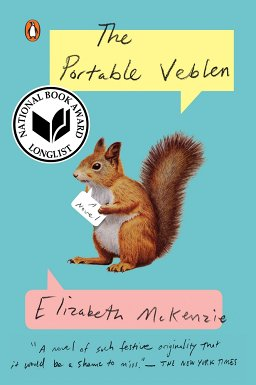
The Portable Veblen brings a chittering glitter cannon to a philosophy conference in the best possible way.

Elizabeth McKenzie wrote a playful, brainy novel packed with existential dread, and big questions about modern life. It’s not your typical lit fic, contemporary fic, romance, magical realism lit, or humor, and honestly? Bless it for that.

The Portable Veblen dissects absurdities of contemporary existence through Veblen Amundsen-Hovda and her fiancé, Dr. Paul Vreeland, a neurologist whose clinical precision doesn’t always extend to human relationships. Veblen, named after the anti-consumerist economist Thorstein Veblen, is a free-spirited woman whose quirks are more survival mechanism than affectation. A point made crystal clear once we are introduced to her parents.

Veblen’s approach to life doesn’t challenge Paul outright, but it quietly forces him to confront the contradictions in his ambition-fueled, family-fractured existence. Their relationship teeters under the weight of family baggage, corporate greed, and the chaos of wedding planning.

There’s a squirrel. Possibly sentient, functioning either as Veblen’s life coach or doorman (door-rodent?) to some sort of dissociative state. The squirrel’s role as both a confidant for Veblen and a burr in Paul’s proverbial sock adds another Wes-Anderson-esque layer to an already offbeat story. Eccentric side characters pop in and out, adding humor and pathos as Veblen and Paul try to figure out whether their love can survive their vastly different worlds.

With dry, delicious humor, McKenzie tackles big themes (capitalism, ambition, family dysfunction) while maintaining emotional heft.

The quirk factor is dialed up. The squirrel subplot is either charmingly surreal or distractingly odd, depending on your tolerance for whimsy. Paul is fine. His and Veblen’s dynamic works, but Paul occasionally feels more like a foil than a true partner. Veblen’s mother? Definitely a foil and quite frankly, if she were my parent, I’d be talking to squirrels, too.

The book does meander, much like the titular squirrel darting around a tree. Some detours into Veblen’s family history and philosophical musings are worthwhile while others stretch the story thin.

All that said, The Portable Veblen is a delightfully weird little book — smart, funny, inventive, and completely unafraid to be its peculiar self.

(Fun Fact: I apparently read this book nine years ago. I didn’t remember it, so it was like reading it for the first time. The first time, I was neutral on it, but now not so much. So, in book selection as in life — and pinball — timing is everything.)


Lessons in Chemistry by Bonnie Garmus

I didn’t pick up Lessons in Chemistry because of the buzz — because, let’s face it, buzz has burned me before. I picked it up because women I adore and respect raved about it. Oh, Lessons in Chemistry, you bold, fiery little book. You walk into the room, dressed like an unserious vixen, grab a lab coat, and proceed to calmly and brilliantly roast systemic sexism over a Bunsen burner.

This is the story of Elizabeth Zott, a chemist too fiercely brilliant for the cigar-smoke-filled labs of her time. Elizabeth doesn’t “lean in”; she kicks the door off its hinges — except the world keeps bolting new ones in her way. She’s got a fiercely loyal dog named Six-Thirty, a precocious daughter, and the love of her life in Calvin Evans, an equally brilliant scientist whose unconventionality somehow fits him better than it fits her. Still, Elizabeth fights on, armed with blazing beakers and a spatula, turning a cooking show into a feminist manifesto that teaches women chemistry and challenges the suffocating norms of the era. A+ for gumption and execution.

Bonnie Garmus writes with enough heat to turn the patriarchy into a puddle of goo. The book is laugh-out-loud funny, but it has real teeth, too. It tackles big, hairy topics — sexism, ambition, motherhood, love — with style and smarts. It’s no wonder Lessons in Chemistry has earned its beloved bestseller status. I get it. It’s deep yet accessible, sharp yet breezy, a balancing act that feels effortless.

I’ll admit, though, I’m a sucker for secondary characters, and I wanted more Harriet Sloane. Harriet’s the kind of person I need in my life — or, more realistically, the kind of person I aspire to be (minus the unhappiness). The language throughout is playful, but the mix of quirk and trauma can be tough at times. Elizabeth is sidelined, dismissed, and deeply traumatized, and the hardest part is seeing how much we’ve two-stepped back into those same dynamics today.

Elizabeth is amazing — almost too amazing. She’s so extraordinary that she teeters on the edge of perfection. Yes, she’s flawed, but those flaws feel faint, like a distant planet we’re told exists but can’t quite see. And the villains? Fun to hate but a little cartoonish, twirling their mustaches on the way to oblivion. One “villain,” however, managed to surprise me, which was a welcome twist. Occasionally, the book holds its themes up like a megaphone in your face — effective, sure, but not always subtle.

Then there’s Six-Thirty, Elizabeth’s dog. The switch to his point of view was jarring at first (he’s a dog, after all), but not enough to take me out of the story. And honestly, if you’re going to have a canine narrator, Six-Thirty is the one to have. If my own dog were narrating a story, it would be a series of broken thoughts, endless neediness, and occasional pauses to sniff his own butt.

But subtlety is overrated when you’re taking a flamethrower to societal norms. Lessons in Chemistry is big, bold, and unapologetically feminist, with a beating heart and enough laughs to carry it. It’s the kind of book that grabs you by the collar and shouts, “You’re better than this world lets you be!” And honestly, we probably all need that right now.

Let this one light your inner Bunsen burner of righteous indignation. While its cover might suggest a romance novel — which it’s not — you’ll fall in love with it all the same.

And to the women I adore who recommended it: thank you.


That was a lot (ACK!)

Did you read anything this month that made your neurons fire or your heart rate spike? Share your findings!
The 2024 Reads That Roused This Rabble of One


We All Love an End-of Year Recap, Don’t We? 

My go has been thoroughly gotten. My timbers shivered. Murgatroyd and Heavens have joined forces to create a chaos cabal.

Great googly moogly, folks, I’ve consumed not-quite-a metric buttload of books this year. I’ve also abandoned a few along the way without shame. Life’s too short and other platitudes

We long for stories that fuel the soul. Whether you get them through books, e-readers, audiobooks, puppet shows, or, MAYBE, you know, this superb nonsense right here. You’re welcome.

An image of paper-wrapped books and a caption that reads "The 2024 reads that roused this rabble of one. (We all love and End-of-Year Recap, Don't We) by Jackie Pick

A lot of my reads this year were solid, some stellar, but these? These are the books that stuck like particularly hearty and literary overnight oats.

So, if your TBR pile isn’t yet a towering Jenga stack of ambition, here are some suggestions to make it so. Hopefully, there’s something here for your next visit to the reading nook of your choice.

Presented in the order I devoured them:


Book cover of You Could Make This Place Beautiful by Maggie Smith

You Could Make This Place Beautiful by Maggie Smith

Beyond brave. It’s honest. It’s messy. It’s often overwhelming. It’s wonderful.

This is the one I’ll crawl back to when I’m dangling off the edge of life’s proverbial cliff and need to grab hold of something — someone — for dear life. Artistically speaking. And also in all the other ways.

Full review in this post.


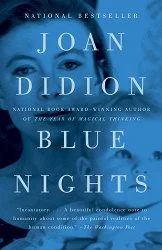
Book cover of Blue Nights by Joan Didion

Blue Nights by Joan Didion

Aging, parenting, disillusionment, regret, grief, and the accompanying sense of fragility, presented with the calm of deep grief. It’s magnificent. It’s Didion.

This is the one I hope I’ll never need to return to — but I’m deeply grateful it’s there, should I need an unwavering companion when grief strikes its deepest, darkest notes.

Full review in this post.


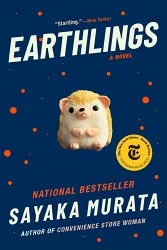
Book cover of Earthlings by Sayaka Murata

Earthlings by Sayaka Murata

So fricking weird. (*heart emoji*) Murata’s wild originality had me falling head over heels one moment and clutching my stomach the next. It’s the kind of book that makes you say, “Wait, what?” on every other page. Do read a summary before you dive in — it’s not for everyone.

This is the one I’ll revisit whenever I need to remind myself just how boundless, bizarre, and brilliantly unsettling human creativity can be.

Full review in this post


Book cover of The Secret History by Donna Tartt

The Secret History by Donna Tartt

Needle-sharp detail. Characters so deep you could drown in them. Language that brushes up against the divine. TIt’s a long one, sure, but not for a second did it feel like it. Every word earns its place.

This is the one I’ll revisit when I want to study with a master.

Full review in this post


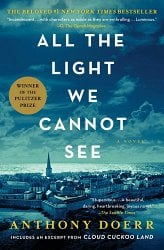
Book cover of All the Light We Canno See by Anthony Doerr

All the Light We Cannot See by Anthony Doerr

Can I interest you in a Pulitzer Prize winner that just doesn’t let go? This is the kind of book to take on a long train ride. Or several short ones. Or just sit with at your kitchen table, pretending you’re in some windswept European war zone while your coffee goes cold because.

Of this year’s books, the one I’m most likely to reread.

Full review in this post.


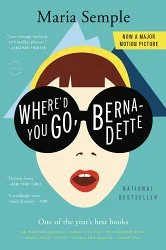
Book cover of Where’d You Go, Bernadette by Maria Semple

Where’d You Go, Bernadette by Maria Semple

A deeply resonant, delightfully offbeat novel that juggles wild trips to the end of the earth, absurdity, and lawn warfare with pitch-perfect balance.

This is the one I’ll reach for when I need a reminder that satire can be both razor-sharp and laugh-out-loud hilarious. Also on those days when I want to pretend that I, too, am a perfectly flawed genius navigating a world that just doesn’t get her, but likes to text about her anyway.

Full review in this post


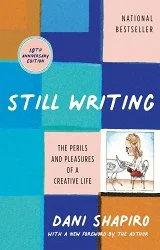
Book cover of Still Writing: The Perils and Pleasures of a Creative Life by Dani Shapiro

Still Writing: The Perils and Pleasures of a Creative Life by Dani Shapiro

A steaming hot bowl of chicken noodle soup — comforting, helpful, a little salty. Perfect. You want to rush through it? Wrong move. This is a slow-simmer kind of book. It’s the kind of thing you read and pause, read and pause. You mellow with it. That’s where the magic is.

This is the one I have already revisited several times as I bemoan one writing issue or another.

Full review in this post.


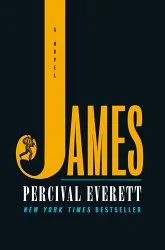
Book Cover for James by Percival Everett

James by Percival Everett

Percival Everett not only brings the goods, the whole goods, and nothing but the goods — he delivers them with such unapologetic brilliance that you’ll find yourself wondering, ‘How has no one done this before?’ And then you realize — no one else could have done this.

I am thunderstruck.

This is the one I will revisit when I’m in the mood to be astonished and delighted by audacious brilliance.

Full review in this post


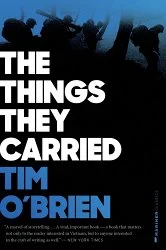
Book cover for The Things They Carried by Tim O’Brien

The Things They Carried by Tim O’Brien

Read this when you are in a place to do so, if only because the writing and structure are elegant and majestic. But also, read it when you can stomach the violence and sorrow.

This is the one I will revisit to marvel over the near-perfection of the title piece.

Full review in this post.


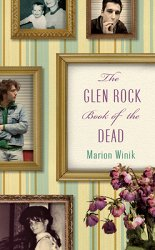
Book cover for The Glen Rock Book of the Dead by Marion Winik

The Glen Rock Book of the Dead by Marion Winik

There is warmth here, and ferocity. There is compassion, too, and an unwavering sense of curiosity. What does it mean to remember someone? What does it mean to be remembered? These are the questions Winik circles, never directly, but with every story she tells.

This is the one I’ll revisit to marvel at how entire lives can unfold in just a few paragraphs, every word chosen with surgical precision and care.

Full review in this post.


What books made your year more bearable? More enjoyable? More human?

The ones that lifted you, grounded you, or just reminded you we’re all in this wild, messy, beautiful thing together?

And what stories do you recommend for us for the coming year?

P.S. Because I love you and them and all of us.

The Folio: What I Read Mid-November through Mid-December 2024


The (Un)usual Humanity of It All

When I wrap up each month’s reading, I like to look for themes that connect the books I’ve enjoyed. I am exciting that way.

This month, the theme seems to be something like “Joke’s on you, asshole.” Fair. A little harsh. I should be nicer to myself.

Anyway, generally, I want my books to feel “slippery and wild,” as Gwydion Suilebhan described in his post about A Real Pain. . The books should make me work for it a little, challenge me, delight me, or knock me off-balance just enough.

This month has been mostly glorious, occasionally frustrating, and terribly on-brand for late November into December. There was so much illness in the house, including me. Two solid weeks of being sick cut into my reading time, as did an ocular migraine that I was sure was a retinal detachment (long story). Finals for the kids, Thanksgiving, and the usual chaos of life were all there too — the kind of busyness we’ve somehow convinced ourselves is virtuous. Spoiler: it’s not.

Still, there were hugs to give, cheers to yell as we clawed our way through heartaches, anger, joy, and everything in between. Most of the books I read this month fit the mood perfectly. And, as you’ll see next month, even Nuclear War (which I didn’t finish in time for this wrap-up) aligns thematically in its own toe-tapping way.

WHY do we do this? Why do we run around like caffeinated ferrets, scuttling to and fro with all our urgent ferret business, only to collapse in December like, “Yes, our ferret work here is done,” and then, immediately decide January is the perfect time to start sprinting again? (Side note: I am fully bracing myself for the onslaught of “Hard to believe, but it’s time to make summer plans for your kids!” emails by January 10th. No. Stop it. Please. Let us wallow in this current hellscape for five seconds before dragging us into the next hellscape — this time flavored with the bitter tang of FOMO over missing All the Important Things.)

Back to the books. There’s a clear thread of humanity in all its messy, ridiculous, and poignant glory.

Some of these were slippery. Some wild. Some both.

Which is all just to say these are the books that I (mostly) enjoyed enough to finish in the last month:


Glen Rock Book of the Dead by Marion Winik 

Marion Winik’s The Glen Rock Book of the Dead is approximately 50 brief, jewel-like portraits memorializing (if not nearly resurrecting)individuals who have touched her life. Inspired by the Mexican Day of the Dead traditions, where mourning and celebration dance together, Winik writes about people she’s known intimately and fleetingly. She flays open lives in just a handful of paragraphs, with warmth, precision, and dazzling compassion.

And oh, holy hell. Sometimes your new favorite book waits quietly, unremarkable in a groaning TBR pile. What a delight this book is. You will feel things you are unprepared to feel about the lives of people you don’t know and whose names you may never find out. Winik doesn’t so much write as she casts spells, allowing entire lives to unfold in under two pages. Each life is “introduced” in vibrant entrances, and their passing takes a back seat to their living. Each subject arriving fully realized, their deaths present but secondary to their lives. Winik seems more interested in how they lived and how our lives imprint on one another.

There is warmth here, and ferocity. There is compassion, too, and an unwavering sense of curiosity. What does it mean to remember someone? What does it mean to be remembered? These are the questions Winik circles, never directly, but with every story she tells.

It confronts pain and disappointment, isolation and failure, but it also finds joy, community, and the unyielding mystery of what it all means. The reader is left wondering what their own two-page version would look like. Disappointment? Pain? Trying to shield myself and my kids from it all, succeeding in some places, failing in others? That’s part of the story. But Winik reminds us that we get to write our own. And that pain? That joy? It’s real. It’s messy. It’s what makes life worth remembering. And it leaves you hoping, above all, that when your story is told, someone notices. Someone remembers. Because, damn it, you mattered. All of you. Your pain and your triumph.

These aren’t obituaries — they’re titrated snapshots of life, love, and the lingering weight of loss. is uplifting even as it wounds, surprising in its candor and its grace.

May we all be remembered like this.

This one is a stunner and you can expect to see it on my “Favorite Reads of 2024.”


Normal Rules Don’t Apply: Stories by Kate Atkinson 

Kate Atkinson’s Normal Rules Don’t Apply is a collection of linked short stories that’s equal parts literary magic trick and narrative haymaker. Atkinson throws you in — no hand-holding, no explanations. Just the weird, the wonderful, the unsettling. The result? A threaded, clanging tumble through lives and timelines.

This isn’t your run-of-the-mill short story collection. It’s a mind-bending, genre-hopping grab bag of what just happened?

This book is cheeky. Boisterous. It’s dark humor wrapped in a velvet glove, then slapped across your face for good measure. Atkinson sets you up with a grin, plays nice for a few pages, and then yanks the rug out from under you. And you’ll thank her for it, because it all tracks. It shouldn’t work, but it does. More than once as a story ended with a brilliant twist, my response was, “Clever girl. Of course.”

The rules of this universe are deliberately opaque. Atkinson leaves you to sort through the fragments, to make sense of the silences between what is said. It’s in those silences that her true mastery lies. She gives you just enough to see the edges of the abyss and then leaves you trembling on the brink.

The collection is quite the cocktail: a shot of Twilight Zone, a splash of Black Mirror, and just enough Grimms’ Fairy Tales to make you wonder what’s lurking in the woods. The rules of this universe are blurry, and that’s the point. And, you know, the title. Atkinson creates the illusion of coherence while actively undermining it.

You don’t settle into this book. You hover above it, guarded, watching through your fingers as the characters stumble into doom, misfortune, and the occasional epiphany. These are stories about endings large and small about how the world tilts on an axis so thin it’s a wonder we haven’t all already fallen off. The characters are magnets for misfortune, yet you are drawn to them, even if only to glimpse their ruin. You feel for them, in the way one might feel for a figure in a painting, separated by time and the inability to intervene.

Not every story is a slam dunk. Some are bumpy, but Atkinson’s gift for words, dialogue, world-building, and her ability to twist your brain into a Möbius strip more than make up for it. Her wordcraft is elegant, ruthless, and a lot of fun.

Standout stories for me included “The Void,” “Spellbound,” and “Classic Quest 17 — Crime and Punishment.”

Normal Rules Don’t Apply is fun. It’s spooky. It’s grim. It’s a Rube Goldberg machine of all sorts of end times — global, personal, and everything in between. And when you’re done, you’ll sit there, wide-eyed, and maybe a little haunted.


Tiny Beautiful Things by Cheryl Strayed 

Cheryl Strayed’s Tiny Beautiful Things isn’t your average advice book — it’s a mixtape of truths wrapped in gorgeous prose and raw humanity. It’s a book of dualities: brutal yet tender, despairing yet hopeful, profound yet breezy. This isn’t sugarcoated “life gets better” nonsense. No, this is Strayed, as “Dear Sugar,” rolling up her sleeves, grabbing your heart with both hands, and saying, Look. This is it. This is life. It’s messy. It’s painful. It’s achingly, stupidly beautiful.

The letters are raw, the writers, asking the questions many of us are too scared to admit we have: Am I enough? Does this pain ever stop? Do I matter? Why am I so lonely? Why does life suck so hard? How do I make it through another Tuesday? These writers are raw, stripped down to their essence, but they are also filled with the absurdity of being human. And Strayed is right there, tossing out lifelines. Not fluffy ones. Not Hallmark-card platitudes. Real, gut-wrenching ropes woven from her own heartbreaks, mistakes, and triumphs. She doesn’t shy away from the mess; she dives right in and invites us to do the same. The water may not always be warm, but you’ll adjust. As Strayed replies with wisdom and candor, there is, when appropriate, a certain lightness. She is sharp, sometimes blunt, but never unkind.

“Vespers” is a stunner — a piece that makes you sit there, slack-jawed, wondering how someone can take pain and turn it into something sacred.

This book isn’t a balm; it’s a salve that stings before it heals. It picks at the scabs of life and gets to the tender, raw human stuff underneath. It’s so much about fixing your problems as it is about reminding you that you’re not alone in the mess. That we’re all just stumbling around, wanting the same damn things: joy, connection, purpose. And, yes, you can probably fix what needs fixing, if you’re brave. You can probably get through this particular heartache if you’re brave. And you’re going to be brave because you are not alone in this.

Tiny Beautiful Things is a reminder to stay human. To stay messy. To stay hopeful, even when it feels impossible. It’s also a reminder that there are good, decent, people in this world who are here for you and me, and we for them.

Cheryl Strayed doesn’t just give advice — she lights a fire in your chest and dares you to hold onto the warmth. You get a lifeline! You get a lifeline! Everybody’s feelings get saved — or at least acknowledged — and isn’t that half the battle?

Tiny Beautiful Things is here to break your heart, stitch it back together, and then maybe poke at it a little for good measure. It’s a book that’ll make you want to hug a stranger, laugh at your own bad decisions, and send a text to that one friend who always puts up with your nonsense. It’s brutally honest, occasionally breezy, and profoundly human. Read it, feel all the things, and maybe grab a box of tissues. You’re gonna need ’em. Chin up, friend. We’re here for each other.


The Misanthrope by Moliere

For a script written in the seventeenth century, The Misanthrope by Molière has a strikingly contemporary feel. The sharp dialogue, biting wit, and complex interplay of ideals versus social niceties could easily be transplanted to a modern setting without losing its punch. Molière’s critique of societal hypocrisy still hits hard.

This wasn’t a game-changer for me, but it’s a classic I’ve wanted to check off my list, and I’m glad I did. There’s something refreshing about reading a script, where the dialogue and characters carry the story’s full weight. Alceste, the titular misanthrope with unyielding moralism, is both frustrating and fascinating, a man who despises the very world he’s hopelessly entangled in. His dynamic with Célimène, his perfect foil, creates a tension that still feels fresh. Her flirtations and charm contrast his severity and bluntness, and their relationship becomes the beating heart of the play. She is everything he claims to despise, yet he cannot look away.

Alceste’s disdain for pretense and societal hypocrisy feels less like a relic of 1666 and more like the bitter grumblings of someone scrolling through social media today. And yet, his rigid moralism isolates him, a reminder that the pursuit of ideals often comes at a cost. The play’s ending, where Alceste stubbornly clings to his principles, has sparked plenty of debate. Is it a comedic jab at the absurdity of rigid moralism or a quiet tragedy about isolation? Molière pokes fun at Alceste’s earnestness while acknowledging that society, in all its artifice, is hardly blameless. It’s not neat, not tidy, but just ironic enough to make you think. Alceste stomps off to be alone with his ideals, proving once and for all that being “right” doesn’t necessarily make you happy. It’s funny, frustrating, and real in a way that feels timeless. Classic Molière.

Look, it’s not going to knock “hanging out at Chuck E. Cheese for my twins’ 5th birthday” out of my top life experiences or anything, but I’m glad I read it. It’s clever, and its critique of human nonsense is as relevant now as it was when Molière wrote it. If you like your classics with a side of sarcasm and existential dread, give this one a shot. Plus, reading a script makes you feel fancy. Like you’re one latte away from writing your own play. And isn’t that lovely?


Arsenic and Old Lace by Joseph Kesselring 

Arsenic and Old Lace is a dark comedy that takes sweet old lady energy and spikes it with cyanide. Mortimer Brewster, your average theater critic, discovers his adorable aunts have been murdering lonely old men and burying them in the basement. One brother thinks he’s Teddy Roosevelt; the other is Creature Feature of the Month having a bad day. The whole thing is bedlam.

I read the play, having heard my whole life that it was a real treat. I didn’t not get it, but I also didn’t get it-get it. So I watched the film — it’s not entirely faithful, but close enough. Same reaction. It’s not for me.

I don’t usually review things I don’t like, or even finish them, but I finished this, so I’m marking it here.

Millions of people love the play and the film, and I leave it to them with warm wishes that it continues to bring joy for years to come (and with sincere hopes that the name “Mortimer” makes a comeback.)


Next week I’ll post my favorite reads from 2024. I’ve got my eye on a lot for 2025. I went through the NYT list of the top 100 books from the year and it made a nice little graphic of things that caught my eye. The local librarians are going to get very sick of me soon.

Were you able to read much this last month? Anything good?