Sequels Are Always Better Than the Original, Right?
ME: Good morning, Every Part of My Brain. Welcome to this second and highly improbable gathering of the committee. Let’s welcome Dragon to the team. He gnaws on my free time like chicken bones.
DRAGON: Cease! There’s no time for kissing up.
ME: We’re going to skip the icebreakers. We all know each other, as last month’s axe-throwing social made painfully clear.
(cheers erupt as Hype Man roars and grinningly points to a massive scar on his forehead. )
CRITIC: So it’s achieved the distinguished state of being largely unread?
HYPE MAN: YEAH! Minutes! The sizzle reel!
ME: Right. Brilliant. Perfect start. (clears throat) Time is like a soufflé: delicate, prone to collapse, and –
DRAGON: – guarded by me.
MONKEY BRAIN: I call this meeting to chaos! All in favor?
ME: Hands down. FYI, this meeting was pushed to the 3rd quarter because –
MARKETER: – because I double-booked us with a webinar on “Optimizing Your Creative Brand in Twelve Excruciating but Photogenic Steps.”
DRAGON: (snorts a puff of smoke like an offended kettle) Pathetic.
ME: Next, Old Business.
ARCHIVIST: Every Business eventually turns into Old Business.
DREAMER: New Business is just Old Business we haven’t met yet.
CRITIC: Our Old Business hangs around like a bad smell, because none of you actually take care of anything. Except, you, Me.
(MONKEY BRAIN flings unwrapped Tootsie Rolls at everyone. Snacking ensues.)
ME: (bangs gavel) Yes, very good. Moving on. I’d like to discuss role consolidation. I propose merging Critic, Worrier, and Self-Doubter into one tidy Efficiency Pod.
CRITIC: Absolutely not.
SELF-DOUBTER: I don’t think I’m pod material.
WORRIER: I’m not pod-shaped.
ME: Fine. Separate disasters you shall remain. Please fill out your timecards accordingly.
DRAGON: You people waste time like it’s your job.
ME: Can we please talk about writing?
Archivist: Ah. The novel. How goes it?
CRITIC: Probably like an axe to the skull, right, Hype Man?
HYPE MAN: Uncool, but still, high-five!
ME: It, I am happy to say, goes well.
DREAMER:(rolling in a corkboard) I took the liberty of creating a Vision Board of our progress. Behold: a vaping dolphin, a typewriter made of ice cream, and Keanu Reeves in velvet singing Elizabethan madrigals.
ME: What on earth?
CRITIC: That’s not a vision board. That’s a cry for help.
HYPE MAN: Love it! Everyone should vape out of their blowhole!
MONKEY: BLOWHOLE
WORRIER: Is Keanu singing madrigals, or is it the velvet jacket?
ARCHIVIST: Actually, that’s corduroy, not velvet.
ME: Let’s all stop –
WORRIER: Stop writing?
ME: What? No!
DREAMER: Taking a rest stop on the cosmic highway!
ME: No rest –
CRITIC: No rest?Sounds like your characters need better working conditions.
ARCHIVIST: Please be sure to log all character reassignments.
ME: I’m reverse outlining and rewriting in loops. Plot, character, theme, setting, subplot, then back around again. Everything in some sort of organized heap, then, adjusted until it works.
DREAMER: Have you considered a treasure map subplot? Or a phoenix? Or writing it in second person? Should only tack on what, 1-9 months to the process?
DRAGON: I’ve barely allowed you enough time to inhale, and you want to exhale treasure maps?
ARCHIVIST: I’ll need to research whether phoenixes and treasure maps can coexist in second person.
MARKETER: Forget all that. Pivot to a cookbook. Cookbooks sell.
MONKEY BRAIN: Iguanas!
ME: No treasure maps. No phoenixes. No second person. No cookbooks. No iguanas. No cookbooks for iguanas or (holds up a warning finger to MONKEY BRAIN) cookbooks about how to cook iguanas. I like my story and have committed to it.
DREAMER: Have you considered switching careers and becoming an organ grinder?
ME: Like in a play-the-barrel-organ way or in a Sweeney Todd way?
MONKEY BRAIN: I’m suddenly uncomfortable
CRITIC: You’re all deranged.
ME: Chair agrees.
DREAMER:[leaps to feet dramatically] I propose we devote the next month to exploring the concept of time as a sentient being.
CRITIC: Opposed. Hard no. Like, concrete-after-a-Chicago-winter hard no.
HYPE MAN: Also a no, but great idea! Imagine the tagline: What if time was alive? Boom! Bestseller! High five!
ARCHIVIST: Seconded, pending a trademark search for “sentient time.”
DRAGON:[snarls] Time is indeed sentient, and it hates you.
WORRIER: Motion for catastrophic preparedness: deadlines missed, mockery, general and specific humiliations. And typos.
HYPE MAN: Opposed! Fear is the mind-killer, baby!
MARKETER: I propose we conduct a comprehensive market analysis before finishing the draft. Demographics, comps, audience studies.
ME: Opposed!
CRITIC: Motion to stop overthinking.
WORRIER: Counter-motion to overthink harder.
HYPE MAN: Counter-counter-motion to stop thinking entirely.
ME: All right, team. The plan is simple: cooperation. If we can work together, we will finish this thing, and maybe even start other things. Right now we’re like a rickety cart pulled by twelve horses in different rodeos.
SELF-DOUBTER: This is delusional.
HYPE MAN: Delusional? This is destiny! Cooperation! Teamwork! No rickety carts!
DRAGON: I know I’m new here, but this sounds like a waste of time. Considering…(gestures at the group, chews a charcoal briquette, then belches).
ME: We’ll continue to work calmly, one voice at a time.
MONKEY BRAIN:(waves squished Tootsie Roll) Guess what this looks like! Guess! Wrong answer, it’s poo!
ME: Why do I bother?
CRITIC: That’s the real question, isn’t it?
HYPE MAN: Because you love it! Because this draft is fire! Because we’re unstoppable!
SELF-DOUBTER: Or because she doesn’t know how to quit.
ME: One of you has got to be right. All right, meeting adjourned. Spirit Halloween wants this space.
This month is about survival manuals. Don’t get excited, I’m not talking about the practical kind. You will not learn how to light a fire or pack a sensible go bag. And frankly, if you’re thinking that’s something I can provide, you don’t know me very well. Or at all. (But, maybe protein bars and magnesium fire-starters?)
This month’s books are survival manuals for other catastrophes: your metabolism leaving you without so much as a Dear John letter; fighting the demon chorus in your head so you can get words on the page; the gods themselves drunk, horny, and hurling thunderbolts again; civilization collapsing; when you’re trapped on a spaceship and you have serious brain fog.
There are giants this month, some even literal. Sometimes the giants are other things: menopause, perfectionism, capitalism, climate change, or just being dumb enough to try and write a novel (hi! It’s me!). The authors — themselves absolute giants in their fields — hand us crumpled roadmaps and tell us to keep going.
The uniting principle? Complicated hope.
Giants are human after all, even when they happen to be gods, or criminals, or your own worst instincts.
And I may not be able to help you make a fire, but maybe one of these selections will light one under you.
Which is all just to say here are the books I enjoyed enough to finish this month, in no particular order except the one I typed them:
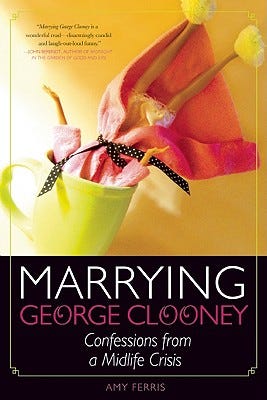
Marrying George Clooney: Confessions from a Midlife Crisis by Amy Ferris
I was first introduced to Amy Ferris via social media, where she is brash, openhearted, more-than-occasionally foul-mouthed, and soothing. She’s the kind of person who makes you feel both seen and slightly underdressed for your own life. I hoped for more of the same from Marrying George Clooney. I was not disappointed.
From the first page, Ferris hits you with big-font certainty. (Possibly the largest font outside of airport signage.) “I am hopeful.” And she is hopeful in the way you can only be in midlife at 3 a.m. Because this is a 3 a.m. book. A book written in the witching hours of perimenopause, when insomnia and anxiety shrilly tag-team you into wakefulness, and you find yourself thinking about your body, your parents, every embarrassing moment of your life, the sudden unignorable awareness that George Clooney is married with children, and also that your metabolism has left you for someone younger.
Ferris reminds us, with furious humor, that hope has sharp teeth and has bitten more than a few people who really should have known better, but who still keep sticking their fingers in anyway. Hope that carries the pressure of memory and the hunger of unfinished business. Midlife hope.
Ferris embodies the credo that You own everything that happens to you and writes accordingly. This is both empowering and terrifying, depending on your life from age 8-108. Ferris writes without filters and with sarcasm-as-survival-mechanism. You may bristle at that, but humans have a knack for dressing their wounds with sarcasm: a sort of glittery topcoat over layers of disappointment and hurt. Ferris points this out, and it somehow draws us closer, which is remarkable because sarcasm often is a way to signal “for the love of God, back off enough for me to recover.”
The book started, she says, as a funny, weird, sad menopausal diary. Then it braided itself with her mother’s descent into dementia. “THIS WAS NOT PLANNED,” she writes. This collision produces a final section of such tenderness that the only sensible response is to reread it so as to remind yourself that language and people can hold this much ache and still be lovely.
There’s a girlfriend-intimacy to her voice. She writes as if to one Dear Reader, and for the span of these pages, you get to believe you’re the one. She lets you in on her weirdest, wildest 3 a.m. thoughts.
Midlife is like losing your keys in your own handbag. Ferris is that girlfriend who reminds you your glasses are already on your head. She’ll insist that you put them on before you dig deeper, because the keys are definitely in there. Somewhere. Or possibly in another dimension.
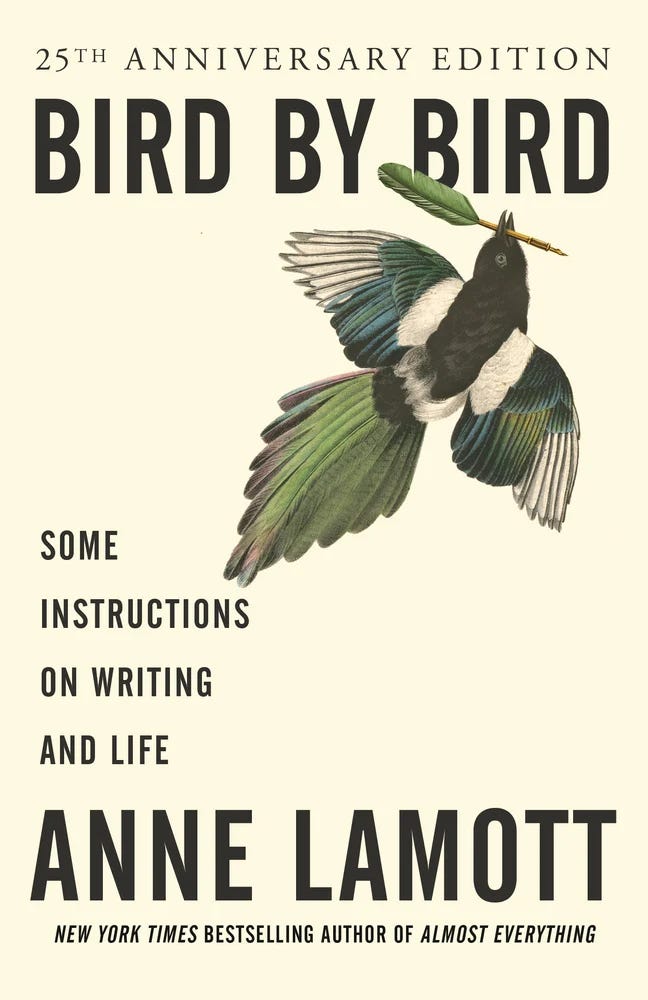
Anne Lamott begins Bird by Bird with a memory from second grade: her poem published in the school magazine. “I understood immediately the thrill of seeing oneself in print. It provides some sort of primal verification: you are in print; therefore you exist.” This is everything you need to know about writers: we don’t believe we exist until we appear in print. Is this the artistic mindset? Is it neurosis? Who’s to say?
Probably Lamott, actually, and I think she’d lean more towards “this is how writers are.”
Bird by Bird is a must-have (or at least a must-have-heard-of) for most writers, and with good reason. Writers love rules and systems. We want formulas for success the way other people want life hacks for cleaning a cast iron skillet (and just as debatable online). Anne Lamott, to her credit, refuses to give them any. This is also why writers like her. We are a capricious bunch.
Writing is, as everyone knows, a profoundly humiliating and humbling activity, which Lamott affirms with delicious humor. Then she convinces you that it is somehow still worth it.
The famous “shitty first drafts” chapter has become canon for writers. Everyone quotes it, mostly because it’s true and also because it allows them to say “shitty” in a professional context. Lamott captures the voices in your head (the vinegar-lipped critic, a German dude, your parents, William Burroughs for some reason, and a chorus of judgmental dogs) and says: yes, those voices are there, and yes, you still have to write anyway. You will make a mess, and then you will make another mess, and out of this mess, a book might crawl onto the shore.
Perfectionism, she points out in another section, is an additional problem we writers have. Writers cling to perfectionism as if one day someone will congratulate them for never finishing anything.
Lamott reminds us that characters are desire, contradiction, and ways people bump awkwardly into each other in the world. Good characters want things you’d rather they didn’t. They disobey. Sometimes they have a distressing tendency to walk off with the plot while you aren’t looking. Follow them.
Lamott insists that writing is about giving. Day by day, you have to give the work in front of you your very best, not hoard scraps for some future masterpiece. “It is only when I go ahead and decide to shoot my literary, creative wad that I get any sense of full presence,” she writes.
And then she doubles down: “You are going to have to give and give and give, or there’s no reason for you to be writing. You have to give from the deepest part of yourself, and you are going to have to go on giving, and the giving is going to have to be its own reward. There’s no cosmic importance to your getting something published, but there is in learning to be a giver.”
Lamott has been down the dark, boggy writing path and lights a torch for the rest of us. She is precisely the sort of person you want tending to your writer’s heart.
Many of us of a certain age learned Greek mythology in middle school, where it was presented to us thusly:
Behold these photos of statues and partial buildings in Greece.
Memorize fifty names, none of which sound remotely different after the third cup of cafeteria milk.
Realize that Cronus and Chronos are not typos but two different gods.
Take a test.
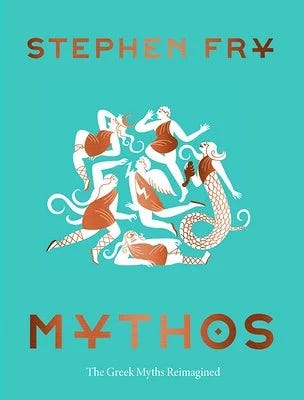
Stephen Fry looked at that steaming pile of joylessness and said, “Nah, let’s turn this into a glorious, messy bitchfest.” And he did.
Mythos is a retelling of the Greek myths stripped of marble solemnity. Fry himself pointedly reminds us these stories are not academic footnotes. Or, as he puts it: “there is absolutely nothing academic or intellectual about Greek mythology; it is addictive, entertaining, approachable and astonishingly human.”
It’s not baseless, though. Fry respects the source material as he roasts it. The man cannot resist a wink and some wordplay.
The gods here are not noble archetypes. They are jealous, petty, vengeful, capricious, warlike, creative, tender, and brutal. They also devour each other. Fry captures that energy and chaos, and the result is both illuminating and astonishingly funny. For example, when Gaia visited her daughter Mnemosyne, Fry tells us she was “busy being unpronounceable.” Later, Gaia gets wise counsel and, “as we all do, whether mortal or immortal—ignored it.” This is the sort of wisdom we can all relate to, because ignoring perfectly sensible advice is one of humanity’s core competencies.
The style is convivial, as if Fry were sharing stories while slightly tipsy at a campfire. Every so often, he pauses to offer an etymology lesson. This is the real work of myths: the breadcrumb trails from Olympus into our everyday speech, the stories we tell about storms and seasons, and the patterns of human interactions.
However, Mythos does not do a deep dive into the contemporary references and anchors mythology has, but this may pique interest enough for you to (oh, please pardon me) do your own research.
The book is broken into short, digestible chapters, like mythological tapas. I don’t think you are meant to binge Mythos in one sitting. Much like the gods themselves, who could never resist a late-night nibble of livestock, nymphs, or one of their own children.
One of the most delightful surprises was the story of Melissa. Yes, Melissa. I was sure Fry was joking, but no: actual nymph, excellent story.
If the last time you cracked open Greek myths was in middle school, Mythos is the perfect reintroduction with equal parts affection and irreverence.
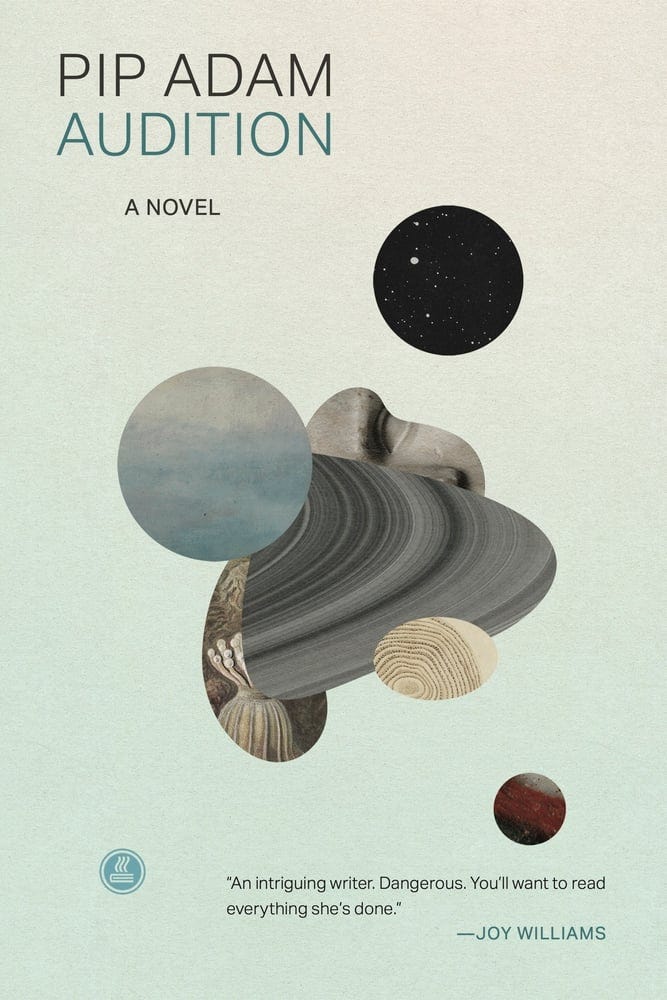
Reading Audition felt like waiting for the curtain to rise on a play that your friend who thrives on the strange is staging in a black box. The lights flicker. Something begins. You think this was a mistake and you start plotting how to escape without the actors noticing because you’re sitting six inches from the stage.
Then you realize you’ve bought a ticket to brilliance.
Audition’s opening section is nearly impenetrable due to fragments of conversation, interruptions, and absurdist overlaps. The only way I found to enter it was to read it as if it were experimental theater or one of those deeply strange animated shorts that air at 3 a.m., the ones that make you wonder who got high and greenlit it. Nonsense, until you let it in. Once I leaned into that frame, the text unfolded like mischievous origami.
The premise: Alba, Stanley, and Drew are three giants with wonky memories confined to a spaceship. They must keep talking or their bodies will expand, pushing against the ship until it breaks. Every word is a sandbag holding back catastrophe. And what do they talk about? Memory, incarceration, identity, the false promises of rehabilitation. These conversations are parceled out and loop back on each other, and the effect is unnerving but masterful. Adam lets information leak in portions just enough to sustain us.
Formally, it’s stunning. What begins as Beckett-like dialogue (people talking about nothing until it turns out to be everything) morphs into fractured recollection, and then just when you’re about to abandon ship, you get clarity. The result is a bit destabilizing. One moment you’re in a spaceship, the next you’re in the remembered history of “before Audition.” The boundary between the two blurs. Eventually, you begin to suspect all the settings are variations of the same place anyway.
Audition is abolitionist, queer, and political down to the marrow. It posits that we are made of memory, and also have holes where systems have taken from us. The giants have been shaped by violence and survival and systems, and Adam refuses to render them neatly.
This is not an easy book. It is experimental to the point that it, too, is pushing against walls until they almost break. Audition shows how speculative fiction can hold abolition and justice at its core. Think The Waves in space, or as one reviewer put it, “brilliantly weird, weirdly brilliant.”
I wanted it to explain itself and behave, but the disorientation is part of the experience. Possibly the point. Audition is theater and testimony and thought experiment. Read it when you’re ready to let a book dismantle you and your certainty.
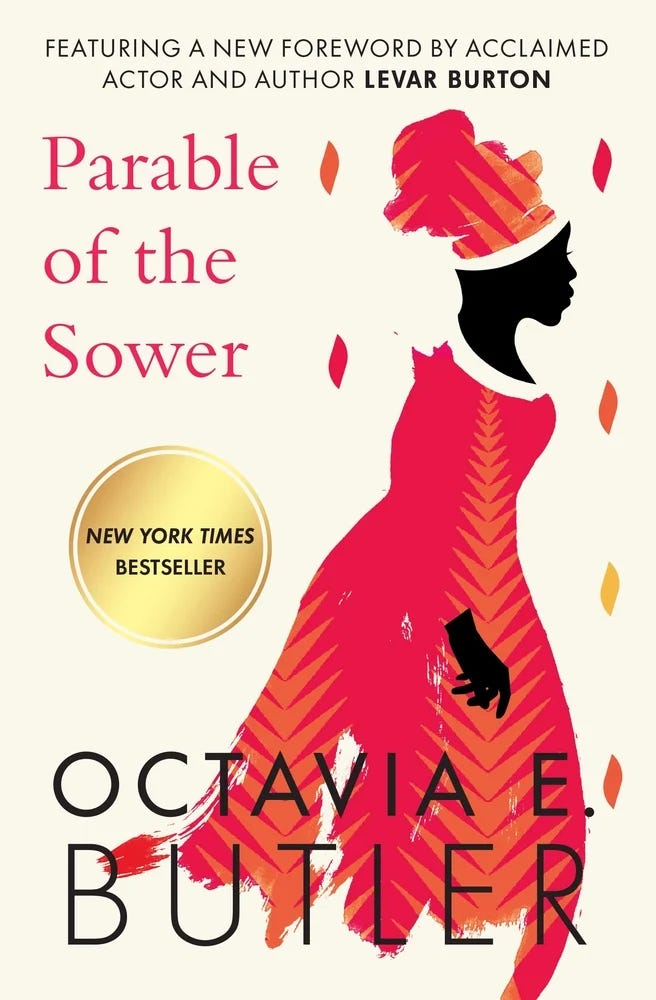
HOW HAVE I NOT READ OCTAVIA BUTLER BEFORE?!! This woman wrote Parable of the Sower in 1993, set it in the 2020s, and basically nailed our current situation. Climate collapse? Check. Wildfires, water rationing, roving gangs? Check. Corporations swallowing up desperate workers into indentured servitude? Check.
It feels like it’s remembering the future before we live it.
Our protagonist, Lauren Olamina, is a teenager during societal collapse (as if being a teenager weren’t enough.) Her neighborhood is walled off in a sort of DIY feudalism project while the outside world devours itself. Lauren suffers from hyperempathy, feeling the pain of others, which is not the sort of thing you’d request in a collapsing society. Hyperempathy makes her porous in a world that rewards hardness. This sounds unbearable, but instead of crumbling under it, she builds a new belief system: Earthseed. Central idea: God is Change. As her world collapses, she walks north, gathering people, planting seeds of this visionary and terrifyingly practical philosophy.
Butler has to convey an entire civilization’s worth of collapse (politics, poverty, violence, religion, drugs, arson, and more arson) and does it without a single moment of expository sludge. The information just unfolds. The world is on fire, but the prose is icily precise. She withholds just enough: a neighborhood that feels safe until suddenly it isn’t, a family plan that collapses in a single night. The restraint makes every disaster land harder.
Earthseed verses throughout the book sound like scripture mixed with human software patches. “All that you touch You Change. All that you Change Changes you. The only lasting truth is Change. God is Change.”
Is Parable of the Sower brutal? Oh yes. Neighbors are slaughtered, and kindness is often punished. But it’s also hopeful. Lauren is pragmatic, visionary, and keeps moving. It’s not a dystopia for spectacle or misery porn, but it does feel uncomfortably close to a guide for dark times.
Harrowing and brilliant.
Tied for my favorite read this month.
And there be the August reads. As always, I welcome any recommendations! What’s in your TBR pile?
“You must be fun at parties” is usually shorthand for “you seem like someone who would scold a balloon, and I don’t enjoy you.” For me, it’s an oddly specific field note.
It’s been seven hours and fifteen decades since I last socialized with any regularity.
I once was, if not the life of the party, the CPR dummy of it: dragged out, asked if I’m okay, inflated briefly, then shoved back in a suitcase until needed again.
Socializing is a muscle, and mine is atrophied because I’ve been on the couch since 2010. Still, I now RSVP to invites aspirationally. I picture Q-and-As sparkling, snacks excellent, and my hair behaving.
In reality, I’m the guest eating chips and dip in a coat closet.
Walk through an event with me. Or near me. Or, better yet, around me:
I prep, of course.
Step one: test-drive some jokes. I am a dancing bear. Dancing bears must dance.
Step two: polish up an elevator pitch about my latest project, which could be the Not-Great American Novel, a nervous breakdown, or cupcakes.
Step three: get dressed (multiple times). Telling me the dress code is casual isn’t helping. Neither is tacking on a word to it. Business casual? You might as well say formal casual, tractor casual, or funeral casual. I choose an outfit fit for the launch of a 1974 space capsule.
My husband is thoroughly briefed: if my grin goes stiff or I start scanning for trap doors, swoop in. When we arrive at the event, he beelines toward a group earnestly debating the finer points of mulch. I, on the other hand, walk into a coat rack while I scan for friendly faces.
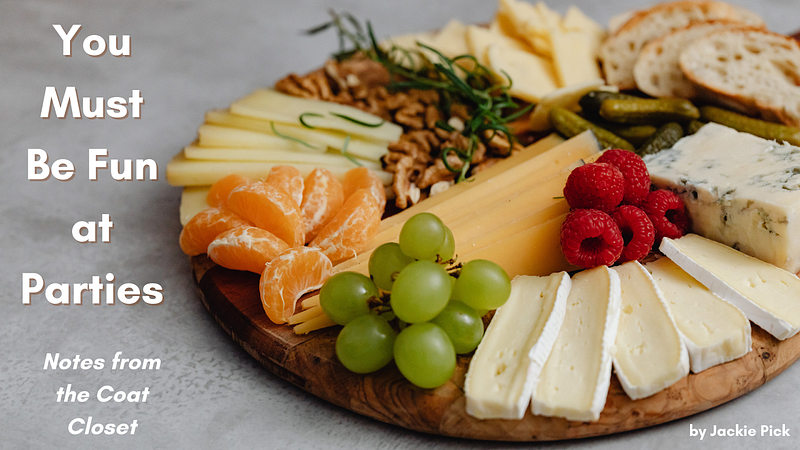
There are fifteen people gathered in polite clusters. Ten hold drinks. Four are deep in conversation. One considers the cheese platter.
Conversation zigzags like it has somewhere to be and no idea how to get there. Everyone is nodding, so I nod too. I can’t be the only weirdo not co-signing. Yes, the municipal composting program is complicated. Yes, Pilates is the only thing keeping Marcy sane. Yes, there’s an alarming shortage of teaspoons. I may have agreed to join a militia. I’m uncertain because I am now also considering the cheese platter, mesmerized by a sexy Kaukauna.
It is during these fun, funny, and utterly disjointed conversations the true language of the night is spoken: couples’ signals. A raised eyebrow means rescue me. A discreet wrist tap is don’t tell that story. A quick mime of wiping teeth translates to spinach. A pointed look says oh no, Backsplash Guy is here. It’s a whole conversation under the conversation. I love it.
Then it happens. No one talks for seven full seconds.
BEHOLD! I am the Once and Future Resuscitation Jackie! I’VE GOT THIS!
I mine for stories, giggle at punchlines, toss out “interesting, tell me more” like so many Mardi Gras beads. Folks oblige and share things about how they feel about their HOA (a cabal!), Trader Joe’s (went for the Steamed Pork & Ginger Soup Dumplings, almost got killed in the parking lot!), and one neighbor who lost a finger to a salad spinner (Legend!). It’s great.
If I ask too many questions, I’ll be less talk show and moreLaw and Order: Social Victims Unit. No one wants to feel like they’re about to be cuffed and read their rights in front of the canapés. So, I watch for any quick eyerolls that say, Help, I’m trapped with this sentient game of 20 Questions wearing a zip-front A-line number.
Meanwhile, my thrives-at-parties husband floats by like a genial sea creature to refresh his drink. I blink in Morse code that I’m running out of questions about bird bath maintenance. I think he’s going to tap in! He does not.
So I persist, though out of steam.
Midway through a discussion about vacation rentals, my strapless bra, believing it was meant for greater things, heads south with dreams of becoming a belt. I do what anyone would do: try to harness it by squeezing my arms to my side, smile like nothing’s wrong, finish my drink, and plot my escape.
Bra somewhere around my thighs, I waddle into the coat closet for an adjustment and some crackers and dip I’ve strategically placed in my pockets for just such an emergency.
Socializing remains an extreme sport for which I am wildly unfit. Will I do it again? Absolutely. Bring on the Kaukauna.


 Jackie Pick