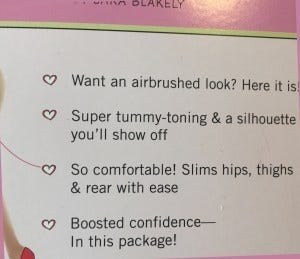
Oof. The things I’m seeing about Mother’s Day. The things I see every year. Every day.
We try to turn motherhood into sainthood. Or vice versa.
Bear with me because I don’t know a lot about sainthood, and I don’t have an exhaustive understanding of motherhood, but “exhaustion” and “motherhood” are two words that, if I am ever turned into a school worksheet, will be included in the word bank.
Candles are involved in both sainthood and motherhood, especially this time of year. Big Candle may be trying to sell us on something a little rank.
Don’t get me started on Big Bubble Bath, Big Pedicure, Big Buffet, and Big Five-Minute Power Nap.
(For the record, I love most of those. Try to tear me away from a good buffet and I will ruin your hairdo.)
They want to offer us something utterly restorative in the time it takes to pumice off whatever barnacles have grown on our feet as we walk, run, crouch, wipe, shuttle, rescue, worry (oh, the worry!), and attend in every meaning of the word. A little something instead of space to sit with how wonderful and how hard it is. We get to trail our fingertips in “wonderful” and are told that the “I’m exhausted and doing my best” commentary is something private, something publicly unutterable unless you’re willing to, in the same breath, bring it back to the tonic chord: “But I love my kids.” Amen.
Our expressions of depletion via devotion don’t mean we don’t love our kids.
Quite the opposite. Because why else would we do it?
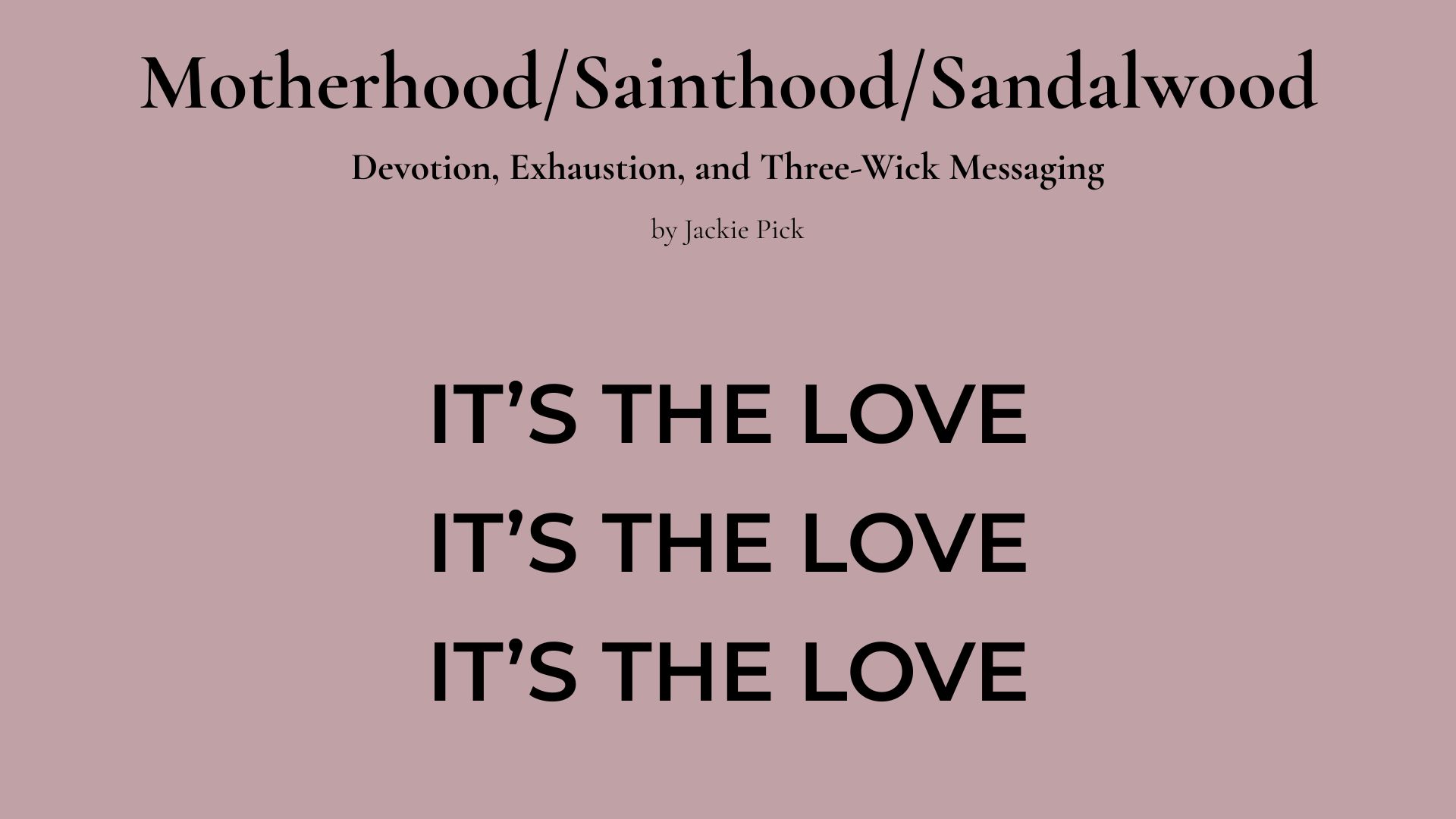
It’s the love.
It’s the love.
It’s the love.
This love, though? It’s superhuman, and we’re only human, so we try to breathe a little without inhaling the three-wick Cashmere Woods messaging that we’re adequate as long as we’re perfect.
It’s ok to have all sorts of words in your word bank.
Your kids are lucky to have you. We’re lucky to have you raising your kids.
This is the piece that began my writing life. It started as a Facebook Note, written in the wee hours during the first week of my daughter’s life.
I submitted the piece to Scary Mommy (polished version here). Some readers shellacked me online because, when it first ran, I wrote “Dr. Who” instead of “Doctor Who” and, mortifyingly, “pass times” instead of “pastimes.”
Totally fair, I was wrong. Fortunately, the editors jumped in and fixed it. I love editors.
I also gave (and give) myself grace. I was caring for a newborn and twin toddlers, recovering from a C-section, writing random thoughts while running on approximately four minutes of sleep. Besides, making dumb mistakes is my brand. May I make smarter ones someday.
The piece below is the original Facebook Note (with the two errors above corrected). Some lines I’d rework or remove completely now, but it’s a good snapshot of that moment.
The baby in question is now in middle school. She’s remarkable, as are her brothers. I won’t say the worry was for nothing. Honestly, a lot of my worry is well-placed — or at least well-aimed. (See: the world.)
Notes To My Daughter
I worry. I worry about the low expectations, the frilly expectations, the just-so-far-and-that’s-fine expectations for you.
“Smile!” will be begged of you by strangers on the street and friends alike. I give you permission to scowl, growl, reflect, cry, muse, sing, smile, wince all you want. It’s your face showing your heart. You do not owe the world a phony grin because we only want our girls to be happy.
Learning you were a girl brought on sighs of shopping for pink frills by well-wishers. I was assured of being thrilled. You were, according to some, a balance for your brothers. According to others, “girls rule, boys drool.” I cringe, as you might if you have sons someday…or daughters.
I hope you mix your Hermione Granger with some Judy Blume and a whole lot of Kurt Vonnegut. I hope you watch Doctor Who and Star Wars and Murphy Brown. Please cast a wary eye at the Kardashians and Twilight books and Real Housewives of Where Ever.
Women are funny. You can be more than the nurse, the wife, the exotic dancer in your scenes, if you want. You can even be more than that mythical “Brilliant Hooker.” Be the surgeon, be the husband, be the strip club owner, be the President.
You can be the ingénue, you can be the side kick, you can be Tree Number Seven.
There’s a lot to be said for being an alto. There’s a lot to be said for a cappella. Don’t be afraid of a solo.
I hope you learn to spike, field, kick, bat, dribble, run, if you want.
Pink isn’t bad, but pink isn’t all. Pink softens and dazzles. Pink is fine. Sequins are usually not.
Shout Holy Yeses as much as you can. The scary things teach and (if you’re lucky) inspire awe.
Don’t be afraid not to be liked. Be afraid of those who excuse rudeness.
Jump. Jump high.
From the moment you were born, the usual comments have been about your looks. Yes, you are beautiful, especially to your mama and daddy. Aspire to receive feedback about talents you honed, earned, and sweated for. Be dazzling. Be brilliant. Work hard. It’s not enough for you to be pretty. May being pretty matter less and less as life presents you with more interesting pastimes. Strive for brilliance, curiosity, devotion, passion, truth, humor, skill. There will still be room for pretty. The beautiful package (and it is beautiful) will be that much more precious if it’s filled with many unique gifts.
Have energy. Know when to stop.
Math isn’t hard. Math takes time for some people. Invest that time. It’s ok that there are right and wrong answers in math. There are right and wrong answers in the world sometimes.
Learn languages. Learn public transit. Learn to say no, thank you.
Be careful about using the word “bitch,” and please avoid the c-word. Other women are not your default enemy.
Learning to be concise is a gift to you and others. Listening is a greater gift.
The word “cute” really stops being a compliment after a certain age.
Worry about your health and feeling good. Indulge sometimes.
Savor.
Laugh.
Apologize.
Forgive.
Raise an eyebrow or two.
Stay my baby for a little longer and know that I would keep you wrapped up in my arms forever if I thought that would make you a better person…it wouldn’t, but it would sure feel good.
Whoever you turn out to be, whatever advice you do or don’t take…
I’ve been rotating through four classic responses to stress: fight, flight, freeze, and Fran. By which I mean Lebowitz. By which I mean I observe the mess, describe the mess, and get a laugh.
I might even drop a “We should circle back.” I absolutely do not circle back. Who has time for that?
If you’ve spent any time with me or my writing, you know I live in a town that likes noise. I do not like noise and I work from home. Local skeet/trap shooting finally stopped after its annual allotted 215-ish hours, and within a day the neighborhood leaf blowers began.
The clean baton pass from one form of mechanical noise to another is impressive.
I register it. I sit still and hope it ends. This is “freeze.” For variety, sometimes I Fran about it.
Meanwhile.
During an unscheduled visit to an upper cabinet, I rediscovered a Rubbermaid 20 Deviled Egg Keeper Storage Container (with lid!). I assume my husband brought it to the marriage, because this is not my spiritual tradition. This container implies we not only make an unholy number of deviled eggs, but also transport them elsewhere like some kind of appetizer diplomacy corps.
Every time we stumble on it, we say, “Oh, I loved deviled eggs!” like we caught them on tour in the early 00’s. We consider using it or donating it. Then we return the container to the upper cabinet because we do not host or attend high-volume eggy gatherings and don’t want to think about it.
Flight.
Bigger Life Problems are less funny, don’t budge for most of those strategies, and deal with the increasingly delicate question of where one safely places one’s actual self in a world that seems to reward anything else. (Even typing that, I assume I’ve annoyed someone. Hello! Welcome to my page!)
You cannot freeze your way into trust. You cannot flee your way into community. Even if you stretch beforehand, you cannot Fran your way into repair.
We sure love forgiveness because it lets everyone move on; repair asks you to be accountable. And while devastating commentary is deeply satisfying (TRUST ME), at some point, if anything is going to be rebuilt, somebody has to stay in the room and do the work.
Which is what this month’s books address – what it actually takes to stay and deal with things.
In The Fran Lebowitz Reader, the move is clear: identify the things and make good suggestions for more motivated folks to do something. In So Far Gone, repair is slow, uncomfortable, full of uncomfortable accountability. The Beginning Comes After the End argues that (re)building is the whole plot (and history proves that the necessary work must continue). And The Book You Need to Read to Write the Book You Want to Write dispenses with metaphor entirely and says sit down and get to it.
Now, fight sounds dramatic, but in practice a great deal of it is showing up and working with the broken thing long enough for it to improve.
Unless it’s a deviled egg container. I’m not dealing with that.
Which is all just to say, here are the books I enjoyed enough to finish this month:
So Far Gone by Jess Walter
The Fran Lebowitz Reader by Fran Lebowitz
The Book You Need to Read to Write the Book You Want to Write by Sarah Burton and Jem Poster
The Beginning Comes After the End by Rebecca Solnit
Note: For sanity and scale (mine, yours, and the internet’s), what follows are the openings of each review. Full versions are linked below.
Jess Walter’s So Far Gone may win the award for the most forgettable title attached to a most unforgettable reading experiences. It’s frustrating because I now have to enthusiastically recommend a book whose title I cannot remember five seconds after I say it. I feel like I’m pitching a movie called That Thing With the People and the Stuff. “You’ll love it!” “What’s it called?” “I DON’T KNOW, BUT IT’S GREAT!”
The book is, among other things, a road trip. Every stop produces the unnerving realization that you have, in some essential way, already been there, emotionally, culturally, existentially, possibly geographically. Each location is a diagnostic tool. Ah. Yes. This particular human mess/cultural sinkhole. Been there, done that, got a koozie.
I had to read The Fran Lebowitz Reader in careful, controlled doses. You can’t really binge Fran Lebowitz. At least I can’t. It’s literary espresso. Lebowitz comes across as someone who remembers that things were supposed to be better and finds the current situation inadequate. And then she lets you know exactly why in as few words as possible.
Lebowitz has an unmistakable voice with an unmistakable cadence. Sentence to sentence, essay to essay, she sounds exactly like herself, which is both the pleasure and the reason you can’t binge this book the way you might a more contemporary essay collection. Also unlike many more contemporary essay collections, there’s no narrative arc or tidy throughline. Essays are loosely grouped under headings like “Manners” or “Science” or “People.”
Which, if I may be so presumptuous, feels very Lebowitz.
I read a lot of craft books. Most, at some point, begin to feel like they are passing around the same handful of writerly chestnuts, all flapping about “structure!” and “voice!” before settling down to discuss three-act arcs. So I approached with cautious optimism but expecting very little.
This one is genuinely terrific, and, for newer writers, probably indispensable.
The Beginning Comes After the End by Rebecca Solnit packs a lot into a small volume. This collection of dispatches reads more like someone trying (calmly, patiently) to answer a question a lot of us are circling right now: how do you keep going when you can’t tell if anything you’re doing is working?
That’s the feeling, yes? That things are…a lot? Maybe too much? That the future feels like it’s unfolding out of control. Solnit doesn’t pretend otherwise as she moves through all of it: the pandemic, climate change, political upheaval, the ongoing fights around feminism, racial justice, Indigenous rights, and who gets to belong and be heard. Nor does she pretend it’s easily manageable. She just keeps pointing us outward and backward – look at where we’ve been, look at where we are, look at what actual people have done, over time, to move things, even when it didn’t look like anything was moving! Look! And breathe!