History is fading, the sea is rising, and a turtle is unimpressed.

Some months, the books are books. Story. Characters. Distinct pleasures.
And then there are months where books refuse to stay in their lanes. They start talking to each other, or maybe through each other. Suddenly the tidy book stack turns into a narrative séance. Ghosts, toddlers, bureaucrats, broken systems, family myths, fractured timelines, fractured time.
Oh, I had questions. What does memory preserve, and what does it redact at convenience? Are stories fixed or quantum? Can language hold sacred when everything else falls apart?
MAYBE.
These five books lurch, loop, and rebuild themselves mid-stride. A girl travels across water and time. A man folds a stranger’s laundry. A mother dies, a child is inherited. Many of these books refuse the ease of a beginning, middle, and end. Some worry about the end of the world. Others worry about surviving the day. Most do both. It all means something or quite emphatically does not.
Memory shows up as both myth and mortar. While ghosts linger and names slip, fragile truth cracks. Growing up and growing old involve figuring out what we owe each other now and in the future (and in some cases, the past). The answers are words shared or withheld and often wrapped in grief.
As shown in these five books, those words, expressed or not, recommend a deep belief in storytelling as lifeboat and anchor. When systems fail and the world turns sideways, people build stories from scraps. That’s how humans get on with this whole business. It may be the only way.
Violence still hums underneath, of course. We’re human after all.
Every story here is about surviving damage.
That can be draining. Worth it? Yes. Still, I’m hoping to gift myself some lighter April reads. But who knows? Haphazard book-choosing is haphazard, as absolutely no one says.
Also, somehow, I read two climate apocalypse novels this month. One would’ve been sufficient. Two feels pointed.
Aaaand, one book does indeed have a talking turtle. The turtle has opinions. Heed the turtle.
Which is all just to say these are the books that I enjoyed enough to finish in the last month.
Thrust by Lidia Yuknavitch
The Joy Luck Club by Amy Tan
Going Home by Tom Lamont
Old Filth by Jane Gardam
Berlin Atomized by Julia Kornberg
Let’s begin.
Thrust by Lidia Yuknavitch
Beautiful, brutal, and shouldn’t make sense, but does
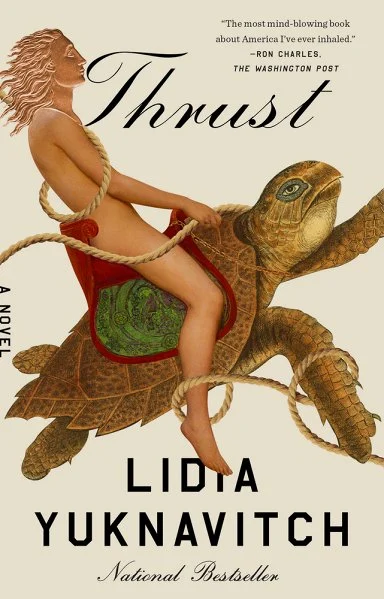
If you pick up a novel hoping for relaxation or comfort, you might want to reconsider Thrust by Lidia Yuknavitch. This is not comfort reading. It’s barely even comfortable reading.
HOWEVER, Thrust is a tsunami wrapped in poetry. Beautiful, brutal, and shouldn’t make sense, but does. Yuknavitch does not shy away from complexity or discomfort, and here she plunges us headlong into narrative that defies ease. It’s a story full of place and people dissolving and somehow still fighting to create something that feels like home and family.
I began Thrust without realizing it was set in a future defined by climate catastrophe. It took a bit of time to get my bearings with the structure of the book and the fantastical elements, but somewhere around page 48, I stopped trying to grip the story and let it carry me. I did not so much sink into this book as hover over it, skeptical and fascinated and ultimately won over.
The story centers on Laisvė, a young girl gifted/burdened with the ability to glide across water and time. She slips between timelines from the Statue of Liberty’s assembly on America’s shore to an America drowning beneath rising seas and its own humanity. Society, it turns out, was always built on shaky ground, half-broken and desperate. Animals speak with her, and unsurprisingly, they have more sensible things to say about humanity than humans do. (Largely that humans may not have ever had our acts together.)
Structurally, the novel loops and swirls through time, memory, and identity with a complexity reminiscent of Cloud Atlas. Just…wetter.
Yuknavitch writes about characters who are lost in one way or another. Those who exist in the kinds of spaces society has reserved for those it cannot properly categorize or who it can categorize a little too glibly. She reminds us that identity, names, and history are slippery things. “I think humans are comforted by names isn’t that right?” a whale asks young Laisvė. “I think names and naming do matter a lot,” she replies. “Also, I think names can slip their meanings.” Profound, although not necessarily cheerful in or out of context.
It’s almost unfair how good Yuknavitch’s prose is. Lines such as, “She slept in pieces,” or “David let out the heaviest breath I’d ever heard, as if he were releasing a long, thick, coiled rope” hit in that way that can make a reader take a deep, respectful breath.
In the end, Thrust isn’t a snuggly read. It’s unsettling, powerful, and almost obnoxiously good. Yuknavitch writes like a time traveler with a flare gun.
“You will all die, too, is the thing. But you haven’t figured out how to make death-stories, and death-places, that have generative power.” And yet, Thrust is exactly that: a death-story, a life-story, and a hell of a ride.
The Joy Luck Club by Amy Tan
A Master Class in Writing the Unresolved
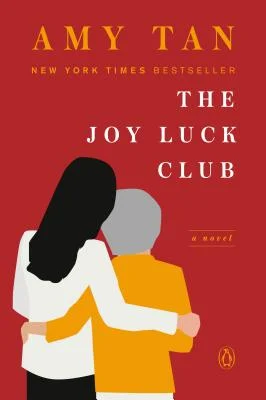
The Joy Luck Club is like being invited to someone else’s emotionally loaded family dinner. One minute you’re trying to stay out of the competition over the side dishes, the next you’re knee-deep in decades-old grudges, unspoken secrets, and love wrapped in miscommunication. Tan serves carefully balanced portions of humor and tragedy, and before you know it, you’ve ingested more insight about your own family than you ever intended to when you told your friend you’d love to go.
I think I’ve exhausted the food metaphors for now. We’ll see.
The novel centers on four Chinese immigrant mothers and their American-born daughters as they work through and/or avoid tangles of memory, identity, and cultural translation. Told through interwoven stories, The Joy Luck Club shows how silence travels through generations just as surely as genetic or cultural traits. The mothers carry unspoken griefs and brutal histories; the daughters try to decode them while managing their own anxieties about expectations.
Tan’s prose is graceful and wry, lulling you in then quietly wrecking you with an underlying throb of the unsaid. Generational connection doesn’t always come from words, it comes from tone, from gesture, from knowing which part of a story was left out. This takes the characters (and, you know, folks in real life) sometimes decades to unravel, if they do at all.
I’m embarrassingly late to reading this. Tan writes with empathy and precision, and there’s a warm familiarity to each character. It’s as though you’ve met them before. Or maybe like you are one of them, depending on the day.
Tan is particularly good at capturing the vibrations between people who love each other but don’t quite know how to show it. It reads beautifully like a sort of emotional translation error. These mothers and daughters are just as estranged by their own efforts to protect, preserve, or forget as they are by language or culture differences. Tan doesn’t tidy that up, thankfully.
What’s striking is how much the book holds at once: war, motherhood, survival, pride, superstition, and kitchen-table psychology. The silences are golden. Not for the characters, necessarily, but definitely for the reader. The silences are earned and enhance rather than frustrate the reading.
The Joy Luck Club is about the things we carry, even when we don’t realize we’re carrying them. It’s a book built on rituals of care and memory. There is also no small amount of the kind of maternal judgment that reads like poetry when you’re ready for it but ooof, does it hit.
You’ll find a lot to love here, especially complicated family dynamics and deeply emotional prose with a light touch.
A lot to love.
Going Home by Tom Lamont
Relationships: Some Assembly Required
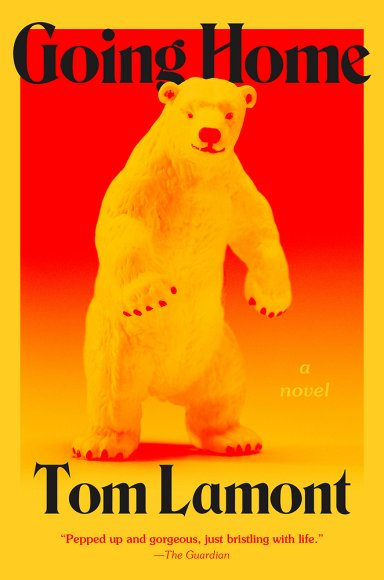
Tom Lamont’s Going Home opens so quietly you might think you’ve wandered into a long meditation on unrequited love and youthful navel-gazing. For a few early pages, I feared a descent into melodrama. But then the book begins a gentle and precise shift, and what emerges is something tender, funny, and clear-eyed: a lovely debut novel about surprise parenthood, fractured friendships, sandwich generations, and the quiet work of becoming someone others can count on.
The setup sounds like the first half of the first line of a joke — three men, a toddler, and a rabbi — but Lamont sidesteps trashy sitcom impulses. Téodor Erskine returns to his childhood town to care for Joel, the two-year-old son of his late friend (and unrequited love), Lia. Joel isn’t precocious, saccharine, or a plot device meant to teach a man how to feel. He simply exists, which makes him and the novel believable.
Téodor’s orbit includes three characters who, in lesser hands, would’ve been cardboard cutouts. His father is occasionally obstinate and struggles with aging. His friend Ben is impulsive and underbaked. And then there’s Sibyl, the newly arrived rabbi who faces particular challenges in her new community. She could have been reduced to the wise outsider trope, but Lamont gives her space and dignity, even if this is ultimately a story about men, and the emotional labor they’re rarely taught how to do.
Lamont writes male friendship without irony or overcorrection. There are no big ol’ bro-hugs or teary confessions under stadium lights. Just the quiet, complicated beauty of men trying, and sometimes failing, to show up.
The book shifts between perspectives, offering characters from the inside and the outside. This adds texture without feeling gimmicky. And while I didn’t tear through it, I didn’t want it to end either.
Most telling: I rooted for every single character. Even the ones who screwed up. Especially them. That’s rare. And while reading about parenting can be brutal (hello self-comparisons and quiet self-judgement!), Going Home reminds us that effort counts and that being trustworthy — or even just wanting to be — is a kind of grace.
Sure, a few threads tie up a little too neatly, but it’s a small quibble for something this warm, intelligent, and human.
Going Home is a gentle hand on the shoulder and a lovely read, but take note that there are moments of hardship and grief that are honestly portrayed.
Old Filth by Jane Gardam
Things dismantle properly and still fall apart.

When a friend (Hi Sadie!) recommends a book, one does not simply stroll to the library. One launches to the library like a caffeinated muppet, arms windmilling, breathlessly asking “DO YOU HAVE THE ONE WITH THE SAD BRITISH JUDGE.” And that is the story of how Jane Gardam’s Old Filth got into my grubby, windmilling, muppety hands. And then I sat with it. And reader, it sat back.
Old Filth reads not with a bang but with the heavy sigh of someone who’s seen too much war, too many port cities, too many fools, and at least one ghost of Empire. It is emotional shrapnel in a teacup and some witty conversation.
On the surface, it’s the story of a retired British barrister looking back on his life, but to leave it at that is like calling the ocean “damp.”
“Old Filth” stands for “Failed In London, Try Hong Kong.” A joke, sure, but also a code. Sir Edward Feathers is Old Filth. A widowed barrister and borderline representative of British restraint. But Gardam gives us the man: a Raj orphan shipped off to England, broken early, bandaged with decorum, built entirely out of Empire and repression. He is a lot. And a little. Mostly lonely.
The novel moves fluidly between past and present timelines. There’s class tension humming throughout, understated but sharp. At the end of his life, Feathers is a bookmark of another world.
Fear not, though, this story isn’t a slow-motion tragedy, thanks to British wit that slips in right when you think the whole scene might tip into something overwrought.
Feathers himself is a marvel of a character: infuriating, endearing, proper to the point of parody, and desperately alone. Through him, themes of closeness, intimacy, and patient survival ripple through the novel. There’s illness (Fevers! Bad bananas!) but it’s not a Victorian swoon-fest. It’s atmospheric dislocation and quite necessary.
Gardam’s prose is spare but piercing, and occasionally devastating. It’s not entirely a breezy read, but it’s generous. It reads like a Saturday afternoon on PBS, all history, dignity, a touch of mothballs and some sepia-toned scandal.
Maybe I’m too twitchy these days, what with *indicates the world with the muppet wildness engaged when first getting the book.* So I am a little restrained in my adoration, although unhesitant in my enjoyment. Maybe this book is an October book. Or an August-in-a-Hammock book. I’ll revisit it. And when I do, I’ll likely be the windmill-armed version of myself, full of adoration. This one will stand up to a second date, I am certain.
This is a grown-up, thoughtful, quietly brilliant novel, and it rewards a grown-up, thoughtful reader. This book doesn’t grab you by the eyeballs and scream “LOVE ME!” But it will move something in you that you didn’t know was still tender. It’s full of nuance and memory and wit so dry it could start a small fire.
Thanks, Sadie! Good call!
Berlin Atomized by Julia Kornberg
Heat and Static.
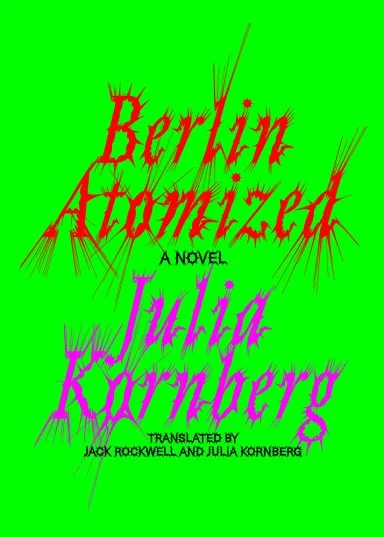
The word atomized, once largely in the realm of physics or dystopian sci-fi, now feels like the most honest way to describe moving through the world. Not exploded, just broken down into parts. Julia Kornberg’s Berlin Atomized embodies it. Families are scattered, identity is poofed away, and narrative floats about and is pieced back together if you can trap it at all.
Berlin Atomized follows Goldstein siblings Nina, Jeremías, and Mateo, children raised in the unnervingly pristine gated community of Nordelta outside Buenos Aires. The novel opens in a world already broken. The poor have been politely removed, the landscape reshaped, and the wealthy moved in to build something that metaphorically functions like a luxury scented candle “Only those who were invited were allowed to enter,” we’re told. It’s a perfect setting for dislocation.
The siblings scatter eventually and in their own ways. Nina rituals her way through bathtubs and language; Jeremías seeks refuge in music; Mateo turns toward fire. Each is lost, or lawless, or both. All seem allergic to stability. All feel uncomfortable in their own skin.
The novel itself feels hot and unsettled, even though the whole thing is framed from the future. In 2063, childhood friend Angélica Oshiro is trying to reconstruct their lives from notes and fragments. The whole premise renders the story slightly and deliciously unreliable as she attempts this archival experiment from the kind of scraps that usually end up in a recycling bin or memoir.
Kornberg’s sentences are strange, straightforward, and sometimes slippery. The world may be falling apart (and yes, it’s another climate disaster novel), but these characters still try to exercise control in the way they know how: by naming, remembering, forgetting, floating, burning and bathing.
And underneath it all lies the question of Jewish identity. Berlin Atomized doesn’t put Jewishness at the forefront, but it’s there. All of the siblings are tinged by something ancestral, something broken and half-remembered. In an interview with the Los Angeles Review of Books, Kornberg said, “There’s a messianic aspect to Judaism that I really appreciate; the idea that you have to work to make the future better is very appealing and real to me.” The novel wrestles with that drive. It’s a kind of generative eschatology — what happens after the world ends, when you still have to get up and figure out who you are.
This is not a warm novel. But it isn’t cold, either. It’s precise. It’s not trying to be overly charming. Instead, it is deeply suspicious of comfort.
Berlin Atomized is beautifully and strangely built and slightly haunted. It’s a novel about people trying to assemble themselves from the pieces left behind. If you’ve ever wondered what’s holding your fragments together, this one is a must-read.
It’s messy in the way that trying to survive a world that doesn’t know what to do with you is messy.
Read any good books lately?