Category Archives: Books

Spines, NyQuil, and Staring At the Ceiling

What I Read February 2026

For a few days in February, my God-installed, non-award-winning back and intercostal muscles decided to spasm up and shut down operations. I was horizontal against my will, which is the least fun way to be horizontal. I did not enjoy this real-world lesson in what intercostals are, but I did get to spend a not-insignificant amount of time staring at the ceiling like it’s a limited series.

Just as my spine stopped trying to yeet my head down the hallway like a bowling ball, I got sick. Just like the rest of the family, only they all got it before I did.

So now I have this painful, unproductive cough, which my back is like NO, DO NOT. (You may insert your own “your writing is also painful and unproductive…NO, DO NOT” joke here. First prize is one underwhelmed “Good One, Mild Heckler” from me. Don’t spend it all in one place.)

Because of all that, this intro section is clearly going to be a bit of a wild ride, plus or minus one Mr. Toad. Whatever. It’s fine. If the intro licks a doorknob, just pretend you didn’t see it.

ANYWAY. A couple fingers of NyQuil in, and after my fourth attempt to roll over without sounding like a two-pack-a-day rusty door hinge, I started thinking about whether there might be some clever thread tying together the books I read this month. At the same time I was bellyaching about my back — *insert celestial music*

This month’s reading stack is about spines. Spines let us move through the world without collapsing into a soupy mess.

Look, I’m sticking with this premise, even if I have to force it a bit (consider it artistic chiropractic).

A man tries to stand upright in a world determined not to see him. A woman wonders what remains when cultural and personal scaffolding falls away. In another story, women hold lineage like vertebrae across generations. And in a craft book, writers are reminded that stories need structural, thematic, and other spines, and are shown how to build them.

These books also address questions of dislocation, power structures, self-determination, appearance versus reality, and the social codes that buoy and bruise us.

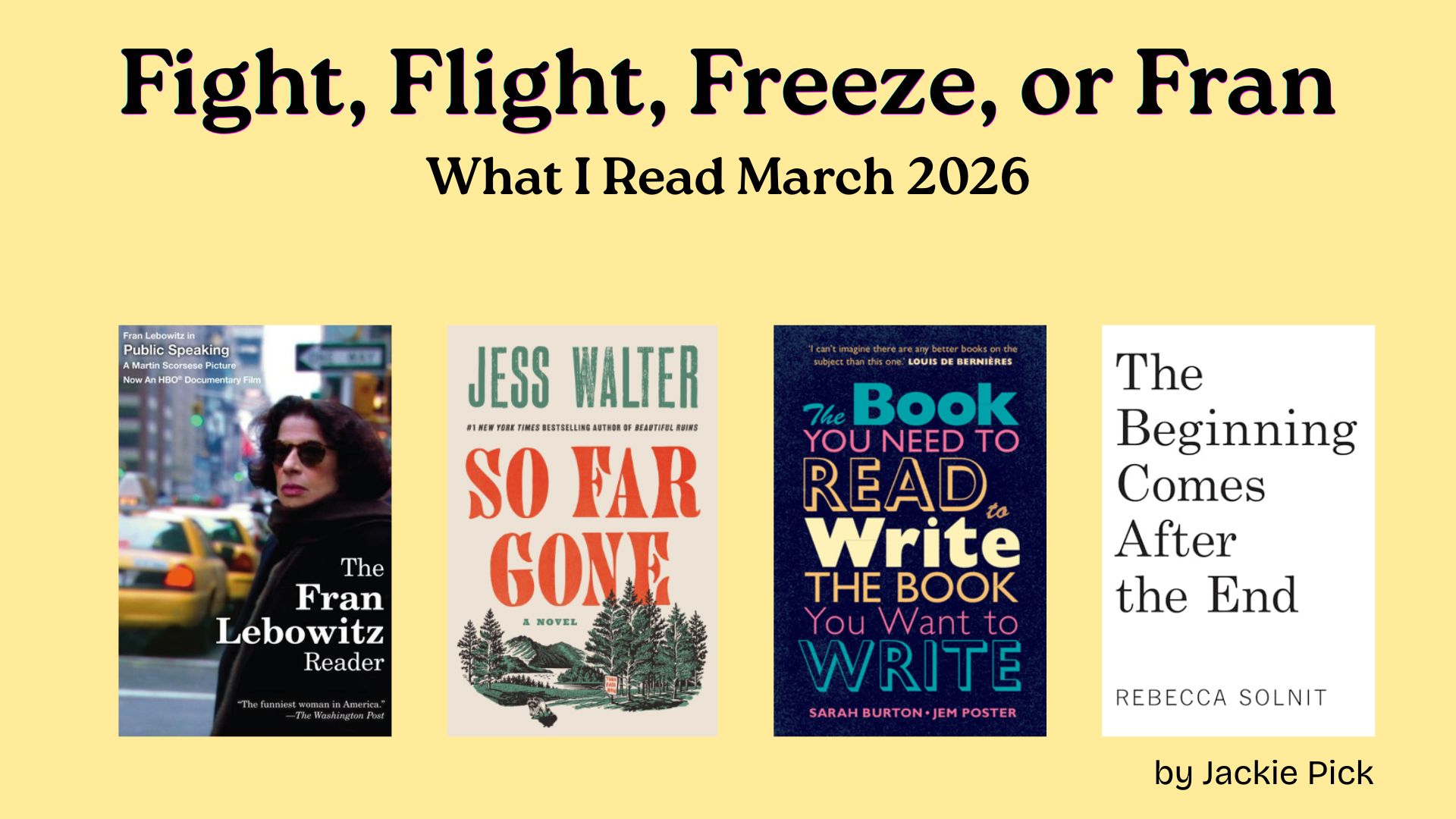
Which is all just to say, here are the books I enjoyed enough to finish this month:

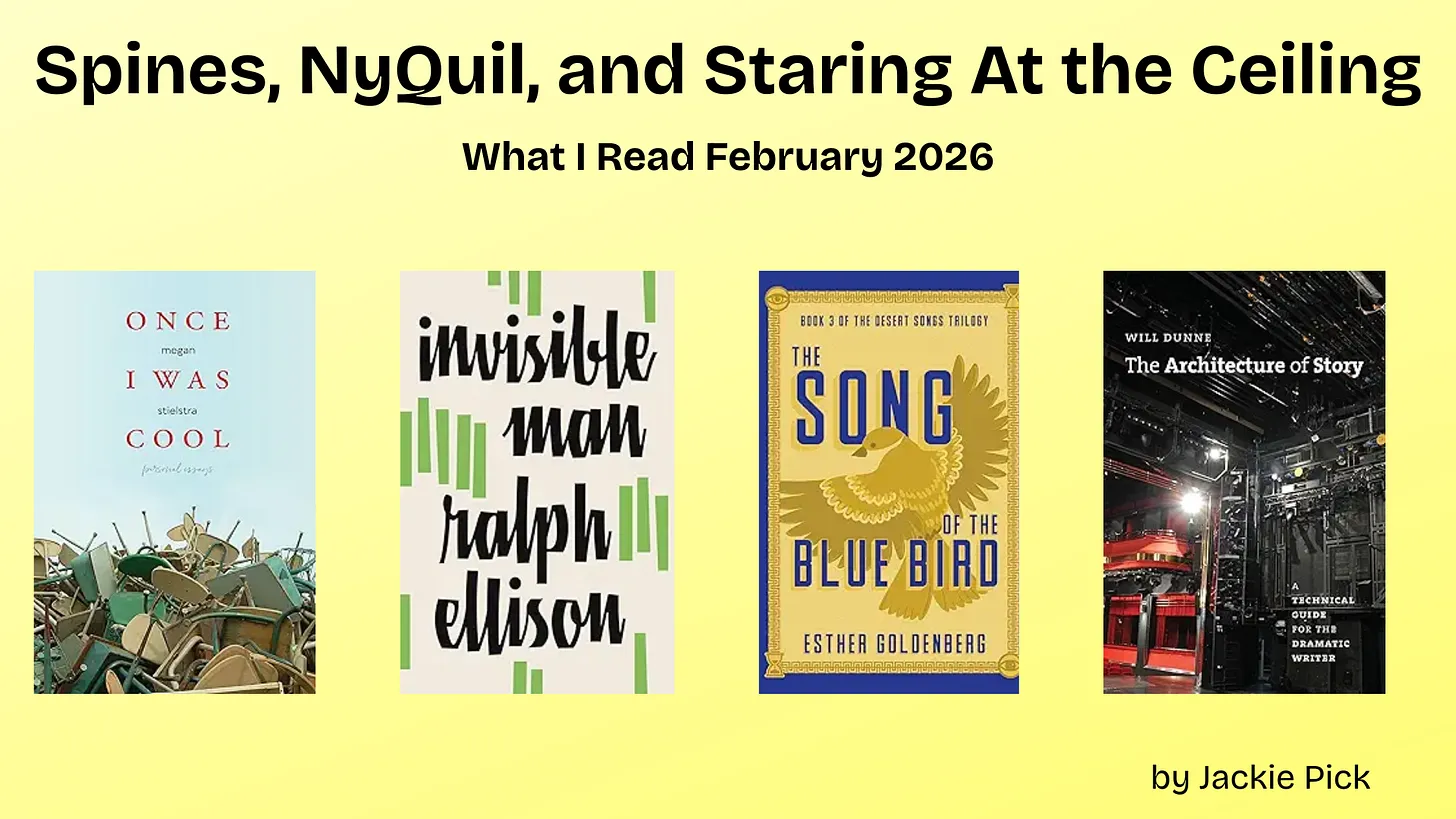
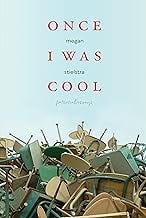
  • Once I Was Cool: Personal Essays by Megan Stielstra
  • Invisible Man by Ralph Ellison
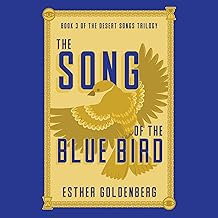
  • The Song of the Blue Bird by Esther Goldenberg
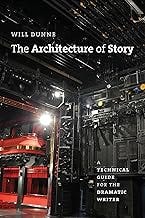
  • The Architecture of Story: A Technical Guide for the Dramatic Writer by Will Dunne

Note: For sanity and scale (mine, yours, and the internet’s), what follows are the openings of each review. Full versions are linked below.


Once I Was Cool: Personal Essays by Megan Stielstra

Once I Was Cool: Personal Essays

Cool is elusive and requires a certain indifference to what other people think. That’s extremely difficult to achieve for people like me who spend a certain amount of time thinking about what other people think. (Perils of the job.)

Which is to say: I am not cool. And, unlike Megan Stielstra, I may never have been.

Once I Was Cool lives in that gap between who we thought we were and who we are now…

(continued here)


Invisible Man by Ralph Ellison

Invisible Man (Edition 2) by Ellison, Ralph [Paperback(1995£©]

We tell ourselves stories about who we are. We tell ourselves that effort will be seen, that talent will be recognized, that identity is something we build and then present to the world.

Invisible Man by Ralph Ellison dismantles that.

The novel follows an unnamed young Black man trying to find his place in a society determined not to see him as an individual…

(continued here)


The Song of the Blue Bird by Esther Goldenberg

The Song of the Blue Bird: The Desert Songs Trilogy, Book 3

History is usually sung in the key of men: their journeys, their covenants, their departures and returns. The women, if they appear at all, are often relegated to the margins, tending the hearth.

The Song of the Blue Bird by Esther Goldenberg shifts the lens and begins where the women have always been: at the heart of survival and the center of the story. These women are far too busy living, enduring, scheming, loving, and adapting to remain marginalia in someone else’s story…

(continued here)


The Architecture of Story: A Technical Guide for the Dramatic Writer by Will Dunne

The Architecture of Story: A Technical Guide for the Dramatic Writer (Chicago Guides to Writing, Editing, and Publishing)

I picked up Will Dunne’s The Architecture of Story while working on my novel and trying very hard to ignore the inner voice that had begun scream-whispering, “You don’t know what you’re doing!”

I was stuck. I had reached Chapter Twelve with the creeping suspicion that Chapters One through Eleven were not only slightly disconnected from Twelve, they might also be slightly disconnected from each other and possibly from any version of “good…”

(continued here)


And there be the February reads. As always, I welcome any recommendations! Read any good books lately?
I Feel Bad About My [*Waves Around Wildly*]

What I Read January 2026

Thank you for being here. I mean that. There are, after all, many other things tugging at your sleeve for your attention. And yet, you’re moving your eyeballs down this screen while at least fourteen other tabs (literal/metaphorical) attempt to hijack your concentration. One of them is almost certainly bad news. One a recipe. One a person whisper-screaming about cortisol. Somewhere, something is on fire. Possibly a dumpster.

(You will probably not make that recipe, by the way. Close that tab.)

My point, if indeed I have one, is that focus is scarce. Heck, I’m having trouble focusing on this sentence I’m writing. The fact that you’re still here is either due to admirable determination or you’re experiencing a temporary failure of escape mechanisms. Or maybe you’re resting your thumb for a moment.

Still, here we are, clinging to the page like the mildly confused primates we are. Good for us!

Friend, I don’t need to tell you that January was awful. The news is a firehose of inhumanity. The weather has been making creative use of its worst instincts. People have been doing the same. We, the body politic, are fatigued and enraged. We’re cold. Our brains are pudding. It’s all just a grinding, cumulative awful.

As such, reading has been work this month. I’ve been bargaining, bribing, and staring at margins before turning pages. I reread the same passages multiple times and often still couldn’t tell you who anyone is or why they’re there. Are they in a room? A void? The DMV? (But I repeat myself.)

My brain, ever eager to help, kept suggesting alternatives to reading. Catastrophize! Scroll! Dissociate in the shower like a normal person! I know reading is good for me. My brain is in a big noping-out phase. Darn the puddingness of it.

It’s easy right now to feel like everything is stupid and terrible, and everyone is ridiculous, and we’re all trying to optimize ourselves into…I don’t know. What are we trying to optimize ourselves into this week?

ANYWAY, I read because I must and want to, and at some points it all opens up. I am not reading books right now to be transported. “Here” is fine. I know where everything is.

What I want andneed are books that affirm Yup, that’s a mess. Let’s poke it with a stick.

And I found some! Trust me, a lot of books were flung aside. There are scuff marks. SEND MAGIC ERASERS.

Nora Ephron (one of my January reads) reminds us that reading is both escape and the opposite of escape, a way to make contact with someone else’s mind when your own keeps short-circuiting.

In a moment when we keep mistaking performance for connection and proximity for community, good books feel like a refusal to join the grinding, cumulative, optimized, puddingish awful.

I’ll take it.

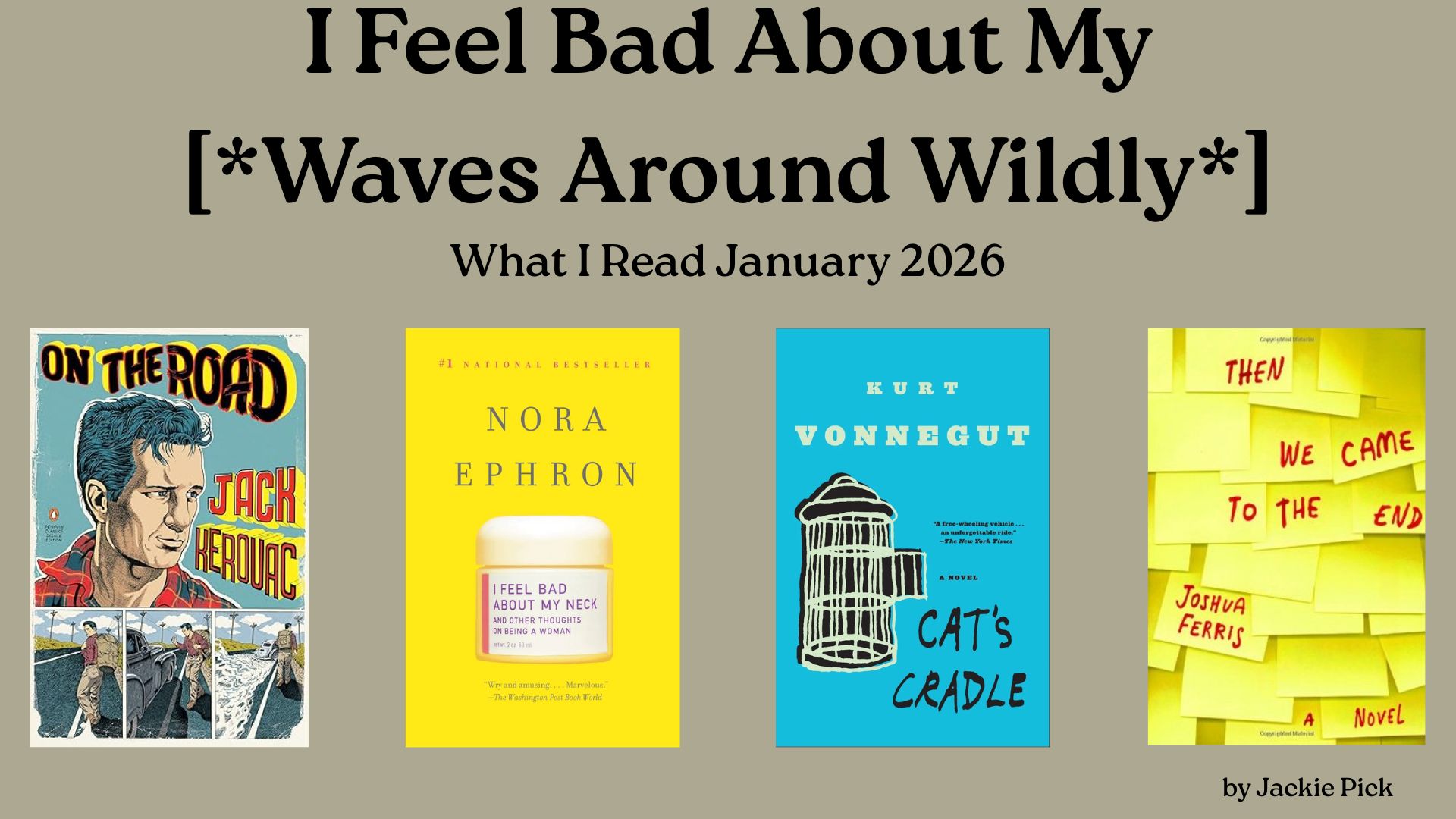
Which is all just to say, here are the books I enjoyed enough to finish this month:

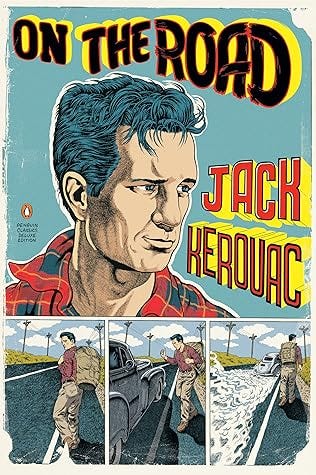
  • On The Road by Jack Kerouac
  • I Feel Bad About My Neck: And Other Thoughts on Being a Woman by Nora Ephron
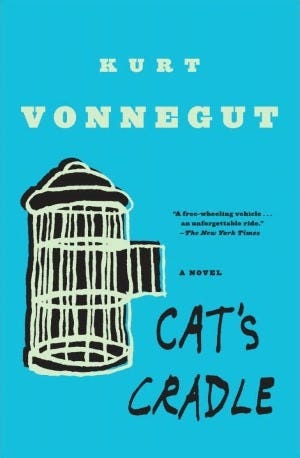
  • Cat’s Cradle by Kurt Vonnegut
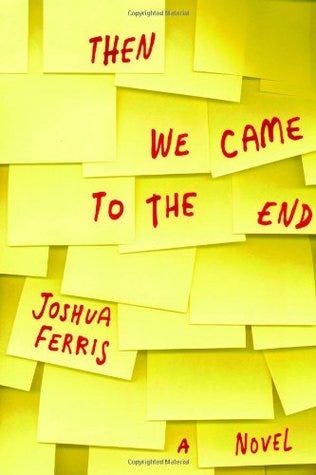
  • Then We Came to the End by Joshua Ferris

Note: For sanity and scale (mine, yours, and the internet’s), what follows are the openings of each review. Full versions are linked below.


On The Road by Jack Kerouac

On the Road by Jack Kerouac

On the Road is devoted to the idea that the journey matters more than the destination. Narrator Sal Paradise is happiest when he is on the go, scarcely letting the engine cool before thinking about his next departure. I, on the other hand, am happiest when I am on the couch, so it was hard to relate. Maybe this book hits differently for young men on the whole. Maybe it hits differently before you’ve learned that, no matter how fast you’re going, motion and purpose are not the same thing. On the Road spends a lot of time suggesting that they are.

Par exemple: “There was nowhere to go but everywhere” has done a lot of unpaid labor for On the Road for nearly seventy years. It promises freedom, transcendence, and meaning, preferably without responsibility, receipts, or a return time. In short, keep chugging and you will discover something profound.

Well, smack my jukebox and call me Fonzie.

(continued here)


I Feel Bad About My Neck: And Other Thoughts on Being a Woman by Nora Ephron

I Feel Bad About My Neck and Other Thoughts on Being a Woman by Nora Ephron

It’s been tricky to find books I want to read and then tricky to finish books I start. Not sure what I needed this month other than, pitifully, some validation. Specifically, smart, funny validation. And for this, Nora Ephron’s I Feel Bad About My Neck hit the spot while also inspiring me to write better. Or at least try to. I’m sure that brings some small relief to my intrepid band of readers.

Ephron notices what absolutely sucks and what absolutely does not suck and talks about it in great detail. She is irritated, observant, loving, and correct. These are qualities I respect.

(continued here)


Cat’s Cradle by Kurt Vonnegut

Cat's Cradle by Kurt Vonnegut Jr.

The epigraph to Cat’s Cradle is a cheerful little threat. “Nothing in this book is true.”

What a nice way to say, Relax. I’m only going to describe the collapse of civilization. No need to tense up.

You should know that this is a funny book. You should also know that being funny does not stop it from being horrifying.

Vonnegut is often called a gateway author, and maybe that’s because often people read him young and then spend the rest of their lives trying to find that exact flavor again: smart, fast, funny, devastating. “Gateway” suggests he is the some sort of charming, goofy doorman waving you through toward Real Literature

Nonsense. He’s serious and brilliant and immediate. Besides, if anything is going to ruin your day, it should at least get to the point and have a sense of humor about it.

The vibe is University of Chicago, all angles and bells and theorems. Sharp intellect, unpretentious, but exacting and impatient.

In other words, the vibe is impolite, wild-haired brilliance.

(continued here)


Then We Came to the End by Joshua Ferris

Then We Came to the End by Joshua Ferris

I do not believe in the concept of a “work family.” Families visit you in the hospital. Work sends an URGENT email while you’re in the hospital, then eliminates your position in Q3. The phrase “work family” exists so companies can feel moderately at-ease replacing compensation and boundaries with feel-good vibes. And yet, this is the sharp, pointy edge of Then We Came to the End. Offices still manage to feel intimate (and we, the public demanding to be entertained, love that. See: every workplace comedy ever.) We spend more time with our coworkers than with our friends. We know who drinks oat milk. We know who steals that oat milk. We know who cries in the bathroom. We know whose job we could probably do if things went sideways. Work dehumanizes people while demanding emotional, intellectual, and physical labor from them.

A lot of reviewers call Then We Came to the End a “workplace satire.” Yeah, sure, and a colonoscopy is “light touch diagnostics.” This book is about “business as usual,” where nothing is technically wrong, but everything feels wrong, and most of it probably is wrong on some level or another. Usually ethics.

(continued here)


And there be the January reads. As always, I welcome any recommendations! Read any good books lately?
Girl Bosses Tilt at Windmills (Or Do They?)

What I Read December 2025

I read three books this month. “Only” three, because the page count of one of the books triumphed over my ambition to get cozy and read anywhere between 5 and 43 books. Look, as you already know if you’ve ever wandered even accidentally into my writing, I am extremely busy. Doing what, you ask? Fretting about how busy I am, which is its own full-time job. It’s exhausting and inefficient, but it’s a living. Now, please mind your business (after you finish this piece, thanks.)

One of these books was Don Quixote. A famously long book (900+ pages! In a row!) about a person who reads too much and begins to confuse stories with reality. Any of you who are heavy readers probably relate.

My second read was Cultish, which is about how language creates meaning, belonging, and identity, and how quickly those things can curdle into manipulation.

The third was First Person Singular, a collection of stories in which Haruki Murakami does his thing. Things happen, or don’t. Or maybe they do, but in some weird emotional vapor. The narrators themselves often seem unsure what, if anything, just occurred. Then, more often than not, they decide that if an event did have meaning, it probably wasn’t consequential. And then The End. Sir? Excuse me? And also, this feeling I have at the end of each story isn’t necessarily unpleasant. Whyyyyy?

In all three, things happen, and they happen with juice. Not literal juice, in case any of you folks are in a “well, actually,” mood, although if you’re talking about cults, Kool-Aid will eventually burst in via a non-load-bearing wall.

Which is all just to say, here are the books I enjoyed enough to finish this month:

  • Don Quixote by Miguel de Cervantes (Translated by Edith Grossman)
  • Cultish: The Language of Fanaticism by Amanda Montell
  • First Person Singular: Stories by Haruki Murakami, translated by Philip Gabriel

Note: For sanity and scale (mine, yours, and the internet’s), what follows are the openings of each review. Full versions are linked below.


Don Quixote by Miguel de Cervantes (Translated by Edith Grossman)

Oh sure, let me just take on a 900-page canonical, picaresque novel. That’s a reasonable response to insomnia, especially given what all that reading famously does to Don Quixote himself.

Uh oh.

Still. I did it. One must have standards, even while abandoning common sense. I promised myself I would watch Man of La Mancha once I finished, a show I have somehow avoided my entire life, despite being the kind of person who should have already seen it.

Also, I get to use the word picaresque. And now you do, too. Congratulations.

(continued here)


Cultish: The Language of Fanaticism by Amanda Montell

Janice from your high school PE class has emailed you. She’s very excited. She wants you to join something, you girlboss, you. Details about that something are murky, but it will change your life. Act fast.

If your gut reaction to this is “ew” and that “ew” is unrelated to Janice serving a volleyball directly into your face during the volleyball unit, you may have good reason.

(continued here)


First Person Singular: Stories by Haruki Murakami (Translated by Philip Gabriel)

Recently, I chatted with someone I’d done a show with years ago, and we started talking about rehearsals. At some point I said, “Remember when I got yelled at for moving the chair?”

He did not remember this.

I remembered it very clearly. During a tech rehearsal, I’d moved a chair while trying to clear the stage between scenes because the person assigned to move it hadn’t done it. The director growled, “DON’T MOVE SET PIECES THAT YOU’RE NOT ASSIGNED TO.” It was mortifying. I don’t like being yelled at, even if I have committed some kind of theatrical felony. I may have cried a little backstage, facing a corner and pretending I was absolutely not crying and just liked looking at walls.

According to everyone else, though, this never happened. Or if it did, it was no big deal. No one remembered the chair. Or the yelling. Or my belief that I had ruined everything.

I did not enjoy realizing that a moment so clearly part of my theater experience seemed not to exist anywhere else at all.

Which brings us to First Person Singular.

(continued here)


And there be the December reads. As always, I welcome any recommendations! Read any good books lately?