Category: Book Review

Witnessing

What I Read April 2026

Graphic with a muted pink background and large serif title “Witnessing,” with subtitle “What I Read April 2026.” Below are four book covers in a row: The Making of Marigold McGrath by Carrie Hayes, Vigil by George Saunders, Beloved by Toni Morrison, and The Great Game by Andrés Martinez. At the bottom, it reads “by Jackie Pick.”

I tried very hard not to have a theme this month.

I know I say that a lot, but this time I meant it. I was just going to read books without some moment where I dramatically connect everything and pretend I planned it that way. It would have saved me from unnecessarily firing neurons I am trying to save for winter.

And then, somehow, there was a theme. Somewhere between books two and three, I realized we were doing a thing.

That thing, by the way, is witnessing. (That “we” by the way is…I don’t know.)

And yes, I mean the very lofty “bear witness” kind. Dress up in a robe, grab your favorite gavel, and put it in your non-book-holding hand. Congratulations! You’re in for some really amazing reads! Just watch where you point that gavel.

Across wildly different books (historical fiction, literary fiction, cultural analysis, whatever it is George Saunders is up to) the same problem keeps showing up. People living (and dying) inside events they may not fully understand. People documenting, interpreting, misinterpreting, or just standing there blinking, as history (or morality, or love, or grief, or politics) does its thing.

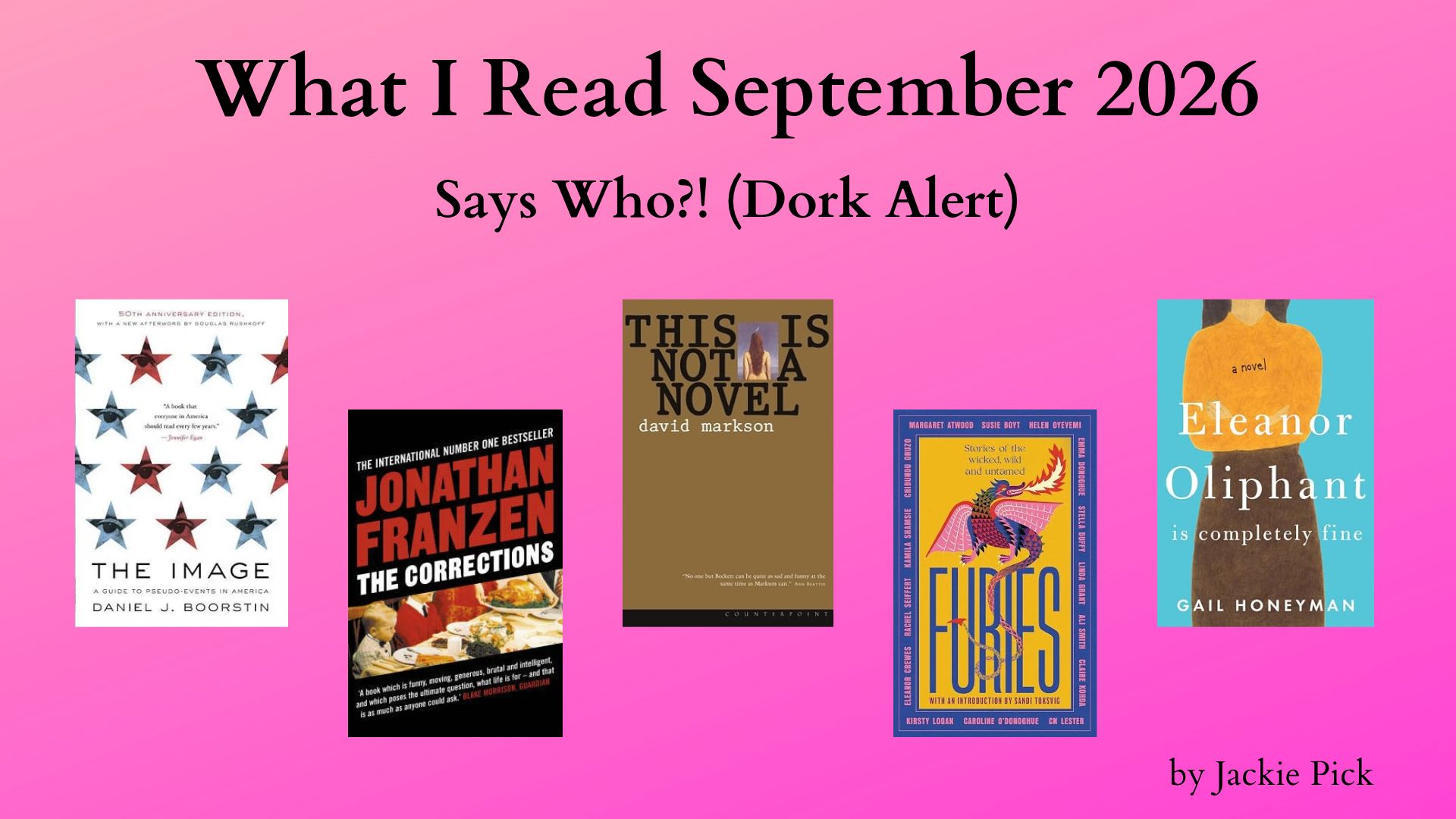
Which is all just to say, here are the books I finished this month:

  • Beloved by Toni Morrison
  • Vigil by George Saunders
  • The Making of Marigold McGrath by Carrie Hayes
  • The Great Game by Andrés Martinez

Note: For sanity and scale (mine, yours, and the internet’s), what follows are the openings of each review. Full versions are linked below.


Beloved by Toni Morrison

Toni Morrison observed that there were no adequate memorials for those who were enslaved in the United States. “No small bench by the road,” no modest roadside markers, no sanctioned sites of mourning. So she wrote one. Beloved is a monument of language and memory. There is, to my knowledge, no more fitting extension of a literary work into the world.

I find myself hesitating to even try to articulate my admiration for fear of diminishing the work. From the first page, it is clear you are entering a kind of sacred space, one that is welcoming and exacting and asks you to be your best self. To sit with the past, witness, reckon, and repair.

(continued here)


Vigil by George Saunders

Vigil is George Saunders doing the afterlife thing he does so well, this time with even more bite and a contemporary target. It’s set in an in-between space that’s not quite heaven, not quite anywhere you can Yelp, where a spirit’s job is to help the dying make peace before they go. Like cosmic hospice with moral stakes.

(continued here)


The Making of Marigold McGrath by Carrie Hayes

Historical fiction set during World War II is something I tend to approach with high expectations and a ready-to-go side-eye, but The Making of Marigold McGrath by Carrie Hayes won me over with its intelligence, its restraint, and its refreshing perspective on what it means to come of age while the world is unraveling. Hayes gifts us a story about what it means to live inside and bear witness to a moment that has not yet resolved into history.

(continued here)


The Great Game by Andrés Martinez

Ordinarily, I don’t read sports books. I barely watch sports. Sports are what I put on when my brain needs a screensaver or my children are in the room and I’d like to keep them there a little longer. But The Great Game by Andrés Martinez is a book about everything sports touch: politics, power, media, identity, community. It’s also very much a book about America’s favorite pastime: wanting to be part of the world while also insisting we should do our own thing.

(continued here)


And there be the April reads. As always, I welcome any recommendations! Read any good books lately?

Fight, Flight, Freeze, or Fran

What I Read March 2026

I’ve been rotating through four classic responses to stress: fight, flight, freeze, and Fran. By which I mean Lebowitz. By which I mean I observe the mess, describe the mess, and get a laugh.

I might even drop a “We should circle back.” I absolutely do not circle back. Who has time for that?

If you’ve spent any time with me or my writing, you know I live in a town that likes noise. I do not like noise and I work from home. Local skeet/trap shooting finally stopped after its annual allotted 215-ish hours, and within a day the neighborhood leaf blowers began.

The clean baton pass from one form of mechanical noise to another is impressive.

I register it. I sit still and hope it ends. This is “freeze.” For variety, sometimes I Fran about it.

Meanwhile.

During an unscheduled visit to an upper cabinet, I rediscovered a Rubbermaid 20 Deviled Egg Keeper Storage Container (with lid!). I assume my husband brought it to the marriage, because this is not my spiritual tradition. This container implies we not only make an unholy number of deviled eggs, but also transport them elsewhere like some kind of appetizer diplomacy corps.

Every time we stumble on it, we say, “Oh, I loved deviled eggs!” like we caught them on tour in the early 00’s. We consider using it or donating it. Then we return the container to the upper cabinet because we do not host or attend high-volume eggy gatherings and don’t want to think about it.

Flight.

Bigger Life Problems are less funny, don’t budge for most of those strategies, and deal with the increasingly delicate question of where one safely places one’s actual self in a world that seems to reward anything else. (Even typing that, I assume I’ve annoyed someone. Hello! Welcome to my page!)

You cannot freeze your way into trust. You cannot flee your way into community. Even if you stretch beforehand, you cannot Fran your way into repair.

We sure love forgiveness because it lets everyone move on; repair asks you to be accountable. And while devastating commentary is deeply satisfying (TRUST ME), at some point, if anything is going to be rebuilt, somebody has to stay in the room and do the work.

Which is what this month’s books address – what it actually takes to stay and deal with things.

In The Fran Lebowitz Reader, the move is clear: identify the things and make good suggestions for more motivated folks to do something. In So Far Gone, repair is slow, uncomfortable, full of uncomfortable accountability. The Beginning Comes After the End argues that (re)building is the whole plot (and history proves that the necessary work must continue). And The Book You Need to Read to Write the Book You Want to Write dispenses with metaphor entirely and says sit down and get to it.

Now, fight sounds dramatic, but in practice a great deal of it is showing up and working with the broken thing long enough for it to improve.

Unless it’s a deviled egg container. I’m not dealing with that.

Which is all just to say, here are the books I enjoyed enough to finish this month:

  • So Far Gone by Jess Walter
  • The Fran Lebowitz Reader by Fran Lebowitz
  • The Book You Need to Read to Write the Book You Want to Write by Sarah Burton and Jem Poster
  • The Beginning Comes After the End by Rebecca Solnit

Note: For sanity and scale (mine, yours, and the internet’s), what follows are the openings of each review. Full versions are linked below.


So Far Gone by Jess Walter

Jess Walter’s So Far Gone may win the award for the most forgettable title attached to a most unforgettable reading experiences. It’s frustrating because I now have to enthusiastically recommend a book whose title I cannot remember five seconds after I say it. I feel like I’m pitching a movie called That Thing With the People and the Stuff. “You’ll love it!” “What’s it called?” “I DON’T KNOW, BUT IT’S GREAT!”

The book is, among other things, a road trip. Every stop produces the unnerving realization that you have, in some essential way, already been there, emotionally, culturally, existentially, possibly geographically. Each location is a diagnostic tool. Ah. Yes. This particular human mess/cultural sinkhole. Been there, done that, got a koozie.

(continued here)


The Fran Lebowitz Reader by Fran Lebowitz

I had to read The Fran Lebowitz Reader in careful, controlled doses. You can’t really binge Fran Lebowitz. At least I can’t. It’s literary espresso. Lebowitz comes across as someone who remembers that things were supposed to be better and finds the current situation inadequate. And then she lets you know exactly why in as few words as possible.

Lebowitz has an unmistakable voice with an unmistakable cadence. Sentence to sentence, essay to essay, she sounds exactly like herself, which is both the pleasure and the reason you can’t binge this book the way you might a more contemporary essay collection. Also unlike many more contemporary essay collections, there’s no narrative arc or tidy throughline. Essays are loosely grouped under headings like “Manners” or “Science” or “People.”

Which, if I may be so presumptuous, feels very Lebowitz.

(continued here)


The Book You Need to Read to Write the Book You Want to Write by Sarah Burton and Jem Poster

I read a lot of craft books. Most, at some point, begin to feel like they are passing around the same handful of writerly chestnuts, all flapping about “structure!” and “voice!” before settling down to discuss three-act arcs. So I approached with cautious optimism but expecting very little.

This one is genuinely terrific, and, for newer writers, probably indispensable.

(continued here)


The Beginning Comes After the End by Rebecca Solnit

“Hope” is a great four letter word.

The Beginning Comes After the End by Rebecca Solnit packs a lot into a small volume. This collection of dispatches reads more like someone trying (calmly, patiently) to answer a question a lot of us are circling right now: how do you keep going when you can’t tell if anything you’re doing is working?

That’s the feeling, yes? That things are…a lot? Maybe too much? That the future feels like it’s unfolding out of control. Solnit doesn’t pretend otherwise as she moves through all of it: the pandemic, climate change, political upheaval, the ongoing fights around feminism, racial justice, Indigenous rights, and who gets to belong and be heard. Nor does she pretend it’s easily manageable. She just keeps pointing us outward and backward – look at where we’ve been, look at where we are, look at what actual people have done, over time, to move things, even when it didn’t look like anything was moving! Look! And breathe!

(continued here)


And there be the March reads. As always, I welcome any recommendations! Read any good books lately?

Spines, NyQuil, and Staring At the Ceiling

What I Read February 2026

For a few days in February, my God-installed, non-award-winning back and intercostal muscles decided to spasm up and shut down operations. I was horizontal against my will, which is the least fun way to be horizontal. I did not enjoy this real-world lesson in what intercostals are, but I did get to spend a not-insignificant amount of time staring at the ceiling like it’s a limited series.

Just as my spine stopped trying to yeet my head down the hallway like a bowling ball, I got sick. Just like the rest of the family, only they all got it before I did.

So now I have this painful, unproductive cough, which my back is like NO, DO NOT. (You may insert your own “your writing is also painful and unproductive…NO, DO NOT” joke here. First prize is one underwhelmed “Good One, Mild Heckler” from me. Don’t spend it all in one place.)

Because of all that, this intro section is clearly going to be a bit of a wild ride, plus or minus one Mr. Toad. Whatever. It’s fine. If the intro licks a doorknob, just pretend you didn’t see it.

ANYWAY. A couple fingers of NyQuil in, and after my fourth attempt to roll over without sounding like a two-pack-a-day rusty door hinge, I started thinking about whether there might be some clever thread tying together the books I read this month. At the same time I was bellyaching about my back — *insert celestial music*

This month’s reading stack is about spines. Spines let us move through the world without collapsing into a soupy mess.

Look, I’m sticking with this premise, even if I have to force it a bit (consider it artistic chiropractic).

A man tries to stand upright in a world determined not to see him. A woman wonders what remains when cultural and personal scaffolding falls away. In another story, women hold lineage like vertebrae across generations. And in a craft book, writers are reminded that stories need structural, thematic, and other spines, and are shown how to build them.

These books also address questions of dislocation, power structures, self-determination, appearance versus reality, and the social codes that buoy and bruise us.

Which is all just to say, here are the books I enjoyed enough to finish this month:

  • Once I Was Cool: Personal Essays by Megan Stielstra
  • Invisible Man by Ralph Ellison
  • The Song of the Blue Bird by Esther Goldenberg
  • The Architecture of Story: A Technical Guide for the Dramatic Writer by Will Dunne

Note: For sanity and scale (mine, yours, and the internet’s), what follows are the openings of each review. Full versions are linked below.


Once I Was Cool: Personal Essays by Megan Stielstra

Once I Was Cool: Personal Essays

Cool is elusive and requires a certain indifference to what other people think. That’s extremely difficult to achieve for people like me who spend a certain amount of time thinking about what other people think. (Perils of the job.)

Which is to say: I am not cool. And, unlike Megan Stielstra, I may never have been.

Once I Was Cool lives in that gap between who we thought we were and who we are now…

(continued here)


Invisible Man by Ralph Ellison

Invisible Man (Edition 2) by Ellison, Ralph [Paperback(1995£©]

We tell ourselves stories about who we are. We tell ourselves that effort will be seen, that talent will be recognized, that identity is something we build and then present to the world.

Invisible Man by Ralph Ellison dismantles that.

The novel follows an unnamed young Black man trying to find his place in a society determined not to see him as an individual…

(continued here)


The Song of the Blue Bird by Esther Goldenberg

The Song of the Blue Bird: The Desert Songs Trilogy, Book 3

History is usually sung in the key of men: their journeys, their covenants, their departures and returns. The women, if they appear at all, are often relegated to the margins, tending the hearth.

The Song of the Blue Bird by Esther Goldenberg shifts the lens and begins where the women have always been: at the heart of survival and the center of the story. These women are far too busy living, enduring, scheming, loving, and adapting to remain marginalia in someone else’s story…

(continued here)


The Architecture of Story: A Technical Guide for the Dramatic Writer by Will Dunne

The Architecture of Story: A Technical Guide for the Dramatic Writer (Chicago Guides to Writing, Editing, and Publishing)

I picked up Will Dunne’s The Architecture of Story while working on my novel and trying very hard to ignore the inner voice that had begun scream-whispering, “You don’t know what you’re doing!”

I was stuck. I had reached Chapter Twelve with the creeping suspicion that Chapters One through Eleven were not only slightly disconnected from Twelve, they might also be slightly disconnected from each other and possibly from any version of “good…”

(continued here)


And there be the February reads. As always, I welcome any recommendations! Read any good books lately?