This is, hopefully, the final installment in my (also hopefully extremely limited) series, “Why Am I Like This?”
Writers are cautioned not to overuse exclamation points. If we must use them at all, we are told to ration them. No Serious Writer™ uses more than three exclamation points per novel. I use three before breakfast. No Serious Writer™ would dare rely on punctuation to do the emotional heavy lifting. No Serious Writer™ would employ exclamation points unless something truly calls for excitement. I have been alive for some time, and few things ever truly call for excitement. Except cake.
But some of us are Excitement Folks. I myself am a human exclamation point. Out of the house, my natural register becomes Jack Black impersonating Judy Garland while spinning plates. I greet people like we’ve survived a maritime disaster together. I smile as if paid by the watt.
Mind you, this is not my natural state, but it is often my public one.
I have long aspired to become awoman of repose. I have tried, truly, to be someone who radiates calm, who says “hmm” instead of “OH MY GOD, YESSSSS,” who does not tell your dog I love him the very first time I meet him.
Alas, my attempts at composure resemble Animal from The Muppets being shot out of a confetti cannon directly into a line of cymbals.
Women of repose give the impression that they read Smithsonian Magazine in the bathtub. I give the impression that I clap when planes land.
Enthusiasm is a peculiar human response to the otherwise bleak recognition of existence. It manifests as sudden bursts of unsolicited and often alarming cheerfulness. Enthusiasm is socially contagious but has an inconvenient half-life of twelve minutes and a regrettable tendency to startle normal people.
For a while, I managed something approaching serenity. My public self finally matched my private one. My resting heart rate was no longer espresso.
Then came Zoom, a technology that brought people together by separating them entirely.
Staring into a camera instead of human faces, it’s hard to catch social cues unless someone types LOL or You are a dork in the chat. Since we’re all deprived of feedback, I overcompensate as speaker and listener. I nod violently and try to show you that I’M WITH YOU AND I LIKE YOUR VIBE AND ALSO I’M TURNING MY CAMERA OFF BECAUSE I’M SHOVING AN ENTIRE COSTCO TUXEDO CAKE IN MY FACEHOLE AND YOU DESERVE BETTER BUT I’M STILL HERE NODDING PROMISE.
We can call that enthusiasm. Or nightmare fuel. Whatever.
Then the meeting ends, and I power down like a droid in Star Wars.
Is this growth or regression? Is my at-home, off-camera restraint maturity the real me, or just battery depletion? Am I even seeing myself accurately? Because, honestly, the only time I see myself is on Zoom.
Both versions of me feel real, but they can’t coexist. I’m trying to find the midpoint between “!!!” and “…”
Maybe an em dash, that modern-day punctuatio non grata.
Definitely not a period though, because I prefer to do things not with a whimper but (wait for it!) with an interrobang.
For all of us who’ve ever asked, “Why am I like this right now?”
This week, I wanted to write a funny post to be filed under “Life and Other Existential Crises.” You know, something relatable and semi-literate. The problem: everyone, everywhere, has chosen this exact moment to be an ass. This presents certain creative difficulties.
(Yes, excellent start. Let’s see where this goes, shall we?)
The world, at present, is too much. Everything is a little sticky and smells like pumpkin-spiced feet. Kind of like a Spirit Halloween that’s moved into an abandoned Bed Bath & Beyond space.
(Live. Laugh. Leave Me The Hell Alone. Wooden sign, $29.99.)
I brought my own too-muchness to a Zoom the other day. For reasons no one fully understands, I opined that the period between late August and mid-November is “the PMS of the calendar year.” Everything is slightly wrong and relentlessly demanding. My to-do list now qualifies as a UNESCO World Heritage Site. I’m overwhelmed, overbooked, under-rested, bloated, irritable, hungry, dehydrated, and everything itches. I have no idea why I feel this way until I look at the calendar. Oh. Ohhhh. That explains why everyone is being an ass. Including me.
(Maybe that? Maybe leave this post at that?)
I have Projectile Figurative Language Use.
(Ah, I see we’re staying here and carrying on.)
Because ordinary English collapses in my hands, I resort to invoking metaphors, similes, emotional geometry, and a verbal Vitamix. If I can’t find the right word, I’ll invent one. Then, realizing no one else is in my brain, I over-explain the metaphor. Then apologize for over-explaining. And suddenly I’m talking about my eyelid eczema, which was not, in fact, the original metaphor nor the point of anything I was saying.
This, I’m told, is my charm. The metaphor thing, not the eyelid eczema thing. That’s not charm, that’s just sex appeal.
(No one has ever said any of that.)
The writers on the Zoom were kind. Writers often are. We traffic in mutual recognition, responding to each other’s weirdness with appreciative laughs or perhaps mercy mutings. Either way: respect for this collection of creative humans.
I imagine a collective noun for writers is “A Card Catalog of Writers,” or “A Procrastination of Writers,” or “A Syntax Error of Writers.”
The singular of all of these is “A Flinch.”
(Tip your waitstaff.)
Somewhere in all of that is a point. Maybe to keep talking even if the words come out like anguished verbal origami. Maybe to sit with your odd language instead of trying to translate it into something respectable, which is how good ideas can die of politeness. Maybe to trust that someone, somewhere, will hear your nonsense and send you a party-hat emoji in solidarity.
Were I a better personwriter, I would pivot here into something about gratitude or artistic discipline or the resilience of the creative spirit, but, truthfully, I just want to stand in the middle of that abandoned Bed Bath & Beyond (now Spirit Halloween!) andscream, “GET IT TOGETHER!”
Because…Autumn…the PMS thing. Remember?
(Yes, we get it.)
I want to be insightful, but maybe the humor/mess of language is the panic room I built for myself. Right now, all I have are half-finished thoughts and worries up the wazoo. Julia Cameron would suggest journaling through it, but I’m pretty sure she never had to navigate endless labyrinths of online portals while her dog threw up on the carpet and a kid yelled ‘Mom?!’ from somewhere inside a Common App essay draft while the entire world burned.
So these days, I spend a lot of time in my own head. It’s not exactly insightful or profound in there, but at least there’s parking.
(Don’t)
And yeah, part of it is that the world is kind of awful and falling apart, and I oscillate between feeling idiotic for making jokes and idiotic for not making them.
However, the only thing that feels truly dangerous and guaranteed to lock up my words is not saying anything.
So here I am: over-metaphored, under-hydrated, armed with a single, wobbly sentence about the itchy PMS-ish quality of autumn. Perhaps that’s enough to keep me from desperately clutching a package of Nutter Butters and insisting, “I’M FINE.”
Sometimes the best you can do is name the chaos and tack on a punchline.
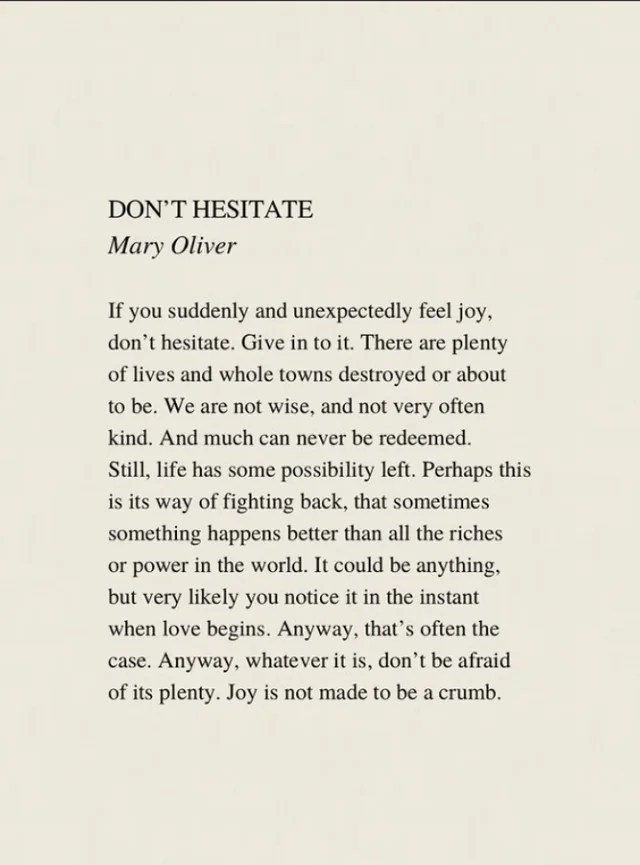
And sometimes the best you can do is offer, without reasonable transition, Mary Oliver telling us quite firmly, “Don’t Hesitate.”
This month I’ve been juggling eleventy kajillion calendars. This is not, as you might assume, because I am a particularly efficient or important person. It is because time, like most of my kitchen drawers, gets jammed on all the oversized things I try to cram in it. Items currently requiring my attention and scheduling: two schools, two adults working from home at somewhere between two and seventeen different jobs, volunteer activities, various kid activities and applications, and the all-important sacred day when the Halloween candy finally materializes on the grocery shelves. That’s the one holiday America does perfectly. Costumes, sugar, minimal chitchat.
Fittingly, every book I finished in September carried within it the godforsaken ticking of a clock – THE clock – with incessant urgency and inevitable silence.
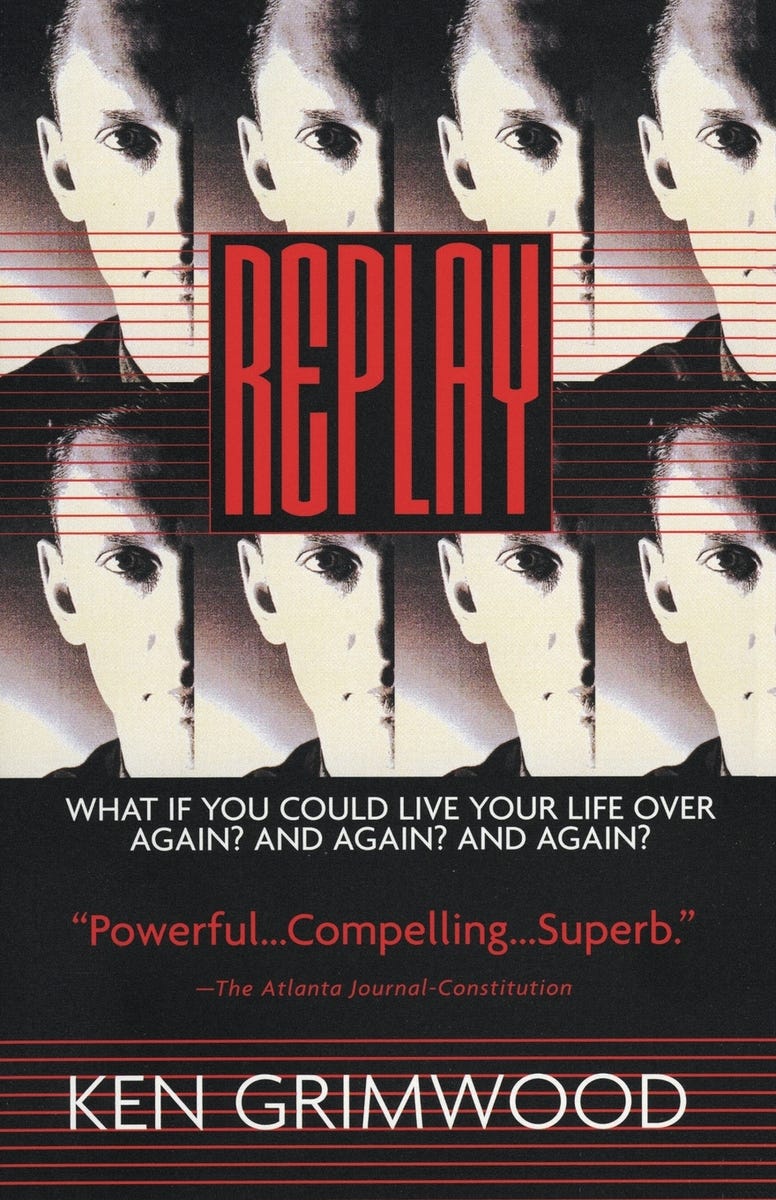
In Replay, time is a wheel greased with déjà vu: die, reboot, repeat. Maggie Smith’s Dear Writer is profoundly gentler, insisting we use our time well and show up to the page. The end will come regardless but right now there is time to mark the paper purposefully, joyfully, fearlessly. Obitchuary treats death like a hot gossip item, grief delivered with a rimshot. Robert Benchley proves that even the most mundane of moments can be slapstick if you just untie its shoelaces.
Put another way: my eleventy kajillion calendars don’t lie, though they constantly contradict each other. We’re all quite busy running out of time, and what remains is how we spend it. There are jokes, stories, hope, relationships, and maybe a decent breakfast before the lights click off.
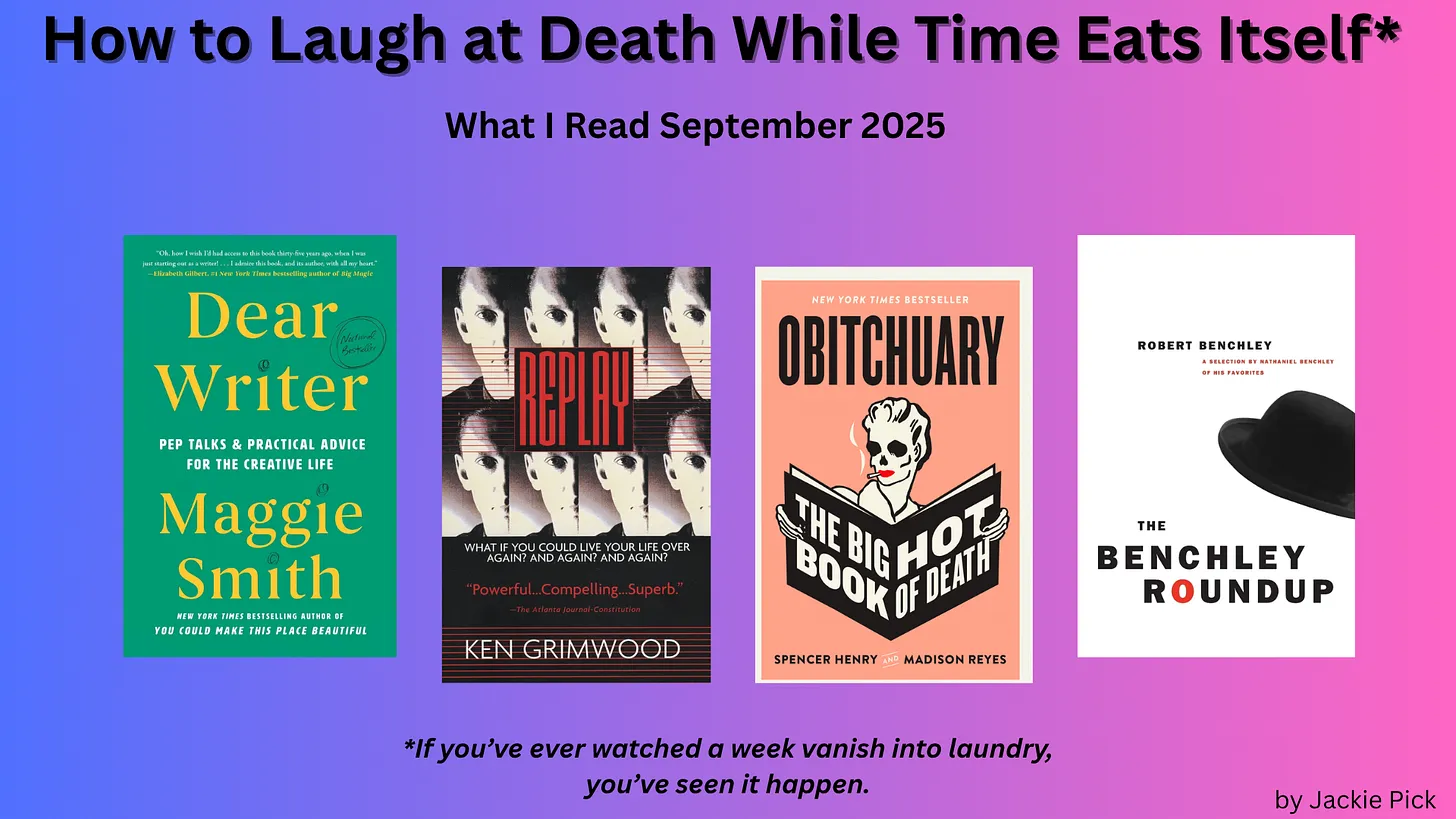
Which is all just to say here are the books I enjoyed enough to finish this month, in no particular order except the one I typed them:
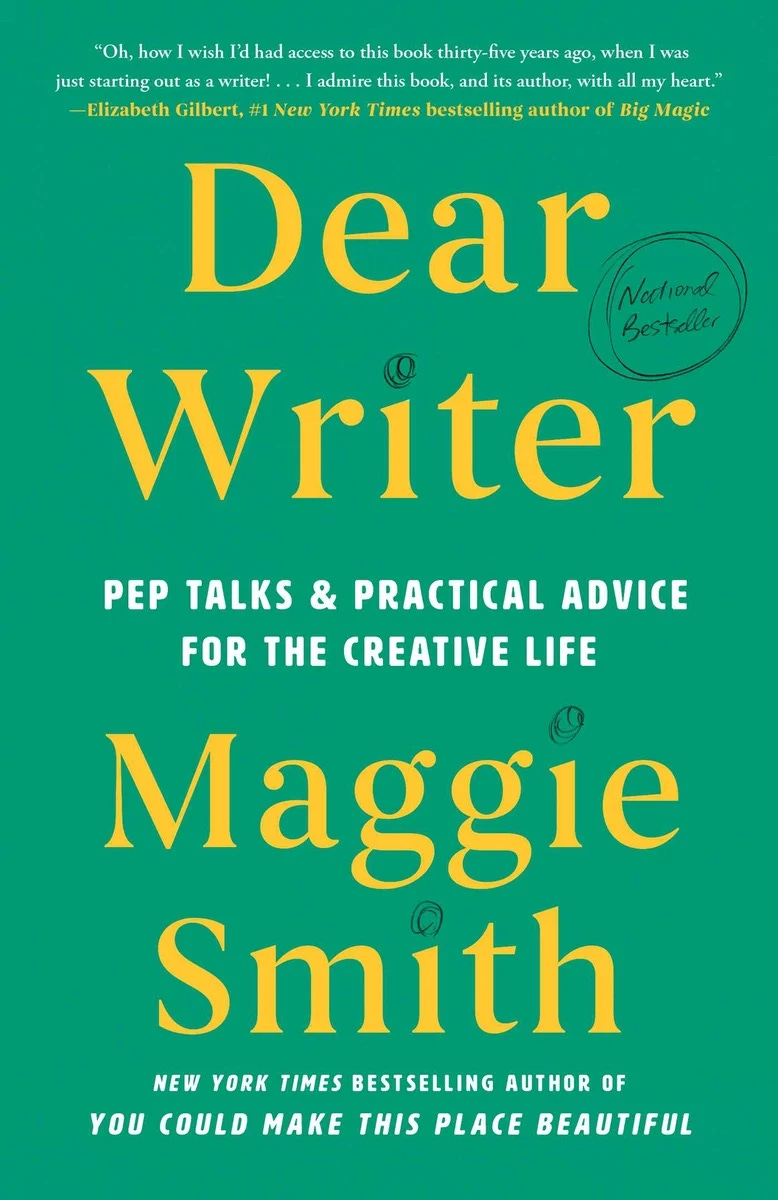
Dear Writer by Maggie Smith
Replay by Ken Grimwood
Obitchuary by Spencer Henry and Madison Reyes
The Benchley Roundup by Robert Benchley
*If you’ve ever watched a week vanish into laundry, you’ve seen it happen.
In the opening paragraphs of Dear Writer, Maggie Smith writes, “I believe creativity is our birthright as human beings.” I like this. It’s a much better birthright than, say, a Costco card or bad knees. She doubles down a page later: “When you read a poem, or listen to a song, or watch a play, you’re not the same person afterward. You’re slightly rearranged.”
Smith organizes her book around ten principles, which incidentally sound like the syllabus for the world’s nicest graduate program: Attention, Wonder, Vision, Play, and more. Each comes with a note to “Dear Writer,” followed by essays, some prompts, and suggestions for further reading. It’s craft book meets pep talk, heavy on kindness and honesty, light on prescriptive rules.
The section on Vision is a banger. Smith advises us to “make your own uncool,” which is the kind of line I love because I am, in fact, deeply uncool, so this will take very little effort on my part. The gist: take risks, some people won’t like your work, and that’s okay. The chapter on Restlessness also hit home. Smith reframes that itchy dissatisfaction we all feel when a draft isn’t there yet as something generative.
Smith’s quotable lines are legion. In Tenacity: “Your creativity is calling. It needs you. Work on your endurance and stamina. Wring your mind out like a rag over a bucket, until it’s bone-dry. Get every drop.” In Hope: “If hope is imaginative, then pessimism is a failure of imagination.” And she drops a piece of advice from Stanley Plumly that I’m still chewing on: “Stay deep within yourself and stay alone there — that is where your poems come from, and that has nothing to do with an audience. You are the audience.”
You don’t have to please anyone else in the room. You’re the damn room.
My personal underline-and-throw-exclamation-points-in-the-margin fest came in her section “On Feedback.” As someone who’s received workshop comments that shut me down for months, I found her take validating and humane. Feedback, she reminds us, isn’t about finding what’s “wrong,” it’s about clarifying, supporting, and helping the writer get closer to what they want.
If you’ve read Anne Lamott’s Bird by Bird, this book is its scrappy cousin. Same heart, different swagger.
This month I’ve been juggling eleventy kajillion calendars. This is not, as you might assume, because I am a particularly efficient or important person. It is because time, like most of my kitchen drawers, gets jammed on all the oversized things I try to cram in it. Items currently requiring my attention and scheduling: two schools, two adults working from home at somewhere between two and seventeen different jobs, volunteer activities, various kid activities and applications, and the all-important sacred day when the Halloween candy finally materializes on the grocery shelves. That’s the one holiday America does perfectly. Costumes, sugar, minimal chitchat.
Fittingly, every book I finished in September carried within it the godforsaken ticking of a clock – THE clock – with incessant urgency and inevitable silence.
In Replay, time is a wheel greased with déjà vu: die, reboot, repeat. Maggie Smith’s Dear Writer is profoundly gentler, insisting we use our time well and show up to the page. The end will come regardless but right now there is time to mark the paper purposefully, joyfully, fearlessly. Obitchuary treats death like a hot gossip item, grief delivered with a rimshot. Robert Benchley proves that even the most mundane of moments can be slapstick if you just untie its shoelaces.
Put another way: my eleventy kajillion calendars don’t lie, though they constantly contradict each other. We’re all quite busy running out of time, and what remains is how we spend it. There are jokes, stories, hope, relationships, and maybe a decent breakfast before the lights click off.
Which is all just to say here are the books I enjoyed enough to finish this month, in no particular order except the one I typed them:
Dear Writer by Maggie Smith
Replay by Ken Grimwood
Obitchuary by Spencer Henry and Madison Reyes
The Benchley Roundup by Robert Benchley
*If you’ve ever watched a week vanish into laundry, you’ve seen it happen.
In the opening paragraphs of Dear Writer, Maggie Smith writes, “I believe creativity is our birthright as human beings.” I like this. It’s a much better birthright than, say, a Costco card or bad knees. She doubles down a page later: “When you read a poem, or listen to a song, or watch a play, you’re not the same person afterward. You’re slightly rearranged.”
Smith organizes her book around ten principles, which incidentally sound like the syllabus for the world’s nicest graduate program: Attention, Wonder, Vision, Play, and more. Each comes with a note to “Dear Writer,” followed by essays, some prompts, and suggestions for further reading. It’s craft book meets pep talk, heavy on kindness and honesty, light on prescriptive rules.
The section on Vision is a banger. Smith advises us to “make your own uncool,” which is the kind of line I love because I am, in fact, deeply uncool, so this will take very little effort on my part. The gist: take risks, some people won’t like your work, and that’s okay. The chapter on Restlessness also hit home. Smith reframes that itchy dissatisfaction we all feel when a draft isn’t there yet as something generative.
Smith’s quotable lines are legion. In Tenacity: “Your creativity is calling. It needs you. Work on your endurance and stamina. Wring your mind out like a rag over a bucket, until it’s bone-dry. Get every drop.” In Hope: “If hope is imaginative, then pessimism is a failure of imagination.” And she drops a piece of advice from Stanley Plumly that I’m still chewing on: “Stay deep within yourself and stay alone there — that is where your poems come from, and that has nothing to do with an audience. You are the audience.”
You don’t have to please anyone else in the room. You’re the damn room.
My personal underline-and-throw-exclamation-points-in-the-margin fest came in her section “On Feedback.” As someone who’s received workshop comments that shut me down for months, I found her take validating and humane. Feedback, she reminds us, isn’t about finding what’s “wrong,” it’s about clarifying, supporting, and helping the writer get closer to what they want.
If you’ve read Anne Lamott’s Bird by Bird, this book is its scrappy cousin. Same heart, different swagger.
The trouble with dying at 43 (or any age, really) is that you expect it to be permanent. So imagine Jeff Winston’s surprise when he keels over at his desk, only to wake up in his 18-year-old body, circa 1963, with all the memories of a man who’s already survived disco. From the opening pages, it feels more exciting than the life he just lost.
At first, Jeff Winston does exactly what most of us would do. He places major bets, invests wisely, and generally struts through life knowing how it all turns out. But then the loop resets. He dies at 43 again. And again. And again. Turns out living the same 25 years over and over, no matter what, is maddening.
Like Groundhog Day stretched across decades, the book shifts from fantasy to philosophy. Can you only enjoy being 18 if you’re actually 43 inside? What happens when you’re living as a teenager and a middle-aged man at the same time? Grimwood leans into those ripple effects where every choice remakes the world, but the ending never changes.
The pacing is tight. Grimwood spares us the tedium of every replay in full, fast-forwarding to the choices that matter like a cosmic remote control with a mercifully working fast-forward button. Yes, it reads a little late-1980s, but then again, so did the 1980s.
If you love books like 11/22/63, “what if” fiction with actual emotional depth, or have ever just wondered “If I had to do it all over again, knowing what I know now…” you might enjoy Replay.
Replay starts as wish fulfillment (i.e., the fantasy of having the opportunity to do it again and fix things) and becomes a philosophical exploration of regret, loneliness, and the dreadful suspicion that life only matters because it ends. The brilliance of Grimwood’s novel is in showing that inevitability can be both a curse and a peculiar sort of gift.
I didn’t realize until after I got hold of this one and looked at the back cover that the authors are podcasters. This did not bode well. I like my podcasts like I like my books: unrelated.
I opened it anyway.
Obitchuary is breezy, irreverent, and laden with more-than-occasionally-gross death facts. If there is a Venn diagram of “Halloween enthusiasts” and “people who correct you on the Latin root of rigor mortis,” this book sits precisely in the overlap. Especially good for pub trivia enthusiasts during Spooky Season.
The tone at first is like listening to two slightly tipsy friends who’ve been speaking in inside jokes since middle school. Now set them loose on the surprisingly sober business of what happens to your body after death. It’s not wholly unpleasant, but it’s undeniably jarring.
By Chapter Two, they settle in. The humor shows up in the right places instead of everywhere all at once, and the information takes the lead. Honestly, they are funny, it just lands better when they don’t keep poking you in the ribs to make sure you noticed the joke.
What Obitchuary underscores, with a deliciously relentless cheer, is how people are quite odd about death. Before it, during it, long after it. Some readers will find this refreshing, others gratuitous, and still others will wonder if they’ve accidentally purchased the wrong book.
That’s gallows humor for you.
I finished it out of morbid curiosity (tip your wait staff). I read some sections twice, skipped others. That’s the great advantage of nonfiction. You can dip in and out.
But whatever you do, don’t skip the epilogue. It’s unexpectedly tender and inspiring.
This book might best be enjoyed by fans of the Obitchuary podcast, trivia junkies of the macabre, or readers who like their death culture delivered with a wink. If you think you might be the audience, flip through it first. You’ll know pretty quickly.
Robert Benchley was the sort of man who could look at a perfectly ordinary activity and turn it into a full-scale farce. He made being baffled by modern life into a writing career, which is no small achievement considering modern life’s eagerness to baffle.
The Benchley Roundup, assembled by his son Nathaniel, gathers these short pieces into a single cabinet of curiosities.
It is what you might call a “panoply,” although I can’t imagine anyone actually using that word outside of a catalog.
Nathaniel admits up front that his father’s humor is hard to pin down: “I don’t think it can be analyzed. It is sometimes mad, sometimes penetrating, and sometimes based on nothing more than word associations, and the only generalization that can be made with any degree of certainty is that it is different—or, if you will, unique.” Which is another way of saying: abandon all hope of categorization. Benchley was, inconveniently, unique. And that’s exactly the appeal: Benchley never sounds like anyone else, even now. I would venture a guess that Benchley thought faster than the rest of us, and we’ve been trying to catch up ever since.
Many of these essays originated in magazines. Some land perfectly; others remind you that you are reading something written when people still wore spats with jokes and references that make you feel like you’ve walked into a party eighty years too late. Others arrive startlingly fresh, proof that certain absurdities never go out of fashion. Humor is like that: part fossil, part banana skin.
Reading Benchley today is like watching an old black-and-white film where everyone speaks in that brisk, so-called mid-Atlantic accent that once passed for sophistication and now just sounds faintly ridiculous. But that voice, that sense of time, is half the fun. His writing is unpretentious, seemingly effortless, and wide-ranging. You get the sense he could spin absurdity out of absolutely anything. And often did. This is either a tribute to Benchley’s talent or a condemnation of how little progress we’ve made as a species. Probably both.
The Benchley Roundup is a delight to dip in and out of. Some essays feel like artifacts, some land with fresh precision, but together they remind you why Benchley mattered, how he influenced subsequent generations of humorists, and why his style still feels different, even now. It’s smart, silly, and deceptively simple. As his son notes, the collection is best read in small doses, dipped into like a jar of peculiar sweets, because each piece is its own odd little universe. Some will feel like time capsules, others like dispatches from a mind still waiting for us to catch up. Benchley pointed out, with impeccable timing, just how gloriously inexplicable the world was and still is.
And there be the September reads. As always, I welcome any recommendations! What’s in your TBR pile?





 Jackie Pick