Oh, November. You spicy dirtbag what with your chaotic offerings. Pumpkin pie (yes!) My birthday (fine), and *checks hearing* skeet season. Indefatigable skeet season. Because nothing says “charming small town in late autumn” like ten-hour PEW PEW symphonies punctuated by leaf blowers every weekend. Best noise friends forever!
Apologies for griping about this again. I’m tired. And not in the fun “I ran a marathon” kind of way, but in the “I live inside a t-shirt cannon” kind of way.
I’d love to be cool about it. You know, like a Sweathog. They’re still cool, right? Or they once were? Sort of?
Bless their hearts.
Also, just so we’re clear: If I ever so much as hint at interest in running a marathon, call Liam Neeson. Clearly I’ve been taken.
Speaking of taking, my twins are out here taking tests — driver education, PSATs, SATs, a whole alphabet soup of Ts? It’s familiar and not so much. They don’t even have to fill in the circles completely and make their marks dark. What madness is that?
Life is lifing, people, and I’m bracing for the impact of seismic changes as they head out in a few years while also wondering what I did to make my back hurt this time. (Sneezing, probably.) Anyway, the twins and their younger sibling are excellent, hilarious humans who, for reasons unknown to science or the Divine, recently played tic-tac-toe using a photo of Bernie Moreno as the board. I don’t get it. I don’t want to get it. But I love them for it. Probably. Unless Urban Dictionary comes in hot with a definition so cursed it makes me question not just my potentially unholy parenting choices but also which cosmic joke stuck these tic-tac-toe anarchists with me as a mother.
Let’s awkwardly transition here to a more serious note: my mother-in-law passed away this month after illness and a hospice stay that felt both too short and impossibly long. Our rhythms are altered forever. Daily life feels like we’re walking through a house where someone rearranged all the furniture while we were sleeping.
Grief is a strange beast. It’s mercenary and acquisitive. It’s sneaky and insistent. Right now, everything feels very takey. I usually live in the givey camp, so there is clash. At some point, these two modes will need to mesh better (for me, for you, for all of us). But for now, we stand here, holding the pieces, hoping they’ll eventually fit together.
I know I’m not alone in this. Your pieces may look different and might fit together in another way, but we’re all arms-full of pieces.
We’ll figure it out.
This time of year always makes me crave community — real, soft-edged community. Now more than ever, because, honestly, it feels like half of us are allergic to the concept.
For now, I focus on a few good people, naps, moody weather, and curling my fingerless-gloved hands around a mug of something steaming. All the soft, cushiony, slightly drafty things. To be a hygge gourmand, if you will. Or if you won’t. Either way.
For now, the holidays charge at us like an over-sugared, under-napped toddler with a glitter cannon, my writing continues with something like enjoyment, and the world remains a noisy, beautiful dumpster fire of delight and despair.
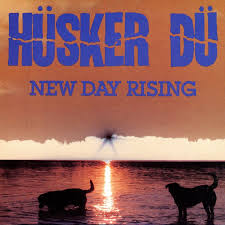
But we’re here, right? We’re doing the damn thing, even if we have no idea what the damn thing is. I think it involves Hūsker Dū, but don’t quote me on that.
Or maybe Hüsker Dü?
As Brian Eno (probably) said: “You’re most alive when you’re not quite sure what’s going on.” If that’s true, then congratulations to me: I am the most alive human in the history of aliveness.
Pass the soup.
Here are some splashes of marvelous from November, 2024:
Watch the following at your own risk. I’m not sure what it is, exactly, but it has big car-crashes-into-a-random-iceberg-floating-down-Main-Street energy. And this ditty is constructing a weird little flute-shaped nest in my brain. Rent free.
This quote by Louise Glück hit me like a piano falling from the sky — sudden, sharp, and oddly satisfying. Except that satisfying part. More like a not-entirely unpleasant metaphysical headache in the key of F#. Anyway, it’s less frustrating than the movie Interstellar.
Read this article about Pulp Fiction turning 30: a retrospective so cool it wears sunglasses indoors. I recommend pairing it with a Royale with Cheese (not included).
Technically this was an October delight. I attended a reading featuring many of the authors from the anthology 3rd and Oak. Then I got the book. You should, too. And if you ever get the chance to see these authors reunite, drop everything and go. Also, a PSA: if Carrie Hayes is moderating anything — I don’t care if it’s a PTA meeting or a seminar on municipal parking regulations — ATTEND. Trust me.
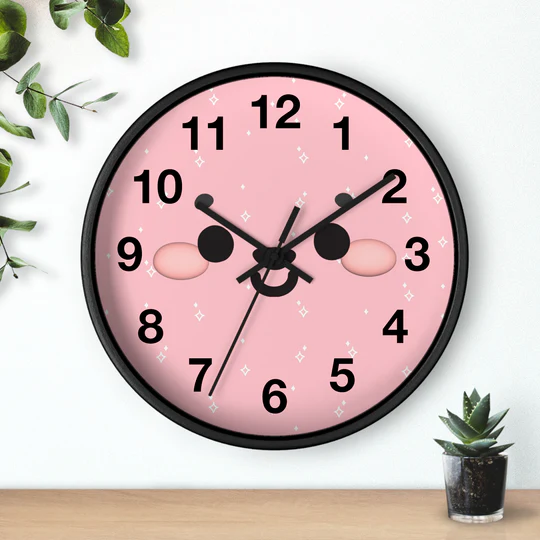
Erika Meitner’s poem over at The New Yorker. Read it. Absorb it. Embody it. Punch a clock in its smug little face. Not this clock, though. It’s cute.
Available at kawaii-heaven.com. I have no affiliation.
Every so often, my teenagers willingly hang out with us, and when they do, we play Jackbox. And let me tell you, I laugh to tears every single time we play. The games are varied enough that everyone gets a moment to shine. Real self-care is enjoying your weird, wonderful family.
So, howdy, December! May yours be full of good essays, weirdly compelling nonsense, and laughter so uncontrollable it could be classified as a cardio workout.
And feel free to call Liam Neeson for me anyway. He seems like he’d be fun to talk with.
Two Le Guins, A General, and a Notable Debut Author
These last four weeks were rare in that the right books and I collided into each other like we ran slow-mo toward each other in some kind of rom-com golden-light meadow. Chocolate may have been involved. It usually is.
This month’s reads were, in many ways, melancholic but also full of life. It’s in the battle between those two forces that the tasty morsels lie. I say “betwixt” because I’m fancy.
The last four weeks were quite a thing (more on that in another post, and everything is fine). Grief and exhaustion were mercenary. I needed mercy — not pity, not a kiss on the forehead — but mercy in its truest, most sustaining form. These books became that mercy.
Reading time, however necessary, was scarce. I took in enough words to stave off starvation, though barely. Crescendo began the month with promise, but then life’s walls came down.
For a time, I didn’t want to feel or think at all. No books, no television or movies, not even music. Eventually, I listened to plinky ambient music — the kind piped through hotel lobbies. Then came a slow tiptoe back to feeling, a desire to care for things. I didn’t want ambient feelings but intentional ones: thoughts that nurture, reinforce, and bring goodness and life without demanding more from me than I could give. But demanding nonetheless. In a good way.
Naturally, this led to a glorious overindulgence in Le Guin — if such a thing is even possible.
Which is all just to say these are the books that I enjoyed enough to finish in the last month:
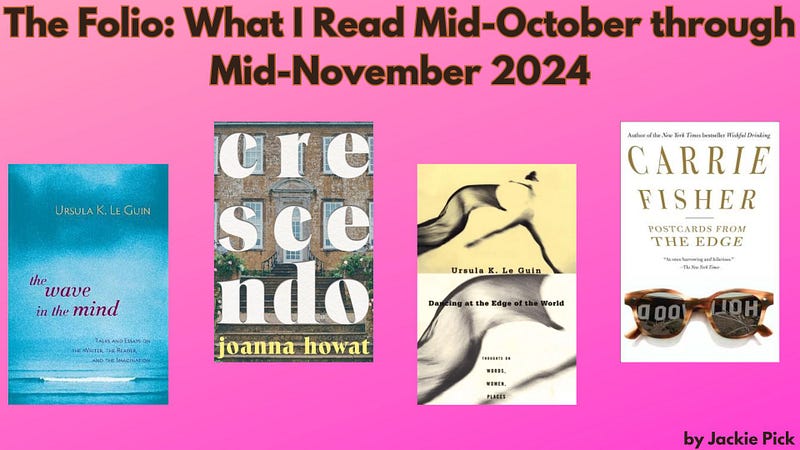
There is a stillness at the heart of Joanna Howat’s lovely new novel Crescendo as it follows two adult children reeling from the accident that took their parents. It is in that stillness that Howat best captures the search for equilibrium and identity. The tragedy and its consequences tear through worlds, relationships, and sense of self, yet Howat never loses sight that death is a part of life, which has as many ridiculous and gentle moments as it does serious and painful ones. In those lighter moments, though, grief also seeps in unpredictably and inconveniently, as Howat also shows.
Jamie, a musician stalled in a drab, unremarkable job, is haunted by a life he cannot quite grasp as well as a more practical need to access a piano. His one light is a new romance, and even that strains under the weight of tragedy so early in its course.
Meanwhile, his sister Caz turns to increasingly self-destructive behaviors that threaten the fragile steadiness of her family. In this stripped-down emotional place, Howat’s story takes flight as Jamie and Caz stumble towards reshaping their lives.
Crescendo pays particular attention to the texture of the ordinary moments that shape young adulthood, all of the pangs and small indecisions that can be ignored until, in a flash, they are unavoidably real. Howat’s focuses on the small, suspended moments that grief amplifies, and the subtle humor that can surface in times of hardship.
This is not a book of overwrought sentiment; its power lies in its honest look at grief with a restrained hand. Rather than dramatizing sorrow, Howat leans into life’s forward march, exploring how family loyalty, memory, responsibilities, and conflicts endure even as the world unravels. Yet Crescendo is not without its moments of levity — Howat tempers Jamie and Caz’s burdens with grace, warmth, and humor. It’s beautifully balanced.
With precision and British sensibility, Howat writes a world both familiar and quietly unsettling. Her prose is crisp, conjuring a sense of place that is cozy with an underlying chill, a reminder that family bonds can be as much a burden as a comfort. Their former nanny appears intermittently, an attentive and overbearing figure whose presence is both welcome and irritating — a person as apt to smother as to comfort. Jamie’s office mates — one competitive and crass, the other empathetic and insightful — round out the minor characters, refreshingly avoiding the clichés typical of supporting roles.
Crescendo places its characters in moments of impasse and progress that move in fits and starts, moments of adrenaline, moments of stillness. Howat brilliantly and, at times, humorously shows grief as it often is: fogged, disorienting, ebbing and flowing. Loss in all of its complex humanity.
I might have wished for a little more of Caz’s point of view for fuller balance to the narration, but this is a small quibble. Though the theme is somber, it is not a weepy stroll through a garden of grief where everyone is either a saint or a monster.
This book offers a surprising sense of escape and an affirmation that, indeed, the only way out is through. Strongly recommend.
Dancing at the Edge of the World is like being hit by a lightning bolt of intelligence, curiosity, and wit — except the lightning bolt also hands you a cup of tea, sits on something cozy, tucks its legs under, and says, “Sit, we’ve got some things to talk about.”
What I value most about this book is its honesty. It doesn’t try to be definitive or grandiose; instead, it starts a conversation — playful and serious in turn — between the writer and the reader.
This collection represents a slice of Le Guin’s thinking across more than a decade, during which she wrestled with pressing personal and societal questions: norms, literary traditions, and humanity’s relationship with the natural world. It’s a series of forays into ideas about writing, feminism, storytelling, and the world we share. You know, small things like that. The essays and speeches are more exploratory than declarative, making them fascinating and ultimately persuasive.
Highlights include “The Carrier Bag Theory of Fiction,” a subversive reimagining of narrative purpose, and the “Bryn Mawr Commencement Address,” which calls for courage and imagination in shaping the world. “Whose Lathe?” is a standout, a brilliant and timely exploration of book banning, as relevant now as it was when she wrote it. It made me want to grab my library card and bellow, errrr, whisper a war cry.
What makes this collection exceptional is the way it bridges the personal and the universal, the writer’s craft and the reader’s world. The slats on that bridge? “How do we live together? What are ways to share the world?” Curious about any of those? Then this is the book for you.
Le Guin’s writing is as lucid and precise as it is poetic and playful. She opens intellectual doors without haranguing, inviting readers to join her. While the collection might feel uneven at times, with some essays lacking cohesion, the diversity of topics reflects her rhythm of thought.
Even in its less polished moments, the book brims with ideas. I love her writing so much I devoured her reviews of books I hadn’t even read and would do so again. Dancing at the Edge of the World is not a handbook or a manifesto — it’s an eddy, tentative yet bold, circling and returning. And if Le Guin stumbles here or there, it’s only because she refuses to stand still.
This is the kind of book that makes you want to pick up a pen — or some other mighty weapon — and face the world, feet firmly planted in whatever world we share.
The Wave in the Mind by Ursula K. Le Guin manages to be both a soothing balm and an electric jolt to the noodle. Beauty, justice, imagination — these timely and timeless essays are steeped in deep respect for writers and storytellers, with Le Guin insisting on honesty, even if that feels like a lot to ask these days.
In this collection of essays, lectures, and reflections, Le Guin offers more brilliant explorations of language, creativity, and the human experience. She moves effortlessly between poetic musings and sharp critiques, always maintaining deep respect for the power of words and the relationship between writers and readers.
The title essay, inspired by Virginia Woolf, likens thought to the rhythm of a wave — nonlinear, rhythmic, wild. Standout pieces include “Being Taken for Granite,” showcasing peak Le Guin wit, and “A Matter of Trust,” which challenges readers to reflect on the ethical responsibilities of storytellers and how to build trust in yourself and beyond (spoiler: write! Then write more!) Another highlight, “Stress-Rhythm in Poetry and Prose,” takes a fascinating, almost scientific approach to language. It’s a linguistic crash course on why words work the way they do. Her discussion of “mumbling” as four unstressed syllables in a row sparked thoughts about how rhythm, stress, and tone shape my humor and communication, both in writing and in spoken word. (To the point that I want to further study linguistics!)
Le Guin’s writing is a cocktail of intellect, warmth, and humor. While the strongest pieces in a collection are often the first, second, and last, this one is threaded with timeless insights into imagination, beauty, and justice from start to finish. The essays succeed in their mission to explore the connections between writing, reading, and living, celebrating imagination as a transformative force. The diversity of topics reflects the rhythm of thought — the wave in the mind, so to speak.
Perhaps most valuable is the book’s honesty. It doesn’t attempt to be definitive or grandiose but instead feels like an intimate conversation, playful and serious in turn. Whether it fully hits the mark depends on each reader, but for me, it absolutely does.
These essays aren’t just about storytelling — they’re about what it means to be an engaged human. The Wave in the Mind is both a celebration of creativity and a call to think critically about how we shape and are shaped by words, stories, and the worlds we create. More of this vibe, please.
Postcards from the Edge is a book written (and clearly semi-lived) by someone who didn’t entirely know what they were doing — and had a hell of a time doing it anyway. Carrie Fisher’s novel tackles serious topics like addiction, recovery, mental health, and fame, but keeps colliding with her brilliant, twisted sense of humor. Thank God for that.
The book is sharp, deep, and honest. It’s abrupt and awkward at times, but breathtakingly well-written if you love dry, self-deprecating (and other-deprecating) humor. And let’s face it, who wouldn’t want to read about showbiz in the 80s — gloriously dank, glittery, and pretending not to be a cesspool?
The story follows Suzanne Vale, a self-deprecating actress navigating rehab, sobriety, and the tangled threads of fame and family. Delivered through a mix of journal entries, letters, and third-person perspectives, the narrative feels like an intimate conversation with someone both smarter and funnier than you, though you’re grateful for it anyway. Fisher’s wit is her superpower, turning even the darkest moments into something dazzling. Her descriptions of people and places are blisteringly precise:
“I shot through my twenties like a luminous thread through a dark needle, blazing toward my destination: Nowhere.”
Her ability to capture mood and anxiety in a single sentence is unparalleled:
“Remember what it was like when you’d be getting ready to jump rope… two people were turning it, and you were waiting for exactly the right moment to jump in? I feel like that all the time.”
Fisher’s skill at drawing character, setting, and mood with just a few brushstrokes is stunning. Weirdly, sadly, it was the story itself that fells flat for me. The story read like the novelization of a one-woman show, and while I haven’t seen the movie, I wouldn’t be surprised if it’s one of those rare cases where the film surpasses the book (*ducks*).
Fisher’s writing is dry to the point of dehydration — my kind of writing. And while I admire Fisher as a performer and writer and human with uncanny self-awareness, underneath it all is pain she never hides. By the end, I wanted to hug her and bring her soup. Perhaps that was the goal. Clever girl.
The novel wobbles, but Suzanne’s voice remains steady. It’s a vivid snapshot of the 80s and the gritty glamour of showbiz. If the plot occasionally falters, the characters and quips more than make up for it.
A Word Before My Shenanigans: While September brought its share of inconveniences for me, it brought devastation to entire communities. Both the community of Springfield, Ohio and those affected by Hurricane Helene faced unimaginable struggles. If you can support your fellow humans in need, I’ll list some places to donate in the comment section.
First, a formal apology for the excessive cuteness about to unfold. I know we’re all pulling ourselves out of the Septempurgatory like it was some sort of bar brawl. Honestly, I’m still finding to-do list shrapnel in my hair.
Septemperament feels like an identity crisis. It’s lumped intofall, and yet we’re standing here, sweating through our half-baked autumn dreams, waiting for the air to chill and pretending we’re not as swampy as an armpit. We can’t settle into the fiscal-year groove until October, yet Halloween candy is already out. Sure, maybe a sugar high is the only thing fending off the looming Septemburnout, but is it also contributing to our sweating? MAYBE. But fun-sized candy does help pass the time during the month’s IMPORTANT AND URGENT MEETINGS. Miss one of those and you activate Septemergency mode.
For a solid 75% of the month, my household was a Septempetri dish. The whole family was sick, overlap-style. And then it was me. Fortunately, just bad head colds, no Septemblarping.
There were new school year events, new responsibilities, and new car troubles, by which I mean Septempanic-inducing check engine lights popping on. Then off. Then on again. We even went to an event that required thematic costumes. My costume highlighted the bags under my eyes. I should have gone as a nice set of Samsonite luggage, possibly with a charming primate ready to toss me around to test my durability.
Emails started rolling in with all those “easy” one-pot meal recipes like it’s cuffing season for dinner plans. The Septemptation is real, though. If I could just toss all my responsibilities into a one-and-done situation — meals, laundry, driving, that would be the Septembest thing ever.
We watched the latest Ghostbusters film. I won’t go so far as to say it was Septerrible, but I didn’t look up from my book once, and I’m a big Paul Rudd fan.
Which is all to say, Septembrawl was a slap-fight with the calendar, the clock, and most of humanity. At any moment, it felt like I’d trip a wire and set off a Septimebomb if I didn’t run faster, farther, or with more finesse.
(That is all metaphorical. I don’t run.)
The busyness swallowed the month, and I haven’t even started on my Reedsy work, which doesn’t feel great. Once this newsletter is out in the ether (hello, Ether-friend!), that’s the next tab I’ll be clicking. Unless, of course, some turn-of-the-century cough starts going around the house again, because obviously.
Anyway, Septemblur has been brought to you (and me) by ibuprofen and my trusty day planner, which I now hope to fill in with ink rather than pencil.
And with that, we Septumble into glorious October — not a moment too soon.
Here are some splashes of marvelous from August, 2024
I got to attend this Printer’s Row Lit Fest and chat with the most marvelous Deborah L. King (whose books you really just have to read. I won’t argue with you about this). Learn more about her work here.
We had milkshakes at Homer’s Ice Cream one night just because. And on another night, we went to Steak ‘n Shake. These are not the same, but each is satisfying in different ways.
Aaaand I’m realizing this blog is mostly an ice cream fandom account.
Apparently, referring to chores as “side quests” is a thing now. (See here and here.) I tried it. I still don’t do chores, but now I’ve got the added stress of imperiling entire worlds because I haven’t tackled the stuck-on gunk in the refrigerator crisper drawer.

 Jackie Pick