Strap on your parachutes, friends, we’re almost at the end of the year. I think I like measuring my year in books, which presents a much more pleasing picture of my 2023 than if I measured it by the number of vats of butter cookies I consumed. Here are the books I read in November that were worth finishing.
The few I’m jazzed enough to discuss? They are all about the heart, emotional landscapes, and their exploration and enrichment.
Birthdays deserve their own red carpet moment. A custom-tailored, roll-out-the-velvet deal. How you spin your red carpet bash, though, that’s your business. Could be low-key. Maybe just you standing on a weirdly fuzzy bathmat, toothbrush in hand, pondering the mysterious ways of your face. Or maybe you’re gunning for the full-blown Academy Awards spectacle. Sure, it might not be everyone’s cup of tea, but who cares? Your birthday, your rules. Unleash the madness, deck out in whatever zany, glitter-bomb gown or suit you want.
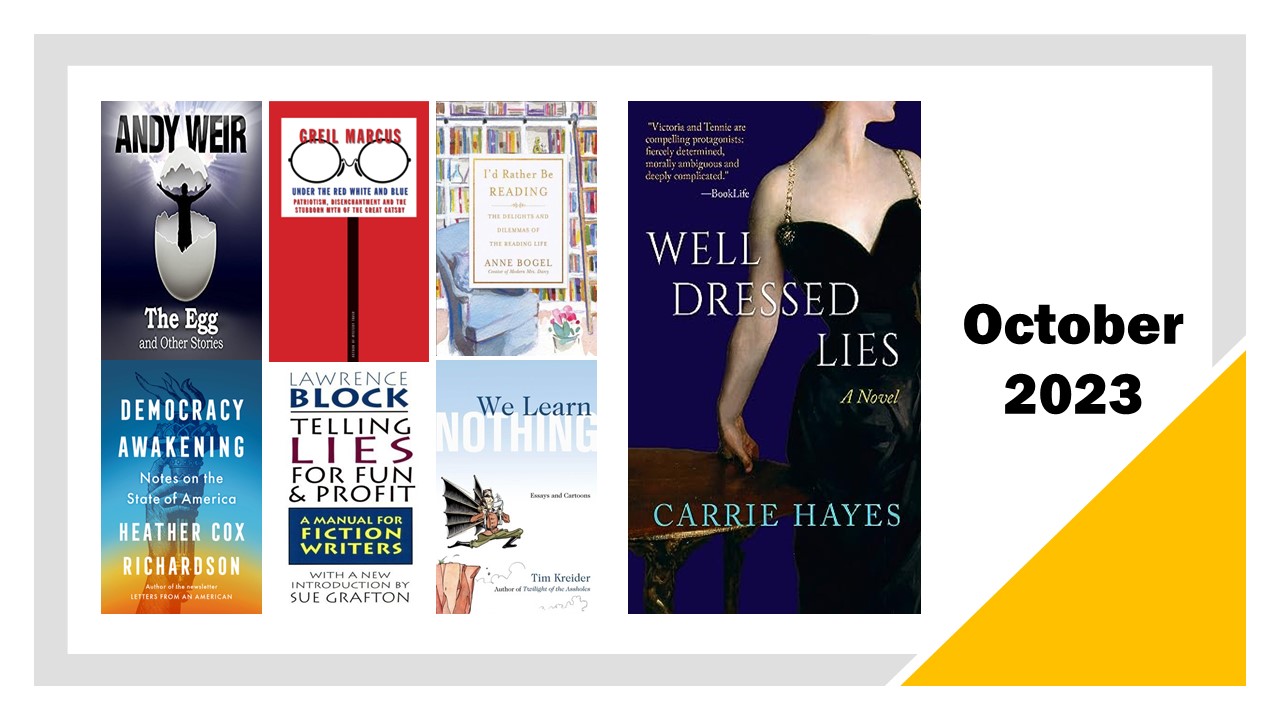
Behold my October reads: each compelling enough to see through to the end. Three of them great enough to share with you here, and other places where reviews are welcome. Like Goodreads. And Amazon. And various aisles in Target.
Apologies to the stranger who didn’t sign up for my spontaneous bookish enthusiasm while browsing olive-leaf-and-oud-scented candles.
Can two trailblazing sisters seamlessly transition from American scandal to aristocratic allure in Britain, trading notoriety for nobility, and redefine themselves amidst Victorian intrigue?
WELL, HELL, I DON’T KNOW.
At least I didn’t until I read Carrie Hayes’ gorgeous new historical novel Well Dressed Lies. And if you have any interest in historical fiction and/or brilliant writing, do dive headfirst into this book.
Well Dressed Lies is a stylish imagining of the lives of occasionally conflicted women caught between trappings and liberation.
The progressive views and bold public stances of sisters Victoria Woodhull and Tennessee Claflin were considered controversial, if not radical, in the late 19th century. We join the sisters in this encore to Naked Truth: Or Equality, The Forbidden Fruit: A Novel as they head to England after enduring public outrage and formidable obstacles in the United States. Can they just traipse from America to Britain’s posh parlors without catching their crinoline on some hook or another? OF COURSE NOT, THAT WOULD BE A VERY BORING BOOK.
(You may want to read the first book, but it’s not necessary if you are patient and/or you have some knowledge of the Claflin sisters. But do read it — it’s delightful for its own sake and replete with Hayes’s dazzling bravura.)
Hayes is careful in her treatment of the sisters and other historical figures in the novel, fully imagining them without sentimentality. The sisters’ relationship pulsates at the core of the story, empowering them to defy society’s disapproval and withstand the relentless scrutiny of casual onlookers.
Hayes has talent to spare and a story to tell. Her greatest gifts, among many, are her wordsmithing and her world-building. We are enrobed in the language and details of the time, which gently pinwheel us in time and place without airs or affectations, and we swing along with the moods of the era. Hayes never underestimates her readers’ intelligence. She plays to our highest intelligence, but never once is arrogant or exclusive. Her prose flows like calligraphy, exuding beauty, elegance, and astonishing flourish. Hayes knows when and how much to withhold or reveal, adroitly keeping the book from veering into melodrama.
For anyone who’s ever tried to find love, who’s tried to reinvent themselves, who’s tried to be more than who the world wants them to be, this book is for you.
Democracy Awakening: Notes on the State of America
This is a necessary book, and possibly a survival guide for the nation.
Democracy Awakening was written by Professor Heather Cox Richardson, author of the insanely popular substack/Facebook posts “Letters From An American.” This book clearly and terrifyingly traces our current teetering-on-the-edge-of-something-terrible back to specific points in American history. Some historical factors for our country’s issues are more inimical than others, but in concert, they are at odds with the nation’s ideals.
Here’s the kicker: Democracy Awakening is not bleak. It is a firm, hopeful call to action for a future that better aligns with the nation’s promises (and its principles and its political legacies). Richardson reminds us that America is not going down without a fight.
I’d Rather Be Reading: The Delights and Dilemmas of the Reading Life
I’d Rather Be Reading: The Delights and Dilemmas of the Reading Life is a scrumptious and rollicking little collection of reading-related essays for those of us whose end tables (and chairs, and desks, and floorboards) creak under the weight of our books, whose veins flow with the ink of a thousand stories, whose personal taxonomy includes a subsection for “books to read before I die,” and whose favorite kind of storm is a plot twist thunderclap.
(The Egg was hit or miss, but where it hit, it hit so good.)

 Jackie Pick