All this and a bag of chips…
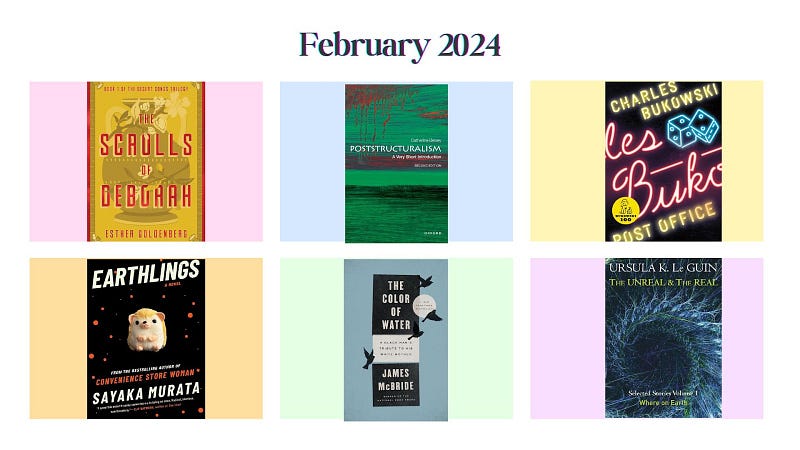
My February reads were all about…aboutness.
I’m not surprised. My own February was all about the aboutness. The aboutness of these books, my writing, and my little spheres. More on that in an upcoming post.
In my previous post, I mentioned it feels as though my reads become a snapshot of that month. Is this synchronicity? Narrative Psychology? Searching for meaning where there is none? Hermeneutics? Dianetics? A sign I’m playing too much Connections?
MAYBE.
February’s reads were about equilibrium and paradoxes in unstable systems, power structures, and belonging.
Without further ado, here are a few words about the books I finished in February, and also some bonus items I enjoyed this month that were not books. If you’d like to talk more about any of these, let me know in the comments!
In no particular order:
Earthlings
How do you survive in a society that actively seeks to harm you? One option is to detach your identity from your physical body and redefine “human.” Another option is to violently reject that society by breaking all of its taboos.
Welcome to Earthlings, where our main characters do that and more.
Our protagonist, Natsuki, believes she is alien — to her own family, this society, and her own humanity. To survive, she stumbles through life with an 11-year-old’s emotional capacity to connect, capable of articulating the grosses of abuses only as “It’s really hard to put into words things that are just a little bit not okay.”
This keeps her alive but not living.
This book is a caboodle of content warnings, loneliness, sorrow, and shame.
It’s a cruel book and a tender one.
Natsuki is lost and disconnected, and like a few of our other narrators this month, her disaffection and abjection are extreme, but not entirely alien to us.
Like all of us, she is in a state of hide and seek, with only other damaged souls calling “Olly olly oxen free.”
She finds sanctuary in outer/inner space.
As I told a friend, proceed at your own risk. Then with abandon.
The Scrolls of Deborah
As I wrote in my review (which you can read HERE), “Goldenberg has picked up the baton of biblical fiction and proves she deserves it. She challenges herself to tell a story rooted in the everyday lives of women in the Middle Bronze Age — lives of service, heartache, and not a great amount of agency. But what is there? Sisterhood. Add to this Deborah’s connection with God, and Goldenberg gives us a beautifully crafted character study, told exquisitely.”
Even if you don’t think you’re a fan of Biblical fiction, try this imaginative retelling of the matriarchs and patriarchs of the Book of Genesis.
Post Office
This book by the godfather of Dirty Realism reads like a Shrinky Dink mid-bake.
This addled temptress was almost indigestible. I wondered if it were an academic exercise designed to alienate and re-engage the reader. “Is this a joke? Am I not getting the joke? Am I the joke?”
Post Office oozes hostility and misogyny, swinging from bawdy to gross. And it’s funny. I feel dirty for reading it.
The book works best in its howlingly funny and bleak depictions of the Post Office’s workings, the longest relationship for the narrator, albeit one built on damage.
With a to-be-read list miles long, I doubt I will seek out more Bukowski, but who knows, because lines like this hit just right:
“In the morning it was morning and I was still alive.
Maybe I’ll write a novel, I thought.
And then I did.”
Poststructuralism: A Very Short Introduction
Poststructuralism, unlike me, developed in France in the 1960s and explores how language describes & constructs our world
This slim book demystifies the critical theory, explores the interplay among knowledge, meaning, and reality, considers the role of language, power, and communication in crafting our sense of identity. It’s a nice dive into what it means to be human.
(And…that’s the connection.)
I really liked it.
The Unreal and the Real: Selected Stories, Volume One: Where on Earth
Some of LeGuin’s earth-bound stories, mostly about people resigned to crumbling desolate places or seeking escape from them. Some hidden gems, some well-known gems, and others that, even in their middling levels, are LeGuin, which is to say, remarkable masterclasses in writing. Come for “The Diary of the Rose,” stay for “Buffalo Gals, Won’t You Come Out Tonight.”
The Color of Water: A Black Man’s Tribute to His White Mother
A story of uncovering secrets and uncovering self, how much we choose to be who we are, how much that is forced upon us, and how much is imprinted. At its heart, though, a story of family.
(MINI-RANT: The audiobook confounded me. There are two narrators of this tale, the author and his mother. The mother’s family came to the country from Poland when she was two, and she was raised primarily in Virginia, which is why the narrator uses…a heavy Borscht-belt “Jewish” accent that is parodic and upholds some weird inapplicable stereotypes?
I turned it off, which was tragic also because J.D. Jackson, who narrated the other chapters, is a complete dream. End rant)
Read, don’t listen to, the book and allow yourself to slow down and savor passages like this:
“It was always so hot, and everyone was so polite, and everything was all surface but underneath it was like a bomb waiting to go off. I always felt that way about the South, that beneath the smiles and southern hospitality and politeness were a lot of guns and liquor and secrets.”
Things made February a little less WTF and more WTG
(Look, as Ms. LeGuin said: “I don’t know anything about reality, but I know what I like”)
My daughter closing in on my height. My sons closing in on their father’s height.
This substack by Michael Ian Black and this one by Steph Sprenger.
These chips. Forever and ever:


 Jackie Pick