Category Archives: Book Review

The Folio: What I Read July 2025

The Hell Is Going On?


This month’s theme is also one of my life’s big questions: The hell is going on? I ask this at least twice a day. More when I’m forced to parallel park, and usually shortened to “The hell?” as men materialize out of nowhere to “help” me by waving their arms like those folks who guide planes on the runway. I do not request their services, and yet they always show up, without those fun and official glowing wands. The gall.

I do not, at present, know what the hell is going on.

The good (?) news is that this month’s books also ask, “The hell is going on?” I suspect if they could, they’d pat me on the shoulder and say, “We were hoping you knew.” If literature offers any comfort, it’s in discovering you’re not the only one functioning in a perpetual state of bewilderment.

This is, I should note, comforting in the way seeing someone else struggle to parallel park is comforting.

All five books embrace the “lean into confusion and see what happens” principle. Narrators, characters, and, in one case, sentient luggage, try to make sense of their place in a universe that insists it’s operating by rules when it clearly isn’t. This requires surrender in a “realizing the plan is not The Plan” sense, not the “I give up” sense.

Now, you may ask, “But what sort of books are these?” To which I reply, “Exactly.”

Ah, the works I read this month, bless their genre-agnostic little hearts.

These books prove categories are sometimes more helpful shelving suggestions than binding agreements. Just like the word “salad” has been applied to things involving marshmallows, cross-pollination of genres is the thing. It’s fine. It works. Categorize these under “Books.”

Anyway, they all attempt to make sense of existence. Usually, this was accompanied by something breaking. Break the fourth wall? Sure. Break entire narrative engines? Cool. Breakdown with enjambment? Why not?

As I said, you’re eventually going to have to give up The Plan and surrender to something in order to find meaning in this weird world.

Otherwise, all you have is an exhaled “The hell is going on” as interrogative rather than declarative.

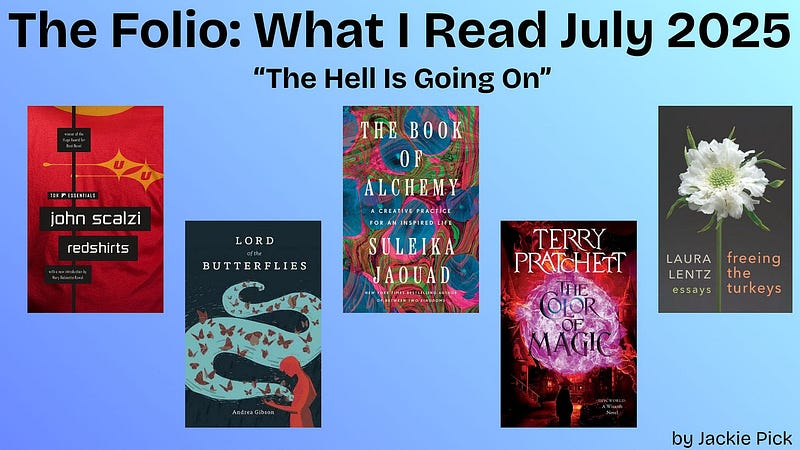
Which is all just to say here (in no particular order except the one I typed them in) are the books I enjoyed enough to finish this month

  • The Book of Alchemy by Suleika Jaouad
  • Redshirts by John Scalzi
  • The Color of Magic by Sir Terry Pratchett
  • Lord of the Butterflies by Andrea Gibson
  • Freeing the Turkeys by Laura Lentz

THE BOOK OF ALCHEMY BY SULEIKA JAOUAD

I’ve never been entirely sure how to journal. The blank pages are tyrannical in their blankness.

The idea, as I gather it, is to faithfully record the events, thoughts, and feelings of your life so that at some point in the distant future when your memory has gone soft and you’ve developed powerful opinions about municipal recycling you may look back upon your younger self and think, “Well, I certainly wasted a lot of time on that.”

But here’s the problem: that may or may not be the case. (CUE RULE-FOLLOWER PANIC.) Should I be composing a daily epistolary masterpiece for the benefit of future anthropologists? Logging the harrowing experience of going to Walgreens and forgetting why I was there (again)? Charting my elaborate plans for inconveniencing people who’ve wronged me? (Not real plans. Just little thought experiments, like, revenge wordle or swapping out one shoe of each pair with something one size too big.)

Hi. I am a writer, i.e., a person who allegedly notices things, and I struggle with journaling. Shouldn’t the noticing of things be enough?

Oh ho, it is not.

The Book of Alchemy will be the first to show you that noticing isn’t effortless or even neutral. It comes with its own weight and politics. The act of paying attention to something is also, always, the act of deciding what to ignore. This is focus, and focus is a critical step of thinking-to-meaning.

This is fun and liberating and important for its own sake.

Each of the ten chapters takes on a theme (Fear, Memory, Healing, Time — the usual gang of existential reprobates) and begins with a short essay by Jaouad. These are followed by writings from guest authors who are, quite frankly, an intimidatingly excellent crowd. (We’re talking George Saunders, Elizabeth Gilbert, Hanif Abdurraqib, Gloria Steinem…and, and, and). Each piece ends with a journaling prompt that, in one way or another, asks who you are when no one is looking.

The tone is devoid of smugness and also mercifully free of false uplift. Just steady voices asking steady questions that somehow end up in very unsteady places.

Jaouad does not pretend writing will fix you, but it might help you see what you’re made of and perhaps uncover things you’ve been avoiding or didn’t know were there.

What this book did, which I did not expect it to do, was put a crack in the dam and get me journaling again — daily! — without worrying if I was doing it right.

This is not a workbook or “30-day challenge.” The Book of Alchemy helps you think about writing and about your history and about how to frame it. It is a companion for the quieter, more difficult work of looking at yourself.

My favorite read of the month.


REDSHIRTS by JOHN SCALZI

Imagine you’re aboard a starship where every mission is likely to end in disaster. You’re not the charming captain or the impossibly brilliant science officer; you’re just a random crew member with a gizmo of some sort. Now imagine realizing all this might literally kill you. That’s the starting point of John Scalzi’s Redshirts, a novel that is, much like the shipmen it depicts, deliciously, wonderfully, brilliantly silly in the grand tradition of Galaxy Quest.

This could’ve been a one-joke book (“Haha, everyone in a red shirt dies!”), but it’s not. Scalzi takes the premise and spins it out into something surprisingly sharp. One minute you’re laughing at a gag about away missions, and the next you’re enjoying musings about free will.

AND THERE ARE ICE SHARKS!

Scalzi’s dialogue is excellent. Scalzi’s characters are sarcastic and often joke to stave off panic.

Funny dialogue is a bit like space travel itself: everyone thinks it should be possible, but few manage to do it without something exploding.

The pacing is brisk, never pausing to admire its own cleverness. There’s a workplace-comedy vibe, but there are also moments of genuine philosophical weight. Scalzi doesn’t overdo any of it or wink at the audience. Additionally, if you’re a Star Trek fan, you’ll find plenty of Easter eggs. No worries — you don’t need to be a superfan. I’m in the “really enjoy the franchise, don’t own a uniform” camp and had a blast.

The characters blurred together occasionally, but that’s probably because I treated this as fun, summer‑escape reading rather than serious, seminar‑note reading. (Pro tip: pay slightly more attention to who’s who at the start than I did.)

Just when you think it’s all hijinks, Scalzi closes with three codas, and the book shifts gears slightly. These short pieces zoom in on a writer, a widow, and a man carrying memories he shouldn’t have, and they add depth to the book. (Coda I also has some insights into writer’s block that may have hit a little close to home.)

If you know what a redshirt is and you have even a sliver of a sense of humor, you’ll probably love this book. If you feel like a redshirt in this world, first of all, big hugs (HEY! MIND THE GIZMO!). Then, read this book.

Humor in novels doesn’t always get the same gravitas as the Serious Literary Stuff (see my review of Pratchett’s The Color of Magic for more of my nonsense about that), but Redshirts proves that funny can also be smart. Read it on vacation. Read it when you need a brain-cation. Read it because reading is allowed to be fun.


THE COLOR OF MAGIC by TERRY PRATCHETT

Writing humor is tricky and often thankless. Serious Novels™ get some grace. Even if people don’t like it, they will admire a Serious Novel™ for its depth, its artistry, and its evocative use of weather as metaphor or something. Like it or not, the brilliance is appreciated. Humor, on the other hand, is subject to the ruthless, binary judgment of the Guffaw Reflex. Either you laugh (Brilliant! Nobel Prize! Drinks on the house!) or you don’t (This author is a flailing imbecile of some sort! Escort them away from all writing instruments and polite society!)

Worry not. The Color of Magic is funny and worthy of respect. Heed these words, because I am not, by any traditional measure, a Fantasy Person (you may insert your own joke there). Fantasy People tend to know things like the difference between a glaive and a halberd or which mystical herb will undo a hex laid by a swamp witch on sabbatical. I, on the other hand, wandered into The Color of Magic expecting a goofy satire and instead found myself on a flat planet balanced on four elephants riding a space turtle. (And I loved it.) Welcome to Discworld. That’s not even the most confusing thing in the first chapter. There are wizards and dragons (sort of), and gods who treat mortals like game pieces. But mostly, there is nonsense, and I mean that in the best way.

The story follows Rincewind, a wizard whose main magical ability is being alive despite it, and Twoflower, an irrepressibly cheerful tourist. They are accompanied by The Luggage, a homicidal wooden chest with hundreds of tiny legs and a poor temperament. Together, they meander across the Disc in four interlinked episodes stitched together by improbable events and glorious wordplay.

I’ll confess that the first thirty pages were slow going, largely because I was trying to parse the rules of fantasy only to realize Pratchett was metaphorically in the margins (or, perhaps more accurately, the footnotes) saying “DON’T WORRY ABOUT IT.” The book assumes, rightly, that lesser fantasy readers may enjoy getting a little lost, which is often where the best views are.

Pratchett’s jokes are embedded in character, narrative, and picking apart tropes. There is affection behind the satire, and intelligence in the absurdity as he reimagines sword-and-sorcery worlds.

The Color of Magic is, supposedly, one of the weaker books in the Discworld series. This is like biting into a “weaker” cake and discovering it’s got three delicious layers AND cream filling AND eating it boosts your credit score.

Is it a perfect book? No. But it’s funny and smarter than it has any right to be.

I am not a Fantasy Person, but I am a student of words — how they’re used, where they’re bent, how meaning is made or broken. Pratchett’s words feel a bit like magic itself. I thank him for it.


LORD OF THE BUTTERFLIES by ANDREA GIBSON

Though it’s probably a mistake to do so, you can boil poetry down to “Pestering the Cosmos”: Who am I? Who are you? Who are we together and apart? What are we doing? Where are we going? What does that mean? Is it good? Is it bad? Does it matter? Who wants a cold plum?

The sensible thing to do when faced with such existential disarray is, of course, to ignore it and hope it goes away. Andrea Gibson, who passed away earlier this year, leaves behind work that refuses to look away from those questions. This may be why they are an extraordinary poet..

I don’t read enough poetry. This is not a confession, it’s an observation about time, and habit, and the way certain genres hover in my peripheral vision. I love poetry with its stripped-down nerve and refusal to put things plainly while absolutely putting things plainly.

The problem is, despite absolutely knowing better and having literally read lots of poetry, I occasionally fall prey to the idea that reading poetry is best done while draped luxuriously in velvet armchairs with minor-key sonatas playing on a gramophone. Possibly a monocle of some size. This is nonsense, of course. Andrea Gibson is no drawing-room poet. They are an open field to explore and run through, and maybe find a soft spot to collapse on.

While the volume is slim, I do not think I could have read Lord of the Butterflies in one go. Some poems require rest stops. Others you’ll want to read again immediately.

I had to stop, then reread the devastating and perfect “America, Reloading.” At first, I wanted to ask whether Gibson had personally survived gun violence, but the poem assumes that, in the United States, everyone alive here has..

Other standouts are “Ode to the Public Panic Attack,” “Diagnosis”, “Good Light.” “Letter to the Editor” and “Boomerang Valentine,” which contains the made-me-snort line “I am so far from ready / for Cupid, that naked little shit.”

Gibson’s voice is part sword, part feather, and you may, after reading a few pages, blink very fast because something got in your eye (it’s feelings. What got in your eye was feelings). Lines like “Come teach me a kinder way / to say my own name” and “There are few weapons more dangerous / than our wounds.” will twist in your chest.

Lord of the Butterflies doesn’t treat the personal and the political as separate continents, but as one slightly tilting island full of people trying to remember each other’s humanity.

Gibson collapses the false divide that so often attempts to place love over here, and pain over there as if the body does not carry both. Their poems ask, again and again, “How do we hold both? How do we move forward anyway?”

You should read their work.


FREEING THE TURKEYS BY LAURA LENTZ

As a child, I believed if I concentrated enough, I could move objects with my mind. I also suspected that grown-ups had very little idea what they were doing.

Alas, my mind never moved a thing. Grown-ups, however, still pretend to know things.

I was and am disappointed, mostly about the mind-moving stuff.

I mention this because Freeing the Turkeys by Laura Lentz reminds me of both my sincere attempt to change the world with my noggin, and my quiet suspicion that no one else is much better at moving the world (or even knowing what they’re doing).

With Lentz’s works, the takeaway is that real movement often comes from noticing how little we actually understand.

Personal essays are notoriously treacherous terrain. They can tip easily into performative writing carefully crafted to make you feel impressed, or guilty, or impressed with how guilty you feel.

Lentz maneuvers her terrain with clarity and not a whiff of performativeness.

Her essays deal with the usual human muddles (grief, time, family, the oddness of Life doing confounding things), but she has the gift of discovering entire universes in the smallest things.

She is eminently underlinable. From the essay Quieting the Noise: “Real silence is not silence at all, but a worthiness, an all-filled existence where we are freed from criticism and delusion and judgment.”

Then there’s the bit where she points out the difference between “Be good” and “You are good.” One is an order. The other assumes grace.

Oh, and this: Time is attention, and attention doesn’t involve a cell phone or a watch. It’s about knowing something or someone so well your rhythm and their rhythm become synced.

This sounds suspiciously like love, if we’re still using that word. (We are.)

Lentz never tries to sell you on redemption or reinvention, and she is certainly not lecturing us. What she writes is honest, funny, and very real. She does come across as a bit of an earth mother, but the good kind. The kind who will tell you the truth, offer you something warm to eat or drink, and then go quiet long enough for you to hear yourself thinking.

This book didn’t change my life in an Oprah‑style, confetti‑and‑crying‑on‑the‑couch kind of way. But it snuck in and echoed for days.

This is a book you should keep in places you forget to look for wonder. Lentz might just move you with her mind.


And there be the July reads. As always, I welcome any recommendations! What’s in your TBR pile?
The Folio: What I Read June 2025

Musings Gone Wild! Almost Zero Horrors!

Hello and other pleasantries to new followers and the brave souls who have been tolerating my nonsense for quite some time.

A reminder and an announcement. I produce two categories of posts:

  1. A sort of high-octane humor that usually ends with me typing in all caps and you wondering whether you’ve accidentally subscribed to the ramblings of an unusually literate honey badger.
  2. Book reviews.

Book reviews are published monthly as “The Folio.” They begin with an attempt at a witty introduction and segue into a more measured discussion. These reviews are longer than advisable, and this, I am aware, can be a turn-off.

Am I trying to turn you on? Certainly, but only to using your library card. Anything else would be unseemly.

I am attempting to keep the reviews aligned with my predilection toward absurdity. Who doesn’t love a slightly deranged, funny book review? PUT YOUR HANDS DOWN. THIS IS THE INTERNET. I CAN’T SEE YOU AND ALSO IT WAS A RHETORICAL QUESTION.

Yes, occasionally, seriousness is unavoidable, especially for the sake of basic human decency. For example, books about war, grief, trauma, or any of the Chicken Soup for the Soul series.

But Writing Reviews That Must All Be Taken Seriously is not always enjoyable. If I must always be properly serious, I’ll run around the town square bellowing “LOOK UPON MY CREDENTIALS, YE MIGHTY!” (which is, incidentally, the fastest way to clear a town square).

Generally, I see no reason to pretend that book reviews should be written in the hushed tone of someone narrating a documentary about endangered sea turtles.

Instead, I’m determined to write the kind of book reviews I’d want to read. Irreverent, digressive, somewhat useful, and not especially academic. When writing these pieces starts feeling like homework, I suspect reading them feels the same. (See review of Terry Pratchett’s book below.)

This is a process. I must first declare independence from the Good Scholar mindset, which is as persistent as mildew and probably smells like it as well.

We’ll see if this works. Forecast: probably not, but to be fair, optimism and I maintain a long-distance relationship.

Anyway, welcome. Or welcome back. Or Welcome Back, Kotter.

Signed, Epstein’s Mother.


I attempted hedonism with my reading this month, which is a pretentious way of saying I tried to read purely for pleasure. Most of the books cooperated. Not Fever Dream, which was an absolute miscalculation on the “fun!” reading scale. It was alarming, but, to be fair, exactly as alarming as promised. (I mean, the title isn’t Sweet Dreams and No Trauma Here.)

This was supposed to be my no-apocalypse month. And while there wasn’t a climate disaster in the bunch (I’ve tended to accidentally read a lot of those this year, if one can accidentally read anything to the end), Fever Dream did slip in poisoned groundwater and the creeping suspicion that everything is contaminated.

As in every month, I tried to find a coherent, unifying thread to connect the books I’d read. Something elegant and unassailable, like a particularly clever (and attractive!) spiderweb. Something that would make me sound like I’d been preparing a rigorous syllabus rather than just reading while eating toast.

The toast, for the record, was not entirely uninspirational.

At first, I thought the unifying theme was “Overthinking,” which is my preferred pastime. Every narrator here is the sort of person who can transform an ordinary moment into an ontological exploration through sheer sustained attention. These are books about people who can’t let a single thought pass unexamined. I recognized them immediately. I am Spartacus.

Just as I was congratulating myself on having found a thesis, another potential theme popped into mind. These books are also about “The Not-Necessarily-Horrific Coming Apart of the Well-Ordered Life.” Which, okay, wordy. All these books involve trying to build a manageable life, only to discover that order is a losing battle. Even the simplest lives can turn chaotic if you pay them too much attention. Or not enough. These books have both.

I spent significant time trying to choose which of these themes to highlight. Overthinking? Everyday order derailment? Eventually, I remembered this is not English Lit 201: Advanced Book Review Blogging and Merriment. No one is grading me. No one even asked for this. (Why didn’t you ask for this, by the way?)

So consider this month’s selections a set of reminders: that our minds are weird and perilous places, that “normal” is perhaps a myth, and that occasionally you will read something so funny, real, and/or unsettling that you won’t even care about the toast crumbs taking up residence down your shirt.

Which is all just to say here are the books I enjoyed enough to finish this month:

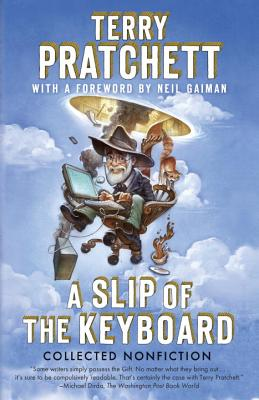
A SLIP OF THE KEYBOARD: COLLECTED NON-FICTION BY TERRY PRATCHETT

FUNNY GIRL BY NICK HORNBY

RUN FOR THE HILLS BY KEVIN WILSON

POND BY CLAIRE-LOUISE BENNETT

FEVER DREAM BY SAMANTA SCHWEBLIN


A SLIP OF THE KEYBOARD: COLLECTED NON-FICTION BY TERRY PRATCHETT

Cover of the book “A Slip of the Keyboard” by Terry Pratchett

My favorite read this month.

Terry Pratchett calls writing “the most fun you can have by yourself.” It’s a throwaway line, but like much that Pratchett lobbed at the world, it is three things at once: it’s funny, it’s self-deprecating, and it’s true.

This collection includes essays, speeches, introductions, and odd bits of reflection. It covers everything from fantasy literature to mushroom picking to Alzheimer’s. It’s brimming with the idea that the ordinary world is weird and interesting. There’s also a bracing indignation aimed squarely at deserving targets, yet even his fury is grounded in compassion.

Here you’ll find Pratchett in fine form, gleefully pricking the balloon of literary snobbery. “Where do you get your fantastic ideas from? You steal them,” he writes. “You steal them from reality. It outstrips fantasy most of the time.” (N.B. This is why writers keep notebooks: to record all the implausible things real people say and do). And you get the sense that saying this felt like slipping a whoopee cushion onto the seat of every Very Serious Writer at some awards banquet.

One of the pleasures of this collection is watching him circle the same conviction again and again: writing, for all its challenges, is meant to be enjoyed. In Chapter 12, he advises writers to amuse ourselves first, because if you’re not having a good time, your readers won’t either. (It sounds obvious until you remember how many books seem to be written purely as acts of flagellation, self or otherwise.) This spirit thrums through every piece. There’s a giddy undercurrent that never tips into preciousness or stupidity. It’s radically sincere and radically human.

Of course, the book isn’t all winks and asides. The essays move into the time after his Alzheimer’s diagnosis, and there is a sharpening. The humor stays, although it can get a little dark, but there’s an urgency, especially as he discusses assisted dying and the politics of autonomy. He had no intention of squandering any of his time on politeness or bromides.

It’s also worth noting how nimble he is. Pratchett can write equally brilliantly about dismantling the idiocy of genre snobbery as he can about daiquiris, and it all feels grounded in what is very clearly his voice and worldview. If you could distill a giggle, a guffaw, a groan, a raised eyebrow, and a perfectly aimed lightning bolt into a single human being, I’d like to think we’d get something very close to Terry Pratchett.

Standouts are most of them, but I particularly loved: “2001: The Vision and the Reality”, “The God Moment”, “Doctor Who?,” and “A Week in the Death of Terry Pratchett.”

Highly recommended. You don’t have to be a Discworld devotee to appreciate this. (I haven’t read them yet.) But you probably should care about books and stories and people and the planet. And if there’s an afterlife with any good sense, may it have a library big enough for him, a comfortable chair, and a hat no one is foolish enough to pinch.


FUNNY GIRL BY NICK HORNBY

Book cover of “Funny Girl” by Nick Hornby

Some of us (ME!) want the laugh. As a child, I’d sneak VHS tapes of Monty Python and Saturday Night Live, memorize sketches, and reassign myself all the best roles. I mentally cast myself as Madeline Kahn in everything she ever did.

So when beauty queen and I Love Lucy-obsessed Barbara Parker realized she’d rather have the punchline than the pedestal, I got it. She wanted to be in the room where the funny happened. Correction: she wanted to be the funny happening. And good for her. Beauty was/is a far more economically efficient trait.

Nick Hornby’s Funny Girl follows Barbara as she abandons the pageant world and reinvents herself as Sophie Straw, a comedically ambitious, photogenic young woman determined to become the next Lucille Ball. She moves to London, lands a lead in a new BBC sitcom almost immediately, and finds herself at the center of a cultural moment. This may sound like the setup for a frothy star-is-born tale, and it is. It’s also well done.

At its best, it’s a warm backstage novel with plenty of nostalgia for 1960s London and classic, frothy sitcoms. The first section snaps. Sophie’s introduction to the world of television is filled with biting dialogue, insecure creatives, and writing-room banter (which is arguably the best part of the book). Hornby nails the way brilliance and bitterness coexist in a creative team, as well as the cranky machine that seems to have been the BBC. I would happily read an entire novel that never left that room.

Once the sitcom takes off and Sophie settles into her role as national darling, the narrative zooms out. We get more focus on her coworkers: writers Bill and Tony, who steal scene after scene (especially Bill!). They embody one of the novel’s central tensions: should comedy comfort or provoke?

The “funny” dissipates into complexity, and it mostly works. Hornby’s wonderful at dialogue, even better at capturing the feeling of being slightly out of sync and by being ahead of your time. Funny Girl is like one of those rubber playground balls: bouncy and liable to knock you in the face when you least expect it. Hornby captures much of the texture of 1960s television: the starchy formality, creative constraints, looming cultural shifts.

What I loved most — and what I wanted more of — was the joy of collaboration, the weird alchemy of making something funny with other people. That’s where the book shines. Not in fame or romance or the idea of being “the one girl,” but in the magic of a room full of smart, neurotic misfits trying to make each other laugh.

If there’s a flaw, it’s the one that afflicts many long-running series. Eventually, there’s a sense that a wrap-up should have come sooner. Also, the book never quite reckons with the sexism it documents. That might have been thrilling as well, but a book cannot be all things to all readers.

When this book lands, it lands. It gets the weird intimacy of artistic collaboration. It gets the rush of writing a good bit. It gets the long slide from being new and bold to just being there.

Perfect for summer. It’s sweet and tart like lemonade, and just as delightful.


RUN FOR THE HILLS BY KEVIN WILSON

Book cover of Run for the Hills by Kevin Wilson

Most of us were raised on a diet of artificially flavored found-family stories. That most cherished of modern fables in which a group of charming misfits (orphans, strays, emotionally stunted baristas, etc.) band together and discover that what really matters isn’t who raised you. (See also: The Brady Bunch, those sunny-eyed avatars of family bliss. Fictional. Sanitized. Immortalized on lunch boxes.) Somewhere along the way, these found families become closer than real families.

Cue the swelling music. Hugs all around.

Enter Run for the Hills, Kevin Wilson’s contribution to the genre, which, thankfully, avoids nearly all of the above. It is not randomly peopled with inexplicably irrepressible eccentrics who “just need each other.” What it is, instead, is a not-saccharine-yet-still-positive, more ambivalent version of found family.

It starts with Mad Hill, a woman living a self-contained life on her mother’s farm, doing a great job avoiding the complicated legacy of her absentee father and minding her emotional business like a professional. That is, until her half-brother Reuben shows up. His plan is to track down the man who abandoned them both, and see if a couple of other step-siblings are up for meeting, if not joining the adventure. The sudden reveal of a half-brother, his PT Cruiser, other siblings, and this whole nutty scavenger hunt is…a lot for Mad to take in. Mad does not want to go. She says yes anyway. This is what we call family obligation, and also improv training, which sadly has no place in this book at all.

What unfolds is a road trip that’s more emotional audit than grand adventure. Wilson isn’t interested in big plot mechanics or over-processed closure. These siblings don’t know each other. All they have is blood and disappointment and a half-formed instinct to care. Over the miles, something resembling a bond starts to form because they decided to try.

The entire trip is a glorious, laugh-out-loud exercise in restrained dysfunction among truly good people.

Wilson writes with enormous empathy and just the right amount of weirdness. The book is emotionally resonant, highly enjoyable without begging for a laugh track or a piped in “awwww.”

After a carefully paced journey, the final pages may feel slightly soft, a quiet, gentle roll to a stop for some readers. Look, sometimes road trips end and sometimes they just keep going.

So, no, this is not the Brady Bunch. It is not about the ideal family, or even the fully-healed one. It’s about the possibility that choosing to remain in proximity to others, despite discomfort or history, is its own kind of commitment. And there is a lot of fun to be had in that.


POND BY CLAIRE-LOUISE BENNETT

Book Cover for Pond by Clair-Louise Bennett

Most people will do almost anything to avoid being alone with their thoughts. They will join clubs. They will cultivate elaborate social obligations. They will distract themselves with devices whose primary purpose is to obliterate solitude (see: iPhone, pickleball). Claire-Louise Bennett’s Pond is a testament to the opposite impulse: the deliberate, even defiant choice to pay attention to one’s mind. Where a banana left out becomes memento mori.

Reading Pond feels like showing up ten minutes late to a strange, luminous experimental film. You stand there, half-certain you’ve missed the part that explained everything, until you realize there is no part like that. You are simply inside someone else’s mind, and you get to stay.

In her debut collection, Claire-Louise Bennett assembles 20 fragments, vignettes, and near-monologues narrated by a semi-reclusive woman living alone on the edge of a village in the west of Ireland. She is never named; she is quite selective about what she shares about her exterior life. What she does share with abandon is a torrential, exhilarating interiority. Our narrator has a mind exquisitely tuned to its thoughts. This isn’t stream-of-consciousness, it’s a waterpark.

What is Pond about? Well, there isn’t much about here. No driving plot, no clear progression. But I’d argue there’s a lot of “there” there. There is an astonishing amount of noticing. Jeannine Ouellette (among others, but I like her approach very much) talks about paying attention as a radical act, an act of devotion, an act of “the most powerful writing practice you can cultivate for yourself.” Pond proves that. Each piece zooms in on a moment, an object, a mood. “Morning, Noon, & Night,” for example, imbues the most basic of breakfast foods with something close to rapture. Bennett’s descriptions are precise and saturated with significance. It’s Walden if Thoreau were a woman living alone in Ireland, interested in cooktop knobs, and quite possibly happier for it.

Bennett sounds like a dear friend who overshares with deep self-awareness while you sit and watch her “do her thing.” Take this line:

“English, strictly speaking, is not my first language by the way. I haven’t yet discovered what my first language is so for the time being I use English words in order to say things.”

This book requires a carving out of uninterrupted time. (Which is to say, this is probably not the book to read in five-minute increments between checking email.) But it is unmistakably alive . Prickly, even. It is also, in its way, a challenge: Who among us is willing to be this honest about what goes on in our heads when no one is looking? Most people can’t stand a single unscheduled thought. This book contains nothing but.

If you want to be reminded that noticing is itself an art form, then I say yes and yes again.


FEVER DREAM BY SAMANTA SCHWEBLIN

Book cover of Fever Dream By Samantha Schweblin

This is a book you absorb, like a symphony or a toxin, depending. It’s short, disorienting, beautifully written, and unpleasant in the best way. 

It is called Fever Dream, which is helpful, as the entire experience reads like the kind of dream you’d have after eating something you should not have eaten at a charity luncheon.

At first glance, this slim, unassuming volume looks harmless. You think, “Oh good, I can read this in a day.” Which you can. What you won’t expect is to spend the evening staring at your water glass, wondering if it has ever tasted quite so chemical.

The premise is simple: Amanda is dying. A boy named David (or perhaps a child-shaped presence named David), who may be real or may be the embodiment of Amanda’s crippling maternal worry or the result of illness, interrogates her as she drifts in and out of narrative coherence. She is trying to explain what happened. He is trying to hurry her along.

Early on, Amanda introduces the concept of “rescue distance” — the invisible, ever-changing rope between her and her daughter that represents how far her daughter can be while Amanda is still able to keep her safe.. She recalculates the rescue distance constantly depending on terrain, proximity, and possible threat. The “rope” tugs or goes slack, and both states feel awful for different reasons. It is one of the best metaphors for motherhood I’ve ever read, a reminder that parenthood is mostly the exhausting calculation of invisible risks.

Something is wrong, not just in Amanda’s mind, but in the rural Argentine town she’s visiting. The land is poisoned. Children are sick. Animals are dying. There’s a woman who might be a witch, and a boy whose soul might have been split or transformed. Or perhaps he was just traumatized. Schweblin doesn’t lean too hard into explaining the supernatural elements that vibrate in the background. That’s not where the horror lives.

The horror is in the groundwater and the gossip and the things the residents agree to pretend not to see. This town is rotting.

Structurally, the book is a conversation braided with memory, braided with something that may or may not be happening in real time. Whether David is present or imagined is irrelevant in this claustrophobic fever-dream-within-a-fever-dream. One minute you’re in a waiting room with Amanda, the next, you’re on a farm with Amanda and dead animals and sick children.

Megan McDowell’s translation carries it beautifully. It’s sparse, urgent, and devoid of unnecessary hand-holding.

As for the ending: it puzzles with an elegant disregard for the readers’ expectations.

Fever Dream is an exquisitely crafted conjoining of anxiety, dread, and maternal devotion. It is disorienting and unforgettable.

It’s motherhood rewritten as slow-burn horror.


And thus went June. I’m excited for my July reads, and as always, I welcome any recommendations! What’s in your TBR pile?

The Folio: What I Read April 2025


Reality Is Suspicious and So Are You

April 2025 reading list by Jackie Pick, titled “The Folio: What I Read April 2025.” Subheading reads: “Reality Is Suspicious and So Are You.” Books shown: Alice in Wonderland, Gentle Writing Advice, Another Roadside Attraction, and Joan of Miami.

This month, I tried to read books that, strictly speaking, weren’t about the world ending in fire, bureaucracy, or vibes. Not because I believe the world isn’t decomposing in full view — it is, and with remarkable enthusiasm — but because I am occasionally tired of being reminded.

I didn’t consume books like they were rations in a bunker. I didn’t read to survive. I read to live. And it was exactly what my overtaxed little brain needed. Books full of humor, weirdness, and sharp little elbows jabbing at the ribs of reality. Did the world behave better as a result? Nope. But these books at least did not add to the noise. They were entertaining. Intelligent. Occasionally infuriating.

You know. Worthwhile.

Can I connect them all thematically? Ha. Obviously. That’s what we do here. Let’s lay them out like tea leaves spilled across a summoning circle and see what dark magic swirls out.

If there’s a thread among these books, it’s not tone or genre. It’s attitude. These are books written by and for people who look at the world and say, “I don’t think so.” Books that side-eye the system, question reality, and refuse to take their elbows off the table.

They are books for people who suspect that reality (like most things) has been poorly edited, and that it’s entirely reasonable to rewrite it.

If you’re looking for polite stories about polite people doing what they’re told, you’ll find none of that here.

Which is all just to say these are the books I enjoyed enough to finish in the last month:

Alice In Wonderland/Through the Looking Glass by Lewis Carroll
Gentle Writing Advice by Chuck Wendig
Another Roadside Attraction by Tom Robbins
Joan of Miami by A. Parrish

Let’s begin.


Alice’s Adventures in Wonderland/Through the Looking Glass by Lewis Carroll

Abandon Linear Thought, Ye Mighty.

Lewis Carroll’s Alice’s Adventures in Wonderland and its companion novel, Through the Looking-Glass, form an enduringly strange and brilliant duology. These tales are far more than whimsical romps through fantastical lands — they are surrealist puzzles, philosophical playgrounds, and cultural mirrors that continue to enchant and perplex readers of all ages.

Though often lumped together, Alice’s Adventures in Wonderland and Through the Looking-Glass have distinct tones and structures. Both follow Alice, a sensible girl dropped into thoroughly nonsensical worlds: first through a rabbit hole into the chaotic dream-logic of Wonderland, then through a mirror into a more structured, chessboard-like realm. Wonderland is a tumbling disorder full of talking animals, shifting rules, and queens obsessed with beheadings, while Looking-Glass is more of a surreal thought experiment, populated by living poetry, mirrored rules, and unsettling nursery rhyme characters. If the first is all riddles and reversals, the second feels like an upward climb toward queenship, meaning, and a strange kind of self-awareness. Both show worlds run by folks who absolutely should not be running the world. Through it all, Alice is as polite as she can be.

Carroll’s characters are unforgettable weirdos who’ve pitched tents in the collective unconscious. From the fretful White Rabbit and the cryptic Cheshire Cat to the haughty Red Queen and the delightfully befuddled Tweedledee and Tweedledum, each figure feels both iconic and symbolic. Some represent the adult world’s hypocrisy, others embody logical paradoxes or childhood anxieties. Their nonsensical dialogue is often razor-sharp satire disguised as silliness. They are real in that sideways way. They’re not metaphors, they are archetypes of dysfunction. And Alice, when she doesn’t outright defeat them, walks away.

Though often labeled children’s stories, these books are subversive and complex. Carroll’s background as a mathematician shines through in his love of paradox and his relentless wordplay as the engine of the narrative. Logic, grammar, and social norms are constantly upended. Alice isn’t just navigating strange places; she’s navigating meaning itself. The poems, puns, and riddles twist language until it starts to resemble something closer to truth — or at least, a more honest kind of nonsense. Carroll games the English language like an old pinball machine and never tilts.

And it works because Carroll seems to understand better than most that language is a power tool. Or a tool of power. Either way, people in power often speak the most nonsense with the greatest confidence.

Alice is a triumphant protagonist: curious, skeptical, occasionally indignant, and deeply grounded in a child’s sense of fairness and reason. She’s not a wide-eyed innocent but a sharp observer who meets absurdity with exasperation rather than awe, making her the voice of reason in a world that gleefully resists it. Neither helpless nor perfect, she holds her own against the madness. In doing so, she becomes the grounding force that allows the books to spiral, twist, and tumble without losing their center.

Alice is just trying to make sense of it all, get to where she thinks she should go, and make some friends along the way without getting her head bitten (or chopped) off.

Aren’t we all?

These books endure because they resist a single interpretation. They can be read as nonsense or satire, fantasy or dreamscape, children’s story or commentary on Victorian society — or all of these at once. Carroll invites readers into a world where nothing is fixed, and that openness keeps Alice fresh with each reread.

Together, Alice’s Adventures in Wonderland and Through the Looking-Glass are strange, clever, disorienting, and absolutely iconic for reasons that are both obvious and, frankly, impossible to explain. They remind us that logic can be silly, that childhood contains profound insight, and that language itself is a kind of magic.

If you’re willing to wander, they’ll take you somewhere worth going.


Gentle Writing Advice by Chuck Wendig

How to Be a Writer Without Coming Entirely Unglued

Writing advice is usually:

  • Agonizingly Practical (“Use a timer, a color-coded scene-by-scene spreadsheet, and an accountability partner with a whistle and cocked eyebrow.”)
  • Fussily Prescriptive (“Make sure your protagonist’s internal arc adheres to all twelve stages of the Hero’s Journey and Save the Cat, then read the entire Western Canon [preferably in the original languages] before attempting dialogue.”)
  • Completely Bananas (“Lie in damp grass, arch your feet, and listen for the ghost of Virginia Woolf to whisper your story into the mist.”)

Oh ho! But there’s another category: advice that isn’t so much instruction as permission. Permission to be weird. Permission to be lost. Permission to not write for a while, or write badly, or want to burn everything down and start a goat farm.

This category is usually where the good stuff is.

Cue Chuck Wendig.

Gentle Writing Advice: How to Be a Writer Without Destroying Yourself is, in theory, a craft book. But in reality, it’s an exploration of “Why Bother?” in the best sense. It’s also hysterical, intelligent, and surprisingly tender in a way that makes you realize halfway through a solid joke about Comic Sans that you’re actually crying. Or writing your next book. Or both.

I am a — well, not firm believer, but a somewhat jiggly, Jell-O-level believer — that writing expertise is mostly a slippery reflection of what we’ve already done. For example, I am an expert on my most recent dumb social media joke, my last published piece, and my last writing disaster (unpublished, thank goodness). That’s the résumé. And yet, like everyone else, I want the hacks. The tricks. The hacks about the tricks.

But what we really want is reassurance that we’re capable, we’ll find our voice (again or ever), and our messiness doesn’t disqualify us from making something good. We want to laugh at ourselves and fiercely believe in ourselves. We want someone to tell us how to be confident and vulnerable and brave and realistic and gentle and productive and very specifically address the spiral of concerns we have about that one unfinished essay that haunts us like a ghost in a hoodie sitting in the corner of our writing space playing the recorder.

Chuck Wendig gets that. (The need-for-reassurance part, not the recorder-playing-ghost part. I hope.)

Note: Yes, the title says “gentle,” but he’s saucy and foul-mouthed, and his words come at you rat-a-tat-tat. And then, like most saucy, hilarious, foul-mouthed people, he lets the mushy, empathetic core out.

In the introduction, Wendig warns us: “Writing advice is bullshit. But bullshit fertilizes.”

Unfortunately, this is very good advice.

He takes aim at the MFA-ified “listen to the clouds” advice that dominates traditional literary circles. Not because it’s wrong, but because it doesn’t always speak to the chaos-writing many of us do in the margins of our lives. We, the 4 AM Scribblers.

Please consider this book if only for the footnotes. (See page 8 for one that made me snort my coffee). Chapter 5, “Self-Care for Writers,” contains a section on shame that I desperately needed, along with perhaps one of the most resonant pieces of writing advice I’ve ever heard:

“Self-care sometimes means limiting people’s access to you.”

This funny, sweary, generous writing guide believes in you. It’s vulnerable because it knows you are, too. It’s strong because it’s built to help you keep going. Gentle Writing Advice connects us to something inside ourselves that still believes in trying.

And honestly? I’m happy Wendig and I live in the same timeline. (I think. The man gives strong “slides between dimensions on Tuesdays” energy.)


Another Roadside Attraction by Tom Robbins

Absurdist fiction / countercultural theology / metaphysical hot dog stand

Let me begin by saying that I do not believe in roadside attractions. I believe in roads. I believe in destinations. I believe in stopping only when absolutely necessary: for example, when a building is on fire, or when someone is waving at you to prevent you from driving into a sinkhole.

Roadside attractions, as a concept, suggest you are not already where you’re meant to be.

Which also describes this novel.

Another Roadside Attraction is Tom Robbins’s debut novel, and it comes in HOT. The plot, such as it is, is something like: a clairvoyant ex-circus performer named Amanda and her musician/tightrope-walking husband John Paul open a roadside hot dog stand that is also a museum of weirdness. They are joined by a scientist/drifter/occasional scold named Marx Marvelous and an ex-CIA operative named Plucky Purcell who steals the mummified body of Jesus Christ. What follows is a swirl of theology, sex, and philosophy.

If you’ve ever read a book and hoped there was at least one pet baboon in it, you’re in luck.

The prose is a study in excesses. Robbins unleashes language upon the reader. His sentences somersault and flirt, then rest. Even when it’s too much — and it often is — it’s never boring.

The characters are archetypes in tie-dye, full of delightfully implausible wisdom and nonsense. Amanda, especially, is the grandmother of every mystic dream girl in contemporary fiction. Yes, radiant, but also written in that “male-gaze-mystical-fertility-goddess of the 70s” way. (although, to be fair, her agency and internal logic are more developed than “archetype” implies.) John Paul is a philosophical foil with a man bun before man buns were a thing. Robbins clearly adores his characters and seems to write them with a loving sense of “You’re fabulous, go be free.”

This book does not ask for permission to be weird. It takes swings at organized religion, capitalism, science, mysticism, and the entire notion of polite fiction.

As one character puts it: “Real courage is risking one’s clichés.”

Robbins risks every cliché. And that is fun. He has big, unwieldy, thought-provoking, and possibly unwashed ideas.

Overall, however, the book felt pseudo…something. Philosophical? Poetic? Literary? Infectious? Familiar? Challenging?

Perhaps that is due to the writing style, which felt relentless. It is metaphor-as-worldview. Or at least as a hallucinogenic window to a worldview. If you’re in the mood, it’s delicious. If you’re not, it feels like being sea-lioned by someone in a fedora who wants to “explain” how you’ve misunderstood greatness by just asking questions. A different editor, perhaps, might have been warranted.

And yes, the book is extremely of its time, and it may be possible to get a contact high off of some of the passages.

Don’t read Another Roadside Attraction for plot. Read it for the ride. For the glittering, overgrown language. For the absurdity and the sincere questioning. For a bygone world that’s falling apart but bringing forth a whiff of patchouli and old truths. It’s for all of us weird kids.

And here’s the thing: Despite all that, I feel largely indifferent about Another Roadside Attraction, and I think Robbins, were he to float by on a peyote-scented cloud, might actually be fine with that. This isn’t a book that begs to be loved by everyone. It’s not tidy — it’s not even particularly clear — and it’s not universal. It’s certainly not a relaxing tale.

This book is not normal.

A not-normal book doesn’t necessarily need adoration. It just needs you to walk through it once, eyes open, and maybe leave a little differently than you arrived. You may even end up admiring it, as I did.


Joan of Miami by A. Parrish

A Joan for the 21st Century

It’s an ambitious book and, to its credit, entertaining while committed to the radical notion that a young woman with opinions might actually change the world.


Read any good books lately? Let me know in the comments!