Jackie Pick is a former teacher and current writer living in the Chicago area. She is a contributing author to multiple anthologies, including Multiples Illuminated, So Glad They Told Me: Women Get Real about Motherhood, Here in the Middle, as well as the and the literary magazines The Sun and Selfish. She received Honorable Mention from the Mark Twain House and Museum for her entry in the Royal Nonesuch Humor Writing Competition. Jackie is a contributing writer at Humor Outcasts, and her essays have been featured on various online sites including McSweeney's, Belladonna Comedy, Mamalode, The HerStories Project, and Scary Mommy. A graduate of the University of Chicago and Northwestern University, Jackie is co-creator and co-writer of the award-winning short film Fixed Up, and a proud member of the 2017 Chicago cast of Listen To Your Mother.
View all posts by Jackie Pick →
A few weeks ago, I picked up my daughter from sports practice at a neighboring town’s park, which is very much like our town’s park, except with different geese. This is a public park, which means the public is allowed in. That is the problem with public parks.
I had to intervene when a pack tween twerps cheered on as one kid had another kid in a headlock. The second boy’s face was red, his eyes were streaming, and he was silent, which, if you know children, is a sure sign that something isn’t fun. Oh, hello, Trouble. There you are.
It was an easy read.
My “Hey!” stopped almost all of them.
One prepubescent Cobra Kai decided to test his standing with the gods and said to me, “Bro, this is none of your business.”
“Bro” is apparently a word that activates me like some sort of verbose sleeper agent. You can imagine how things went for all of them after that.
It was over quickly, but the kid in the headlock had enough time to walk away, which was really the main thing here.
No tween twerps were harmed in this interaction.
Joke’s on me, though (when isn’t it?) because little did I know that August was warming up in the corner, waiting to see if it could take my household two falls out of three.
All of that was once a Facebook post I left up for an hour before deleting, presumably to protect national security or because I pressed the wrong button. I tried to find it later (deleted posts, archived posts, etc.) but couldn’t. Alas, it’s gone, filed somewhere in the Cloud, or the shelf in Space Force’s Lost and Found where they store embarrassing mom anecdotes. I recreated it here, with slightly more effort than the 0.2 seconds I give most Facebook posts.
I had planned a proper post this week as I’ve been trying to post weekly, but then everyone in the house got sick. Like really sick, where after a few days you think you’re okay-ish then you lie down and wake up 5 hours later feeling groggy and not much better, if not a little worse.
Then I got sick. Which was technically covered under “everyone,” but I tend to assume “everyone” means “everyone else.” I usually avoid household contagion, possibly because I move through life in the equivalent of John Travolta’s bubble in that film. Except my bubble is made of grumpiness.
Here’s how I’m doing: for 5 minutes just now, I was trying to remember that actor’s name. Couldn’t retrieve “John Travolta” but pulled up “Vinnie Babarino” like a coin from behind your ear. I had to Google “Who played Vinnie Barbarino?” to complete a joke that, in retrospect, did not warrant the effort.
Everything’s fine.
Now we’re digging out, staggering toward the end of summer with what feels like 100% potential energy, in the physics sense, like we’re all little balls in a slingshot (Google Search: “What is that v-shaped thing made with sticks you pull back and shoot a ball out of?”)
Big Moves are on my to-do list, meaning working on building community and also giving myself ample space and big chunks of time to work on my novel.
I am mildly loath to get back to it all — the hustle and/or the bustle — because “big chunks of time to work on my writing” is an idea the universe finds particularly hilarious.
Also, can one be mildly loath? MAYBE. You know who could probably pull off being “mildly loath?” John Travolta, but only in his role in Pulp Fiction (Google Search: “What was that movie where the dude who played Vinnie Barbarino played a gangster” — which, incidentally, first pulled up Gotti, and that dude was not mildly anything.)
*EXTREME CARRIE BRADSHAW VOICEOVER* And just like that, this August was much like that tween headlock situation: too hot, too loud, the geese are unfamiliar, somebody’s turning red, and the only thing you can do is yell ‘Hey!’ and hope everyone walks away in one piece with a modicum of dignity.
Bro.
Hopefully, a new piece next week.
Anyway, please accept this in lieu of structural integrity this week:
This month’s theme is also one of my life’s big questions: The hell is going on? I ask this at least twice a day. More when I’m forced to parallel park, and usually shortened to “The hell?” as men materialize out of nowhere to “help” me by waving their arms like those folks who guide planes on the runway. I do not request their services, and yet they always show up, without those fun and official glowing wands. The gall.
I do not, at present, know what the hell is going on.
The good (?) news is that this month’s books also ask, “The hell is going on?” I suspect if they could, they’d pat me on the shoulder and say, “We were hoping you knew.” If literature offers any comfort, it’s in discovering you’re not the only one functioning in a perpetual state of bewilderment.
This is, I should note, comforting in the way seeing someone else struggle to parallel park is comforting.
All five books embrace the “lean into confusion and see what happens” principle. Narrators, characters, and, in one case, sentient luggage, try to make sense of their place in a universe that insists it’s operating by rules when it clearly isn’t. This requires surrender in a “realizing the plan is not The Plan” sense, not the “I give up” sense.
Now, you may ask, “But what sort of books are these?” To which I reply, “Exactly.”
Ah, the works I read this month, bless their genre-agnostic little hearts.
These books prove categories are sometimes more helpful shelving suggestions than binding agreements. Just like the word “salad” has been applied to things involving marshmallows, cross-pollination of genres is the thing. It’s fine. It works. Categorize these under “Books.”
Anyway, they all attempt to make sense of existence. Usually, this was accompanied by something breaking. Break the fourth wall? Sure. Break entire narrative engines? Cool. Breakdown with enjambment? Why not?
As I said, you’re eventually going to have to give up The Plan and surrender to something in order to find meaning in this weird world.
Otherwise, all you have is an exhaled “The hell is going on” as interrogative rather than declarative.
Which is all just to say here (in no particular order except the one I typed them in) are the books I enjoyed enough to finish this month
I’ve never been entirely sure how to journal. The blank pages are tyrannical in their blankness.
The idea, as I gather it, is to faithfully record the events, thoughts, and feelings of your life so that at some point in the distant future when your memory has gone soft and you’ve developed powerful opinions about municipal recycling you may look back upon your younger self and think, “Well, I certainly wasted a lot of time on that.”
But here’s the problem: that may or may not be the case. (CUE RULE-FOLLOWER PANIC.) Should I be composing a daily epistolary masterpiece for the benefit of future anthropologists? Logging the harrowing experience of going to Walgreens and forgetting why I was there (again)? Charting my elaborate plans for inconveniencing people who’ve wronged me? (Not real plans. Just little thought experiments, like, revenge wordle or swapping out one shoe of each pair with something one size too big.)
Hi. I am a writer, i.e., a person who allegedly notices things, and I struggle with journaling. Shouldn’t the noticing of things be enough?
Oh ho, it is not.
The Book of Alchemy will be the first to show you that noticing isn’t effortless or even neutral. It comes with its own weight and politics. The act of paying attention to something is also, always, the act of deciding what to ignore. This is focus, and focus is a critical step of thinking-to-meaning.
This is fun and liberating and important for its own sake.
Each of the ten chapters takes on a theme (Fear, Memory, Healing, Time — the usual gang of existential reprobates) and begins with a short essay by Jaouad. These are followed by writings from guest authors who are, quite frankly, an intimidatingly excellent crowd. (We’re talking George Saunders, Elizabeth Gilbert, Hanif Abdurraqib, Gloria Steinem…and, and, and). Each piece ends with a journaling prompt that, in one way or another, asks who you are when no one is looking.
The tone is devoid of smugness and also mercifully free of false uplift. Just steady voices asking steady questions that somehow end up in very unsteady places.
Jaouad does not pretend writing will fix you, but it might help you see what you’re made of and perhaps uncover things you’ve been avoiding or didn’t know were there.
What this book did, which I did not expect it to do, was put a crack in the dam and get me journaling again — daily! — without worrying if I was doing it right.
This is not a workbook or “30-day challenge.” The Book of Alchemy helps you think about writing and about your history and about how to frame it. It is a companion for the quieter, more difficult work of looking at yourself.
Imagine you’re aboard a starship where every mission is likely to end in disaster. You’re not the charming captain or the impossibly brilliant science officer; you’re just a random crew member with a gizmo of some sort. Now imagine realizing all this might literally kill you. That’s the starting point of John Scalzi’s Redshirts, a novel that is, much like the shipmen it depicts, deliciously, wonderfully, brilliantly silly in the grand tradition of Galaxy Quest.
This could’ve been a one-joke book (“Haha, everyone in a red shirt dies!”), but it’s not. Scalzi takes the premise and spins it out into something surprisingly sharp. One minute you’re laughing at a gag about away missions, and the next you’re enjoying musings about free will.
AND THERE ARE ICE SHARKS!
Scalzi’s dialogue is excellent. Scalzi’s characters are sarcastic and often joke to stave off panic.
Funny dialogue is a bit like space travel itself: everyone thinks it should be possible, but few manage to do it without something exploding.
The pacing is brisk, never pausing to admire its own cleverness. There’s a workplace-comedy vibe, but there are also moments of genuine philosophical weight. Scalzi doesn’t overdo any of it or wink at the audience. Additionally, if you’re a Star Trek fan, you’ll find plenty of Easter eggs. No worries — you don’t need to be a superfan. I’m in the “really enjoy the franchise, don’t own a uniform” camp and had a blast.
The characters blurred together occasionally, but that’s probably because I treated this as fun, summer‑escape reading rather than serious, seminar‑note reading. (Pro tip: pay slightly more attention to who’s who at the start than I did.)
Just when you think it’s all hijinks, Scalzi closes with three codas, and the book shifts gears slightly. These short pieces zoom in on a writer, a widow, and a man carrying memories he shouldn’t have, and they add depth to the book. (Coda I also has some insights into writer’s block that may have hit a little close to home.)
If you know what a redshirt is and you have even a sliver of a sense of humor, you’ll probably love this book. If you feel like a redshirt in this world, first of all, big hugs (HEY! MIND THE GIZMO!). Then, read this book.
Humor in novels doesn’t always get the same gravitas as the Serious Literary Stuff (see my review of Pratchett’s The Color of Magic for more of my nonsense about that), but Redshirts proves that funny can also be smart. Read it on vacation. Read it when you need a brain-cation. Read it because reading is allowed to be fun.
Writing humor is tricky and often thankless. Serious Novels™ get some grace. Even if people don’t like it, they will admire a Serious Novel™ for its depth, its artistry, and its evocative use of weather as metaphor or something. Like it or not, the brilliance is appreciated. Humor, on the other hand, is subject to the ruthless, binary judgment of the Guffaw Reflex. Either you laugh (Brilliant! Nobel Prize! Drinks on the house!) or you don’t (This author is a flailing imbecile of some sort! Escort them away from all writing instruments and polite society!)
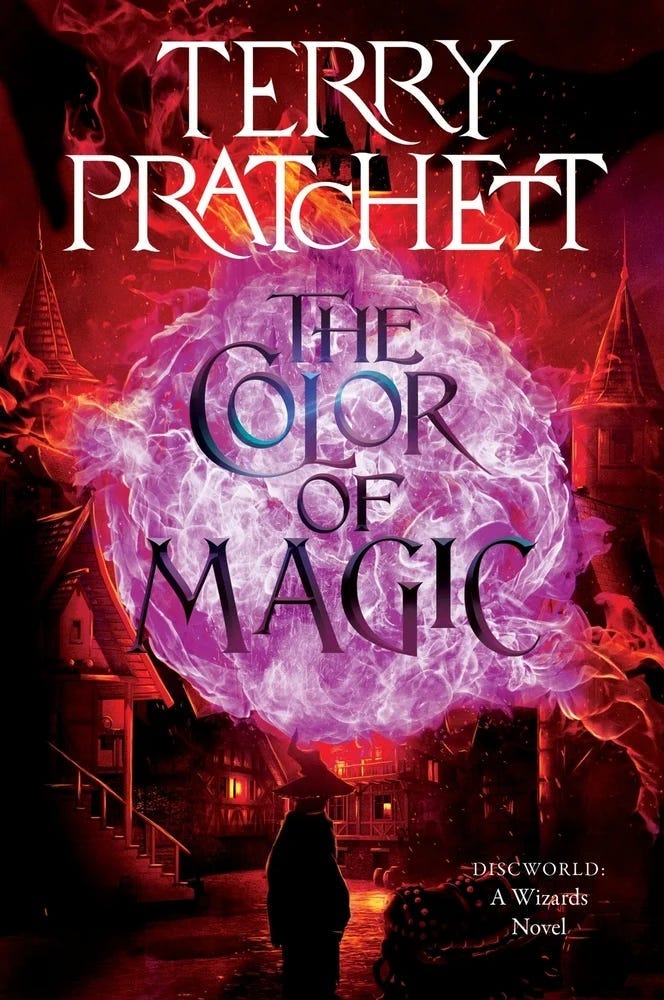
Worry not. The Color of Magic is funny and worthy of respect. Heed these words, because I am not, by any traditional measure, a Fantasy Person (you may insert your own joke there). Fantasy People tend to know things like the difference between a glaive and a halberd or which mystical herb will undo a hex laid by a swamp witch on sabbatical. I, on the other hand, wandered into The Color of Magic expecting a goofy satire and instead found myself on a flat planet balanced on four elephants riding a space turtle. (And I loved it.) Welcome to Discworld. That’s not even the most confusing thing in the first chapter. There are wizards and dragons (sort of), and gods who treat mortals like game pieces. But mostly, there is nonsense, and I mean that in the best way.
The story follows Rincewind, a wizard whose main magical ability is being alive despite it, and Twoflower, an irrepressibly cheerful tourist. They are accompanied by The Luggage, a homicidal wooden chest with hundreds of tiny legs and a poor temperament. Together, they meander across the Disc in four interlinked episodes stitched together by improbable events and glorious wordplay.
I’ll confess that the first thirty pages were slow going, largely because I was trying to parse the rules of fantasy only to realize Pratchett was metaphorically in the margins (or, perhaps more accurately, the footnotes) saying “DON’T WORRY ABOUT IT.” The book assumes, rightly, that lesser fantasy readers may enjoy getting a little lost, which is often where the best views are.
Pratchett’s jokes are embedded in character, narrative, and picking apart tropes. There is affection behind the satire, and intelligence in the absurdity as he reimagines sword-and-sorcery worlds.
The Color of Magic is, supposedly, one of the weaker books in the Discworld series. This is like biting into a “weaker” cake and discovering it’s got three delicious layers AND cream filling AND eating it boosts your credit score.
Is it a perfect book? No. But it’s funny and smarter than it has any right to be.
I am not a Fantasy Person, but I am a student of words — how they’re used, where they’re bent, how meaning is made or broken. Pratchett’s words feel a bit like magic itself. I thank him for it.
Though it’s probably a mistake to do so, you can boil poetry down to “Pestering the Cosmos”: Who am I? Who are you? Who are we together and apart? What are we doing? Where are we going? What does that mean? Is it good? Is it bad? Does it matter? Who wants a cold plum?
The sensible thing to do when faced with such existential disarray is, of course, to ignore it and hope it goes away. Andrea Gibson, who passed away earlier this year, leaves behind work that refuses to look away from those questions. This may be why they are an extraordinary poet..
I don’t read enough poetry. This is not a confession, it’s an observation about time, and habit, and the way certain genres hover in my peripheral vision. I love poetry with its stripped-down nerve and refusal to put things plainly while absolutely putting things plainly.
The problem is, despite absolutely knowing better and having literally read lots of poetry, I occasionally fall prey to the idea that reading poetry is best done while draped luxuriously in velvet armchairs with minor-key sonatas playing on a gramophone. Possibly a monocle of some size. This is nonsense, of course. Andrea Gibson is no drawing-room poet. They are an open field to explore and run through, and maybe find a soft spot to collapse on.
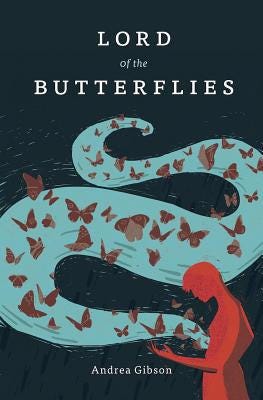
While the volume is slim, I do not think I could have read Lord of the Butterflies in one go. Some poems require rest stops. Others you’ll want to read again immediately.
I had to stop, then reread the devastating and perfect “America, Reloading.” At first, I wanted to ask whether Gibson had personally survived gun violence, but the poem assumes that, in the United States, everyone alive here has..
Other standouts are “Ode to the Public Panic Attack,” “Diagnosis”, “Good Light.” “Letter to the Editor” and “Boomerang Valentine,” which contains the made-me-snort line “I am so far from ready / for Cupid, that naked little shit.”
Gibson’s voice is part sword, part feather, and you may, after reading a few pages, blink very fast because something got in your eye (it’s feelings. What got in your eye was feelings). Lines like “Come teach me a kinder way / to say my own name” and “There are few weapons more dangerous / than our wounds.” will twist in your chest.
Lord of the Butterflies doesn’t treat the personal and the political as separate continents, but as one slightly tilting island full of people trying to remember each other’s humanity.
Gibson collapses the false divide that so often attempts to place love over here, and pain over there as if the body does not carry both. Their poems ask, again and again, “How do we hold both? How do we move forward anyway?”
As a child, I believed if I concentrated enough, I could move objects with my mind. I also suspected that grown-ups had very little idea what they were doing.
Alas, my mind never moved a thing. Grown-ups, however, still pretend to know things.
I was and am disappointed, mostly about the mind-moving stuff.
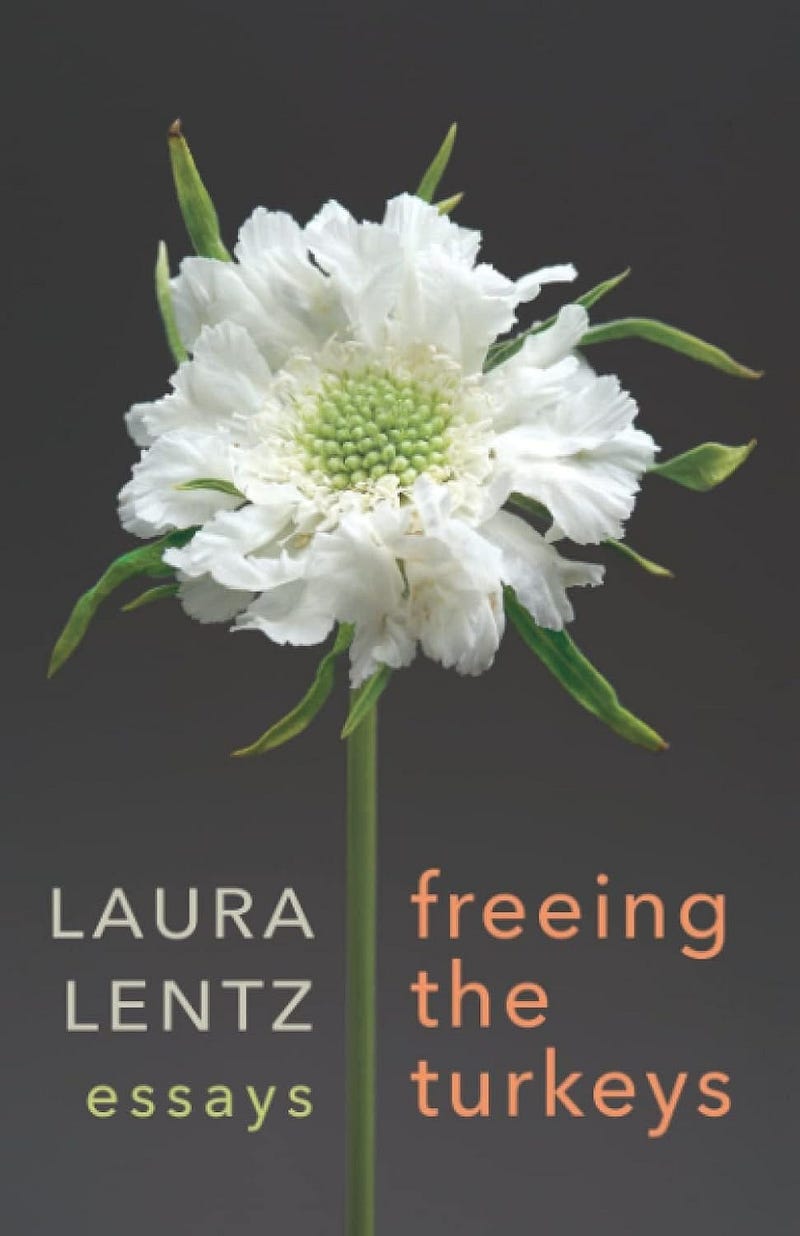
I mention this because Freeing the Turkeys by Laura Lentz reminds me of both my sincere attempt to change the world with my noggin, and my quiet suspicion that no one else is much better at moving the world (or even knowing what they’re doing).
With Lentz’s works, the takeaway is that real movement often comes from noticing how little we actually understand.
Personal essays are notoriously treacherous terrain. They can tip easily into performative writing carefully crafted to make you feel impressed, or guilty, or impressed with how guilty you feel.
Lentz maneuvers her terrain with clarity and not a whiff of performativeness.
Her essays deal with the usual human muddles (grief, time, family, the oddness of Life doing confounding things), but she has the gift of discovering entire universes in the smallest things.
She is eminently underlinable. From the essay Quieting the Noise: “Real silence is not silence at all, but a worthiness, an all-filled existence where we are freed from criticism and delusion and judgment.”
Then there’s the bit where she points out the difference between “Be good” and “You are good.” One is an order. The other assumes grace.
Oh, and this: Time is attention, and attention doesn’t involve a cell phone or a watch. It’s about knowing something or someone so well your rhythm and their rhythm become synced.
This sounds suspiciously like love, if we’re still using that word. (We are.)
Lentz never tries to sell you on redemption or reinvention, and she is certainly not lecturing us. What she writes is honest, funny, and very real. She does come across as a bit of an earth mother, but the good kind. The kind who will tell you the truth, offer you something warm to eat or drink, and then go quiet long enough for you to hear yourself thinking.
This book didn’t change my life in an Oprah‑style, confetti‑and‑crying‑on‑the‑couch kind of way. But it snuck in and echoed for days.
This is a book you should keep in places you forget to look for wonder. Lentz might just move you with her mind.
And there be the July reads. As always, I welcome any recommendations! What’s in your TBR pile?
I’m honored to share my piece in Midstory Magazine, framed by Steph Sprenger’s gorgeous intro and closing reflection.
Thrilled to be in Midstory Magazine this week with a piece about Andrea Gibson and what we sometimes find — and sometimes lose — in writing. Huge thanks to Steph Sprenger for shaping the space with her always-beautiful words.





 Jackie Pick