Jackie Pick is a former teacher and current writer living in the Chicago area. She is a contributing author to multiple anthologies, including Multiples Illuminated, So Glad They Told Me: Women Get Real about Motherhood, Here in the Middle, as well as the and the literary magazines The Sun and Selfish. She received Honorable Mention from the Mark Twain House and Museum for her entry in the Royal Nonesuch Humor Writing Competition. Jackie is a contributing writer at Humor Outcasts, and her essays have been featured on various online sites including McSweeney's, Belladonna Comedy, Mamalode, The HerStories Project, and Scary Mommy. A graduate of the University of Chicago and Northwestern University, Jackie is co-creator and co-writer of the award-winning short film Fixed Up, and a proud member of the 2017 Chicago cast of Listen To Your Mother.
View all posts by Jackie Pick →
I have hunted lions. I have watched the sun rise on days when I was certain the world was ending and drunk enough whiskey to be sure of it. I have fought against the marlin, an enormous wet metaphor for my masculinity.
All of it was nothing compared to perimenopause.
I am a man, a matter of some regret in this context. I have observed and made notes. They are incomplete, as all honest accounts are.
It is unknowable, this Red Ledger of Womanhood, but I will explain it anyway.
Perimenopause, a word with too many vowels, is from the Latin for “the threshold between fertility and glorious cronehood.” It is a time when ovaries, like exhausted grenadiers, abandon their post and estrogen evaporates. Much like absinthe, for which it is also time.
Don’t bother deciphering if it’s happening or not happening. Most things halfway happen. You will know when you find yourself crying inexplicably in the grocery store as “Landslide” plays.
Having set down my credentials plainly, it remains only to tell you how it is in the borderlands between the era of spring-loaded hormones and the years that follow, which are less buoyant by degrees.
These are the things that must be endured:
Insomnia: The nights are the first to betray you. You will lie awake counting your regrets and your nemeses as a fisherman counts his catch, except you will throw nothing back. In the mornings you will feel like you’ve been hollowed out with a grapefruit spoon.
Bleeding: It will happen without pattern or mercy. It will lull you into complacency, then strike with malice. Like when you’re on your boss’s white office sofa. Do not speak of it to your boss. They can only pretend not to notice, and the awkwardness is yours alone. Soon enough, you will get to not miss this.
Hot flashes: A traitorous inner furnace ignites when you least expect it, which is to say, always. You will feel a powerful urge to strip naked in public and become visibly furious at the air. There is no dignified way to do this.
Moods: They will rise and fall like monsoon squalls. You will slam doors, then return and apologize. You will disassociate as the dermatologist removes questionable moles. You will bellow at the toaster if its settings are untrue. Know you are not hurtling toward operatic collapse. Probably.
Carousel of Other Indignities: Everything negative and mysterious you experience from now on is perimenopause. Physical discomfort. Metabolic chaos. That asshole who cut you off in traffic. Thinning hair. Itchy earlobes. People telling you to “let that sink in.” The betrayal of your bladder when you sneeze. Chi-Chi’s vague promise to reopen. Anything that causes the urge to hurl a shoe at someone indiscreetly.
You will seek a system to manage it all. It will fail because everything happens anyway. You will be tempted to try yoga, catalogue your ordeals in a leather-bound journal, or fill your online shopping cart with items terrible and proud.
Do none of this. If you must, cry behind a rack of discounted shapewear at T.J. Maxx. They’ve seen it all at T.J. Maxx. Just do not purchase the waist cincher. You will despise it.
Steel your resolve and proceed.
I hope to leave you with something other than recommendations to age gracefully. Perhaps punch a sandbag and, as you enter this season of dissolving composure, remember: it will pass.
When? A few months. A decade. Maybe longer than Friends, certainly not longer than Grey’s Anatomy. Don’t try to track it. Uncertainty is part of the process.
I warn you so you won’t be startled when chin hairs sprout like a cursed harvest. Fortunately, the forgetting will also begin, and you’ll be left holding tweezers. You will tweeze nothing. You will remember again when you touch your chin and wonder when you became late 1970s Barry Gibb. Those colorless bastards will be nearly impossible to remove. Your eyesight will also have gone to shit.
The point is, this is not the end of all things. Soon enough you will be alone with your pulse and the knowledge that no part of you was ever permanent except that tattoo you got one ill-fated evening with a guy known only as “Little Bowser.”
Perimenopause is natural. Also intolerable. This is the paradox you will ponder as you cry under the Zombie Wasteland Sewer Tunnel at any given Spirit Halloween.
That is the sum of it.
Now go and swoop through the world like a hormonally-imbalanced falcon, taking sweaty dominion over it all.
Hello and other pleasantries to new followers and the brave souls who have been tolerating my nonsense for quite some time.
A reminder and an announcement. I produce two categories of posts:
A sort of high-octane humor that usually ends with me typing in all caps and you wondering whether you’ve accidentally subscribed to the ramblings of an unusually literate honey badger.
Book reviews.
Book reviews are published monthly as “The Folio.” They begin with an attempt at a witty introduction and segue into a more measured discussion. These reviews are longer than advisable, and this, I am aware, can be a turn-off.
Am I trying to turn you on? Certainly, but only to using your library card. Anything else would be unseemly.
I am attempting to keep the reviews aligned with my predilection toward absurdity. Who doesn’t love a slightly deranged, funny book review? PUT YOUR HANDS DOWN. THIS IS THE INTERNET. I CAN’T SEE YOU AND ALSO IT WAS A RHETORICAL QUESTION.
Yes, occasionally, seriousness is unavoidable, especially for the sake of basic human decency. For example, books about war, grief, trauma, or any of the Chicken Soup for the Soul series.
But Writing Reviews That Must All Be Taken Seriously is not always enjoyable. If I must always be properly serious, I’ll run around the town square bellowing “LOOK UPON MY CREDENTIALS, YE MIGHTY!” (which is, incidentally, the fastest way to clear a town square).
Generally, I see no reason to pretend that book reviews should be written in the hushed tone of someone narrating a documentary about endangered sea turtles.
Instead, I’m determined to write the kind of book reviews I’d want to read. Irreverent, digressive, somewhat useful, and not especially academic. When writing these pieces starts feeling like homework, I suspect reading them feels the same. (See review of Terry Pratchett’s book below.)
This is a process. I must first declare independence from the Good Scholar mindset, which is as persistent as mildew and probably smells like it as well.
We’ll see if this works. Forecast: probably not, but to be fair, optimism and I maintain a long-distance relationship.
Anyway, welcome. Or welcome back. Or Welcome Back, Kotter.
Signed, Epstein’s Mother.
I attempted hedonism with my reading this month, which is a pretentious way of saying I tried to read purely for pleasure. Most of the books cooperated. Not Fever Dream, which was an absolute miscalculation on the “fun!” reading scale. It was alarming, but, to be fair, exactly as alarming as promised. (I mean, the title isn’t Sweet Dreams and No Trauma Here.)
This was supposed to be my no-apocalypse month. And while there wasn’t a climate disaster in the bunch (I’ve tended to accidentally read a lot of those this year, if one can accidentally read anything to the end), Fever Dream did slip in poisoned groundwater and the creeping suspicion that everything is contaminated.
As in every month, I tried to find a coherent, unifying thread to connect the books I’d read. Something elegant and unassailable, like a particularly clever (and attractive!) spiderweb. Something that would make me sound like I’d been preparing a rigorous syllabus rather than just reading while eating toast.
The toast, for the record, was not entirely uninspirational.
At first, I thought the unifying theme was “Overthinking,” which is my preferred pastime. Every narrator here is the sort of person who can transform an ordinary moment into an ontological exploration through sheer sustained attention. These are books about people who can’t let a single thought pass unexamined. I recognized them immediately. I am Spartacus.
Just as I was congratulating myself on having found a thesis, another potential theme popped into mind. These books are also about “The Not-Necessarily-Horrific Coming Apart of the Well-Ordered Life.” Which, okay, wordy. All these books involve trying to build a manageable life, only to discover that order is a losing battle. Even the simplest lives can turn chaotic if you pay them too much attention. Or not enough. These books have both.
I spent significant time trying to choose which of these themes to highlight. Overthinking? Everyday order derailment? Eventually, I remembered this is not English Lit 201: Advanced Book Review Blogging and Merriment. No one is grading me. No one even asked for this. (Why didn’t you ask for this, by the way?)
So consider this month’s selections a set of reminders: that our minds are weird and perilous places, that “normal” is perhaps a myth, and that occasionally you will read something so funny, real, and/or unsettling that you won’t even care about the toast crumbs taking up residence down your shirt.
Which is all just to say here are the books I enjoyed enough to finish this month:
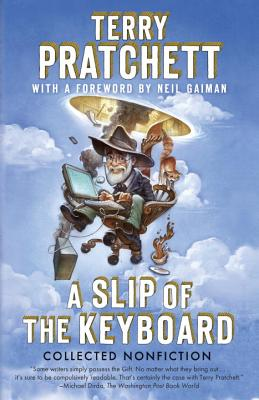
A SLIP OF THE KEYBOARD: COLLECTED NON-FICTION BY TERRY PRATCHETT
Terry Pratchett calls writing “the most fun you can have by yourself.” It’s a throwaway line, but like much that Pratchett lobbed at the world, it is three things at once: it’s funny, it’s self-deprecating, and it’s true.
This collection includes essays, speeches, introductions, and odd bits of reflection. It covers everything from fantasy literature to mushroom picking to Alzheimer’s. It’s brimming with the idea that the ordinary world is weird and interesting. There’s also a bracing indignation aimed squarely at deserving targets, yet even his fury is grounded in compassion.
Here you’ll find Pratchett in fine form, gleefully pricking the balloon of literary snobbery. “Where do you get your fantastic ideas from? You steal them,” he writes. “You steal them from reality. It outstrips fantasy most of the time.”(N.B. This is why writers keep notebooks: to record all the implausible things real people say and do). And you get the sense that saying this felt like slipping a whoopee cushion onto the seat of every Very Serious Writer at some awards banquet.
One of the pleasures of this collection is watching him circle the same conviction again and again: writing, for all its challenges, is meant to be enjoyed. In Chapter 12, he advises writers to amuse ourselves first, because if you’re not having a good time, your readers won’t either. (It sounds obvious until you remember how many books seem to be written purely as acts of flagellation, self or otherwise.) This spirit thrums through every piece. There’s a giddy undercurrent that never tips into preciousness or stupidity. It’s radically sincere and radically human.
Of course, the book isn’t all winks and asides. The essays move into the time after his Alzheimer’s diagnosis, and there is a sharpening. The humor stays, although it can get a little dark, but there’s an urgency, especially as he discusses assisted dying and the politics of autonomy. He had no intention of squandering any of his time on politeness or bromides.
It’s also worth noting how nimble he is. Pratchett can write equally brilliantly about dismantling the idiocy of genre snobbery as he can about daiquiris, and it all feels grounded in what is very clearly his voice and worldview. If you could distill a giggle, a guffaw, a groan, a raised eyebrow, and a perfectly aimed lightning bolt into a single human being, I’d like to think we’d get something very close to Terry Pratchett.
Standouts are most of them, but I particularly loved: “2001: The Vision and the Reality”, “The God Moment”, “Doctor Who?,” and “A Week in the Death of Terry Pratchett.”
Highly recommended. You don’t have to be a Discworld devotee to appreciate this. (I haven’t read them yet.) But you probably should care about books and stories and people and the planet. And if there’s an afterlife with any good sense, may it have a library big enough for him, a comfortable chair, and a hat no one is foolish enough to pinch.
Some of us (ME!) want the laugh. As a child, I’d sneak VHS tapes of Monty Python and Saturday Night Live, memorize sketches, and reassign myself all the best roles. I mentally cast myself as Madeline Kahn in everything she ever did.
So when beauty queen and I Love Lucy-obsessed Barbara Parkerrealized she’d rather have the punchline than the pedestal, I got it. She wanted to be in the room where the funny happened. Correction: she wanted to be the funny happening. And good for her. Beauty was/is a far more economically efficient trait.
Nick Hornby’s Funny Girl follows Barbara as she abandons the pageant world and reinvents herself as Sophie Straw, a comedically ambitious, photogenic young woman determined to become the next Lucille Ball. She moves to London, lands a lead in a new BBC sitcom almost immediately, and finds herself at the center of a cultural moment. This may sound like the setup for a frothy star-is-born tale, and it is. It’s also well done.
At its best, it’s a warm backstage novel with plenty of nostalgia for 1960s London and classic, frothy sitcoms. The first section snaps. Sophie’s introduction to the world of television is filled with biting dialogue, insecure creatives, and writing-room banter (which is arguably the best part of the book). Hornby nails the way brilliance and bitterness coexist in a creative team, as well as the cranky machine that seems to have been the BBC. I would happily read an entire novel that never left that room.
Once the sitcom takes off and Sophie settles into her role as national darling, the narrative zooms out. We get more focus on her coworkers: writers Bill and Tony, who steal scene after scene (especially Bill!). They embody one of the novel’s central tensions: should comedy comfort or provoke?
The “funny” dissipates into complexity, and it mostly works. Hornby’s wonderful at dialogue, even better at capturing the feeling of being slightly out of sync and by being ahead of your time. Funny Girl is like one of those rubber playground balls: bouncy and liable to knock you in the face when you least expect it. Hornby captures much of the texture of 1960s television: the starchy formality, creative constraints, looming cultural shifts.
What I loved most — and what I wanted more of — was the joy of collaboration, the weird alchemy of making something funny with other people. That’s where the book shines. Not in fame or romance or the idea of being “the one girl,” but in the magic of a room full of smart, neurotic misfits trying to make each other laugh.
If there’s a flaw, it’s the one that afflicts many long-running series. Eventually, there’s a sense that a wrap-up should have come sooner. Also, the book never quite reckons with the sexism it documents. That might have been thrilling as well, but a book cannot be all things to all readers.
When this book lands, it lands. It gets the weird intimacy of artistic collaboration. It gets the rush of writing a good bit. It gets the long slide from being new and bold to just being there.
Perfect for summer. It’s sweet and tart like lemonade, and just as delightful.
Most of us were raised on a diet of artificially flavored found-family stories. That most cherished of modern fables in which a group of charming misfits (orphans, strays, emotionally stunted baristas, etc.) band together and discover that what really matters isn’t who raised you. (See also: The Brady Bunch, those sunny-eyed avatars of family bliss. Fictional. Sanitized. Immortalized on lunch boxes.) Somewhere along the way, these found families become closer than real families.
Cue the swelling music. Hugs all around.
Enter Run for the Hills, Kevin Wilson’s contribution to the genre, which, thankfully, avoids nearly all of the above. It is not randomly peopled with inexplicably irrepressible eccentrics who “just need each other.” What it is, instead, is a not-saccharine-yet-still-positive, more ambivalent version of found family.
It starts with Mad Hill, a woman living a self-contained life on her mother’s farm, doing a great job avoiding the complicated legacy of her absentee father and minding her emotional business like a professional. That is, until her half-brother Reuben shows up. His plan is to track down the man who abandoned them both, and see if a couple of other step-siblings are up for meeting, if not joining the adventure. The sudden reveal of a half-brother, his PT Cruiser, other siblings, and this whole nutty scavenger hunt is…a lot for Mad to take in. Mad does not want to go. She says yes anyway. This is what we call family obligation, and also improv training, which sadly has no place in this book at all.
What unfolds is a road trip that’s more emotional audit than grand adventure. Wilson isn’t interested in big plot mechanics or over-processed closure. These siblings don’t know each other. All they have is blood and disappointment and a half-formed instinct to care. Over the miles, something resembling a bond starts to form because they decided to try.
The entire trip is a glorious, laugh-out-loud exercise in restrained dysfunction among truly good people.
Wilson writes with enormous empathy and just the right amount of weirdness. The book is emotionally resonant, highly enjoyable without begging for a laugh track or a piped in “awwww.”
After a carefully paced journey, the final pages may feel slightly soft, a quiet, gentle roll to a stop for some readers. Look, sometimes road trips end and sometimes they just keep going.
So, no, this is not the Brady Bunch. It is not about the ideal family, or even the fully-healed one. It’s about the possibility that choosing to remain in proximity to others, despite discomfort or history, is its own kind of commitment. And there is a lot of fun to be had in that.
Most people will do almost anything to avoid being alone with their thoughts. They will join clubs. They will cultivate elaborate social obligations. They will distract themselves with devices whose primary purpose is to obliterate solitude (see: iPhone, pickleball). Claire-Louise Bennett’s Pond is a testament to the opposite impulse: the deliberate, even defiant choice to pay attention to one’s mind. Where a banana left out becomes memento mori.
Reading Pond feels like showing up ten minutes late to a strange, luminous experimental film. You stand there, half-certain you’ve missed the part that explained everything, until you realize there is no part like that. You are simply inside someone else’s mind, and you get to stay.
In her debut collection, Claire-Louise Bennett assembles 20 fragments, vignettes, and near-monologues narrated by a semi-reclusive woman living alone on the edge of a village in the west of Ireland. She is never named; she is quite selective about what she shares about her exterior life. What she does share with abandon is a torrential, exhilarating interiority. Our narrator has a mind exquisitely tuned to its thoughts. This isn’t stream-of-consciousness, it’s a waterpark.
What is Pond about? Well, there isn’t much about here. No driving plot, no clear progression. But I’d argue there’s a lot of “there” there. There is an astonishing amount of noticing. Jeannine Ouellette (among others, but I like her approach very much) talks about paying attention as a radical act, an act of devotion, an act of “the most powerful writing practice you can cultivate for yourself.” Pond proves that. Each piece zooms in on a moment, an object, a mood. “Morning, Noon, & Night,” for example, imbues the most basic of breakfast foods with something close to rapture. Bennett’s descriptions are precise and saturated with significance. It’s Walden if Thoreau were a woman living alone in Ireland, interested in cooktop knobs, and quite possibly happier for it.
Bennett sounds like a dear friend who overshares with deep self-awareness while you sit and watch her “do her thing.” Take this line:
“English, strictly speaking, is not my first language by the way. I haven’t yet discovered what my first language is so for the time being I use English words in order to say things.”
This book requires a carving out of uninterrupted time. (Which is to say, this is probably not the book to read in five-minute increments between checking email.) But it is unmistakably alive . Prickly, even. It is also, in its way, a challenge: Who among us is willing to be this honest about what goes on in our heads when no one is looking? Most people can’t stand a single unscheduled thought. This book contains nothing but.
If you want to be reminded that noticing is itself an art form, then I say yes and yes again.
This is a book you absorb, like a symphony or a toxin, depending. It’s short, disorienting, beautifully written, and unpleasant in the best way.
It is called Fever Dream, which is helpful, as the entire experience reads like the kind of dream you’d have after eating something you should not have eaten at a charity luncheon.
At first glance, this slim, unassuming volume looks harmless. You think, “Oh good, I can read this in a day.” Which you can. What you won’t expect is to spend the evening staring at your water glass, wondering if it has ever tasted quite so chemical.
The premise is simple: Amanda is dying. A boy named David (or perhaps a child-shaped presence named David), who may be real or may be the embodiment of Amanda’s crippling maternal worry or the result of illness, interrogates her as she drifts in and out of narrative coherence. She is trying to explain what happened. He is trying to hurry her along.
Early on, Amanda introduces the concept of “rescue distance” — the invisible, ever-changing rope between her and her daughter that represents how far her daughter can be while Amanda is still able to keep her safe.. She recalculates the rescue distance constantly depending on terrain, proximity, and possible threat. The “rope” tugs or goes slack, and both states feel awful for different reasons. It is one of the best metaphors for motherhood I’ve ever read, a reminder that parenthood is mostly the exhausting calculation of invisible risks.
Something is wrong, not just in Amanda’s mind, but in the rural Argentine town she’s visiting. The land is poisoned. Children are sick. Animals are dying. There’s a woman who might be a witch, and a boy whose soul might have been split or transformed. Or perhaps he was just traumatized. Schweblin doesn’t lean too hard into explaining the supernatural elements that vibrate in the background. That’s not where the horror lives.
The horror is in the groundwater and the gossip and the things the residents agree to pretend not to see. This town is rotting.
Structurally, the book is a conversation braided with memory, braided with something that may or may not be happening in real time. Whether David is present or imagined is irrelevant in this claustrophobic fever-dream-within-a-fever-dream. One minute you’re in a waiting room with Amanda, the next, you’re on a farm with Amanda and dead animals and sick children.
Megan McDowell’s translation carries it beautifully. It’s sparse, urgent, and devoid of unnecessary hand-holding.
As for the ending: it puzzles with an elegant disregard for the readers’ expectations.
Fever Dream is an exquisitely crafted conjoining of anxiety, dread, and maternal devotion. It is disorienting and unforgettable.
It’s motherhood rewritten as slow-burn horror.
And thus went June. I’m excited for my July reads, and as always, I welcome any recommendations! What’s in your TBR pile?
Mid-year missive? Seasonal Dispatch? Or proof that I don’t understand how “months” work?
It is not December. It is June. Consider me six months late, or six months early, or maybe precisely on time for the inaugural June 25th Holiday Card I shall send from now until my inevitable end in a Kohl’s changing room (probably). Happy Global Beatles Day, International Day of the Seafarer, and Goat Cheese Day, however you celebrate.
Let’s pretend, against better judgment, that this is a normal holiday letter chock-full of unreasonably upbeat retellings of events that barely qualify as events.
Dearly Beloved,
We are gathered here today to bid a fond farewell to the first half of the year, which has slipped behind a paywall with all the grace of a dropped sandwich.
The 2025 bar was low, but with the grit of the truly uninspired, we limboed beneath it with room to spare. We are 170-something days into the year, depending on your level of faith in February. It’s a (preter)natural time to reflect with the bitter clarity that only hindsight and a poorly fitted bra can provide.
Rest was forecast. Rest was promised. Rest is allegedly in transit and estimated to arrive in the next 3–5 business years. I lie awake at 3:47 AM each day to get a jump on accomplishing absolutely nothing.
On the home front, there was no spring cleaning because spring in the Midwest lasts as long as a sneeze. I did move a stack of unread New Yorkers from one side of the coffee table to the other in a solemn act of seasonal repositioning.
Told it was “unkillable,” I bought a pothos. It died. I replaced it with a stack of books, which now loiters atop another stack of books.
I also have an orchid, which they say is “difficult,” that chose to bloom for reasons I can only ascribe to malice. It is my favorite houseplant.
Unfortunately, the state of the actual world is ongoing. Politics remains a choose-your-own-nightmare. The word “unprecedented” has formally requested paid time off. Discourse is louder. Stakes are higher. Comic Sans is hanging on. The economy is allegedly resilient. This is code for “no one knows what’s going on, but we’re refreshing stock apps and trying not to accidentally buy crypto.”
Still, we persist if only out of momentum.
There are good things, though.
No, not that.
My children. I have several of them.They are excellent, frequently taller than I am, and united in their disbelief that I once was cool. I will not list their achievements here — this is not a press release from the Office of Glorious Offspring. They are welcome to write their own holiday cards and/or cease-and-desist letters.
The dog continues to be the least civilized member of this household, as evidenced by his projectile shedding. He has barked at the dishwasher, a cloud, the concept of 2:30 p.m., and a bag of rice. He has rolled in unknowable substances and barfed in defiance of God and flooring. We adore him, this one-pooch anarchist collective.
N.B.: “Least civilized” is doing some heavy lifting here. The rest of us aren’t exactly wearing top hats.
I maintain an ironclad inability to stay awake during any show after 8:30 pm. I started a prestige drama that promised to change my life. It did not. Rather, people mooned about in sweaters, looking wealthy and having big feelings. I fell asleep and woke up believing I was in a West Elm catalog and that someone was mad at me.
Thus far in 2025, I have pursued no new hobbies, firmly adhering to my belief in the sanctity of not doing things other than cleaning up dog barf and marveling at my orchid.
Yet I look ahead, which these days feels like the biggest act of hope:
I will keep showing up, albeit dressed like I’m in Act Two of an experimental play.
I will continue purchasing lemons with unjustified confidence that I will use them.
I will only answer the doorbell if it’s pizza or the good parts of the 1970s.
Like many of you, I am tired, slightly out of focus, and occasionally funny according to random people who comment on my dumb social media jokes.
We’ve made it to midyear. That’s not nothing.
Season’s greetings. Enjoy some goat cheese and the following:





 Jackie Pick