Category Archives: Books

The Folio: What I Read Mid-April Through Mid-May

Legacy, Raised Pinkies, and Cookie Crisp


This month’s reads were about legacy and our role in crafting it. What we spend our time on and how much intention we put behind it. 

NOT THE SNOOZEFEST YOU MIGHT THINK.

These are the books that I enjoyed enough to finish in the last month:
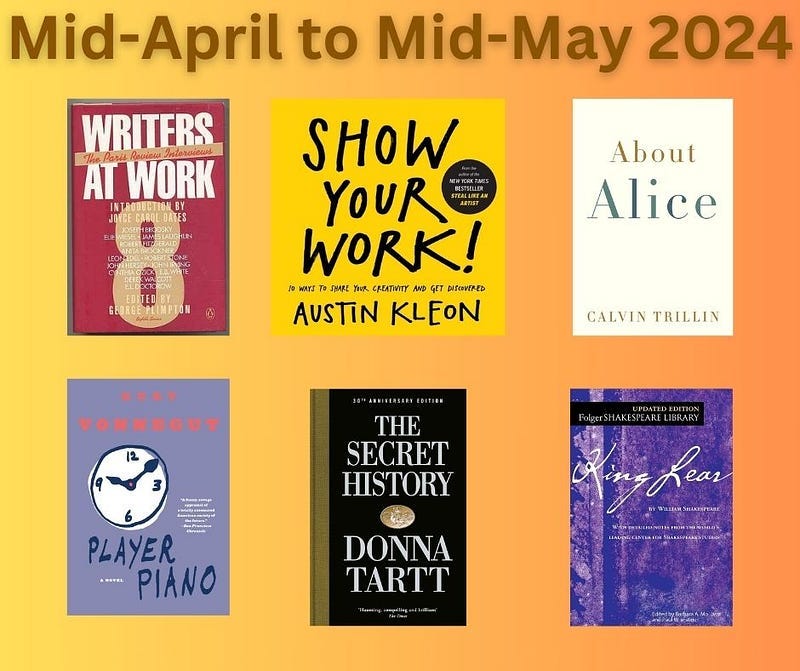
Writers at Work 08: The Paris Review Interviews

This 8th in a gazillion-volume collection from The Paris Review is an invaluable, delightful, and infuriating look into the process, philosophy, and weirdness of various writers. It’s a fantastic reminder to consider the whys and how-fors of craft, examining writing in social, authorial, political, and moral contexts.

From the profound to the gentle, the hilarious to the maddening — boy, what a mess we writers can be. Most interviewees were generous with their self-reflection, some were cloying or downright insufferable, all brilliant. I did have to remind myself these interviews are polished and edited, because there were moments I was like “ARE WRITERS SUPPOSED TO BE THIS GOOD ON THE FLY?”

Undergirding most of their thoughts is awareness of permanence in the work. While perhaps not intentional during the creative process most expressed an consideration of the afterlife of their words. Some eschewed it, some hugged it tight

Standouts:

  • E.B. White (“A writer should concern himself with whatever absorbs his fancy, stirs his heart, and unlimbers his typewriter”)
  • Robert Fitzgerald (“I don’t think it comes on that way…wanting to be a writer. You find yourself at a certain point making something in writing, and this seems to be great fun.”),
  • Elie Wiesel (“I am myself only when I work” and “Writing is so personal, so profoundly and terribly personal.”)
  • John Irving (“I believe you have constructive accidents en route through a novel only because you have mapped a clear way…the more you know about a book, the freer you can be to fool around.”

King Lear by William Shakespeare

You may have heard of this one. Lear descends into madness after handing over his kingdom to two rotten daughters while pushing away the good one. Cue the descent into madness, a cocktail of chaos, tragedy, bad spouses, fools, and some seriously bad-hair weather. It’s all about power, betrayal, redemption — Willie Shake’s big hits.

Do I need to provide quotes or explanations, because this one’s been chewed over for centuries? But, hey, it’s still kicking, repackaged as everything from Succession to Ran to A Thousand Acres to Cookie Crisp. (Kidding. Although I saw some Cookie Crisp hawked on an endcap at two stores the other day. WHO ASKED FOR THIS?)

T.G.I.Family Size

Shakespeare is meant to be watched, yet modern audiences (Hi! Me, even, with all my fancy learnin’) still struggle with the language. Somehow, Lear was never in my studies. Not even the college Shakespeare class. Not sure how that happened. Maybe I had a choice and picked something else, or I just don’t remember because I was focused on BEING IN MY VERY COOL COLLEGE A CAPPELLA GROUP.

Anyway, I’d watch a scene and then read it to soak up the wordplay. 

Not here to brag or claim I only skim the cream of literature, but yeah, my pinky is raised as I type this.


About Alice by Calvin Trillin 

This gem of a memoir by Calvin Trillin is a heart-stuffed tribute to his wife, spilling over with tales of their life and her impact on his work. Love as the ultimate legacy? You bet your sweet typewriter it is.
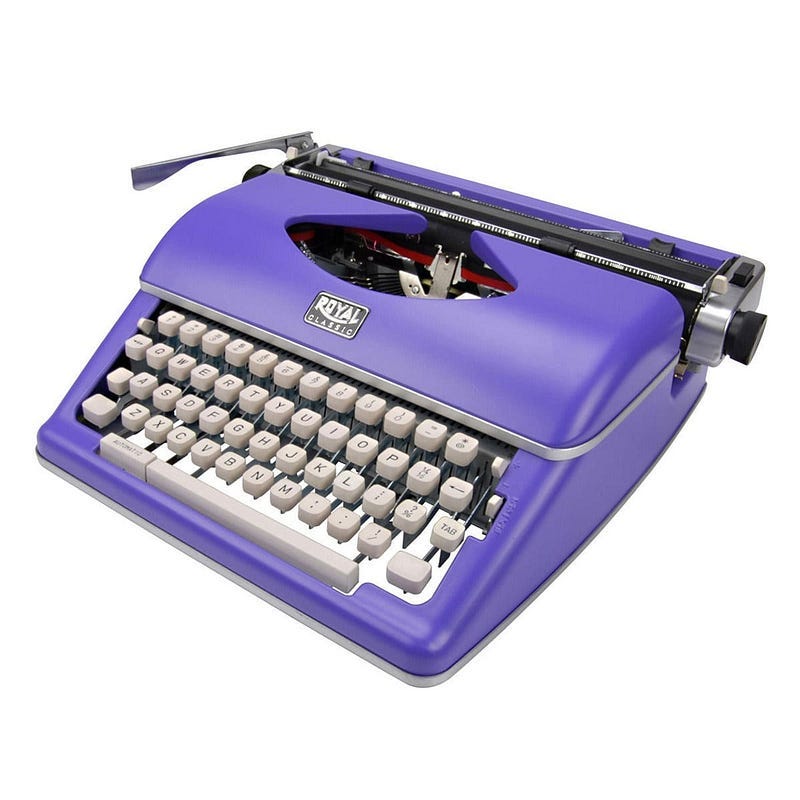
I crave this and would never, ever use it.

I picked About Alice up as a palate cleanser after Lear: short, digestible, and focused on love. It turned out to be both gorgeous and devastating.

Humorous and heartbreaking, it’s a love letter for the ages. There is something intimate in sharing mostly unremarkable moments of a life together. It’s absolutely uncynical, offering respite for a weary soul. Trillin’s love is overwhelming, and we breathe along with him.


Player Piano by Kurt Vonnegut

Are we coding ourselves into oblivion? Can we resist as a form of legacy? Or do we need to surf the beastly waves of tech change to leave our mark? Should we examine these questions through the lenses of technology, identity, and purpose? 

MAYBE!

Picking up this book feels like grabbing a live wire, thanks to the AI anxiety zapping through the creative world right now. Vonnegut serves uncomfortable truth: as technology grows, we and our humanity risk being downsized. Before you hand over your creative keys to some cold, calculating circuits (Would Lear? Doubt it.), think twice.

Yet, despite the gloom, Vonnegut’s just-so, wry humor stops you from walking too far into the existential sea (and hey, if you do, maybe a friendly AI lifeguard will save your ass — what do I know?)


Show Your Work by Austin Kleon

Encouraging creatives to share their process openly. It’s about peeling back the studio curtains and shouting, “Check this out!” to build a tribe that gets you. Kleon’s all about transparency and collaboration, pounding the drum for a legacy that’s more than your final masterpiece — it’s also about the blood, sweat, and tears that got you there.

I’m actually trying to do this with my book — small snippets (“Daily Dispatches”) on my socials, and then dropping a chonkier update here each month. It’s a solid way to summarize the process without blasting everyone with full-frontal, nuclear emotion.

(Hey, you keeping tabs on me? Are you scrolling with me on Threads? How about Substack Notes? And oh, Instagram — where you can witness my gloriously pathetic attempts at photography?)


The Secret History by Donna Tartt

Good gosh damn, Donna Tartt can write. This one had me staying up late and getting up early.

The novel follows a group of elite college students tangled up in a murder. I could crack wise about the different kinds of marks we can leave, but let’s keep this highbrow. The main characters shine in their intellectual pursuits and cloud everything else with a cascade of dark actions. They seek extraordinary legacy, struggling with their ethical compromises and the consequences. The book reflects on how the stories we tell about ourselves — and the secrets we keep — shape our legacy in complex ways.

As with her other works, Tartt writes with needle-sharp detail, creates insanely deep characters, and does so with near-celestial language. Her plots unfurl with deliberate grace.

I mean, holy cow.

___

Last month was a whirlwind romance with The Secret History, and I had a writerly crush on Show Your Work. The long and the short of it, quite literally.

What did you read this month?
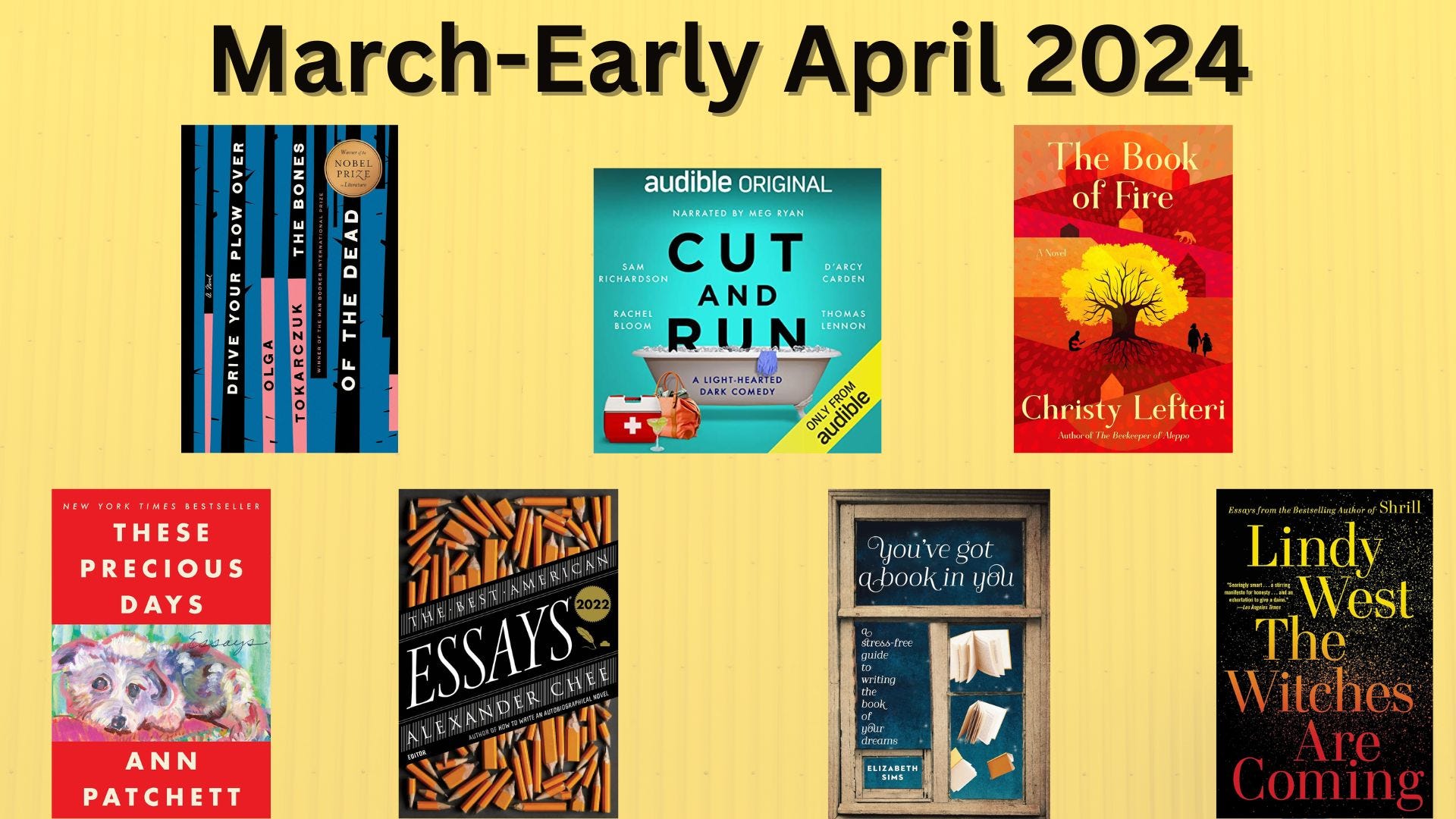
The Folio – What I Read Mid-March Through April 2024

It’s All About the Transformation!

Oh, the twitchy weirdness of not blasting this out the second March ended. Of course, I’m the only weirdo policing the time boundaries of my own monthly book roundups. What can I say? I like the snap of “March Reads” better than the soggy “What I Read March Through Mid-April 2024.” 

But here we are, and this is how it’s going to be for a while and now I’m uniquely positioned as a mid-month book yammerer. 

Market niches, folks.

In the last five weeks or so, I’ve completed seven books.

Ahem.

I was set to roll out an unremarkable apologia, a grand harangue about life and reading and such.

Mad busy, that’s me.

A grand self-flogging, agonizing about feeling like a fraud for not being able to “keep up.” As if I’m somehow a slacker in the sacred arts of wordcraft and self-betterment.

I might have even gifted you this.

Then I’d pivot, launch a counter-offensive on myself, get all gooey about the bliss of slow reading and how my own calendar is stuffed to the gills and my body is drafting strike plans.

I had all sides of this covered and an abundance of gems like “my relationship with reading has evolved” and “joy of discovery.” Flowcharts, highfalutin words, and not a few huffs and puffs.

But there’s something to be said for not doing that.

Let’s just get to the books in some particular order or other:

These Precious Days by Ann Patchett

Ann Patchett excels at weaving tales loosely enough to let them breathe but tightly enough to make them work. Patchett’s explorations of love, loss, and friendship are patient, never slow. She once again pulls, surgically, from the everyday and it is glorious to look at how life squiggles under her microscope

I loved “Three Fathers” (which you can read here). There was a section about one of the fathers whose writing talent, perhaps, did not rise to the level of his eagerness, his effort, or his output. It was a good reminder to her (and me) that when we ask people to read our work, we ask them to give us their time. And time is a gift sometimes more precious than feedback.

I adored “A Talk to the Association of Graduate School Deans in the Humanities,” because it was about life in/of the Humanities. Bookstore Ownership! Theater Attendance! Staged readings of Our Town in the living room. Reading! Community! Oh, how I want all of that. Next, life, I suppose.

“Contrary to popular belief, love does not require understanding in order to thrive.” — Ann Patchett


The Best American Essays 2022, Alexander Chee Editor)

This collection is a child of the pandemic. Each essay, no matter the theme, has an undercurrent of wearing a path in the carpet from pacing back and forth. The collection prowls and lies in wait. 

As with any anthology, you will love some pieces more than others, but trust me, something will snag you, whether you’re reading as a fan or a scribe. Sublime craftsmanship. 

From Chee’s introduction on sense memories and writing: “Was the writing wet? Could you feel the rain, the blood, the tears?” 

Standouts for me were “Abusement,” “Ghosts,” and “China Brain.”


You’ve Got a Book in You by Elizabeth Sims

Every month I try to read a craft book or two. Sometimes I come across texts that are lush and gorgeous. Other times I come across things that are practical and fresh. This is more the latter, but there are dabs of the former.

I’m adding this to my I-only-need-to-lean-over-and-grab-it shelf. 

It’s full of solid advice without being simplistic, repetitive, or useless. 

It’s a reminder that we write because we love it. We may not love it all the time, but we need to commit to that love every time.

It’s “LET’S GOOOO!” across 280 pages.

This one hits at the right time. I think a year or so ago, when I thought all was well with my first novel, I’d have scoffed a little. Now I realize what a lifeline it is.

 I especially like her sections on stormwriting.

“Open it up, write deeper, write long, write relaxed, write loose. And never ever worry about your finished product in the midst of all this messy glory.” — Elizabeth Sims


The Witches are Coming by Lindy West

If you loved Shrill, you may very well love this, even though it covers some of the same territory. That’s probably the point, though. Have things really improved in the world since then? Nope.

I laughed and then didn’t – shouldn’t things be better? Especially if we can name them? Are we naming them correctly?

West is brilliant and the through-line in this book is similarly brilliant. She makes it look easy. It is not easy. That’s her gift. 

“So fine, if you insist. This is a witch hunt. We’re witches, and we’re hunting you.” — Lindy West


The Book of Fire by Christy Lefteri

I won this book in a Goodreads Giveaway, and wrote a longer review here, but for the purposes of this blog, here is a bit of that about this gorgeous book:

The novel is a study of grief, trauma, and guilt. The narrative unfolds in two timelines: one during the fire and the other weeks after. Third-person narration in one timeline adds an honest and heartbreaking layer of detachment. 


Drive Your Plow Over the Bones of the Dead by Olga Tokarczuk

This is an eco-murder mystery set in a Polish village. I almost quit after reading the first quarter. It’s…a little slow and I am feeling impatient these days. Thank goodness I didn’t quit. 

The crafting of language, especially as this is a translation – and a deft one – kept me riveted. 

Deep respect to translator Antonia Lloyd-Jones.

The main character’s devotion to Blake works nicely in this book that is a warning about the natural world getting revenge upon us all. 

This is apparently a movie or something, although the BBC could have done a hell of a series. Then PBS could have found a home for it nestled amongst its other weird and cozy mystery series.

It is a genre-busting tale told by a character in every sense of the word, where we recognize the cruelty of these men in how they treat her, an aging woman, and how they treat animals in the world around them. So please read this and can we talk about how older women in society are treated? THANK YOU!


Cut and Run by Ben Blacker and Ben Acker

ANY BOOK WITH AN UNWITTING ORGAN DONOR IS FUNNY, RIGHT?

Possibly not, but this one is. Available exclusively as an audiobook on Audible, it nails the art of snappy banter and clever meta-commentary. The cast is made up of the finest in the business. *Waves to Ed Begley Jr.*


What’s been moved to your “Finished” pile?

WTFebruary

All this and a bag of chips…

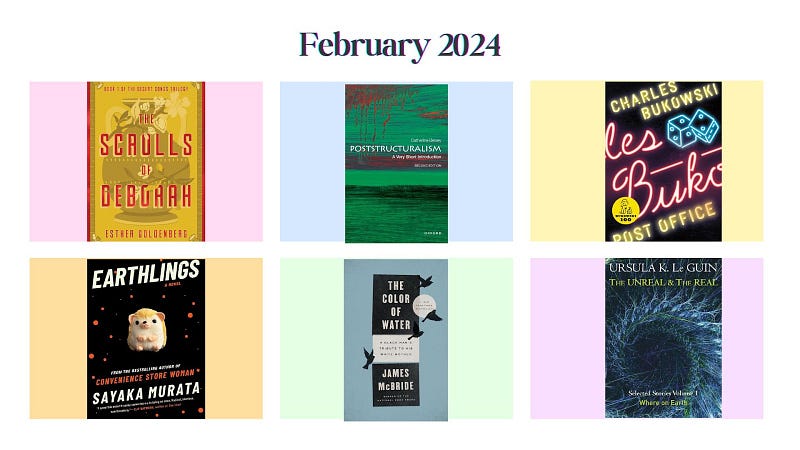
My February reads were all about…aboutness.

I’m not surprised. My own February was all about the aboutness. The aboutness of these books, my writing, and my little spheres. More on that in an upcoming post.

In my previous post, I mentioned it feels as though my reads become a snapshot of that month. Is this synchronicity? Narrative Psychology? Searching for meaning where there is none? Hermeneutics? Dianetics? A sign I’m playing too much Connections?

MAYBE.

February’s reads were about equilibrium and paradoxes in unstable systems, power structures, and belonging.

Without further ado, here are a few words about the books I finished in February, and also some bonus items I enjoyed this month that were not books. If you’d like to talk more about any of these, let me know in the comments!

In no particular order:

Earthlings

How do you survive in a society that actively seeks to harm you? One option is to detach your identity from your physical body and redefine “human.” Another option is to violently reject that society by breaking all of its taboos.

Welcome to Earthlings, where our main characters do that and more.

Our protagonist, Natsuki, believes she is alien — to her own family, this society, and her own humanity. To survive, she stumbles through life with an 11-year-old’s emotional capacity to connect, capable of articulating the grosses of abuses only as “It’s really hard to put into words things that are just a little bit not okay.”

This keeps her alive but not living.

This book is a caboodle of content warnings, loneliness, sorrow, and shame.

It’s a cruel book and a tender one.

Natsuki is lost and disconnected, and like a few of our other narrators this month, her disaffection and abjection are extreme, but not entirely alien to us.

Like all of us, she is in a state of hide and seek, with only other damaged souls calling “Olly olly oxen free.”

She finds sanctuary in outer/inner space.

As I told a friend, proceed at your own risk. Then with abandon.

The Scrolls of Deborah

As I wrote in my review (which you can read HERE), “Goldenberg has picked up the baton of biblical fiction and proves she deserves it. She challenges herself to tell a story rooted in the everyday lives of women in the Middle Bronze Age — lives of service, heartache, and not a great amount of agency. But what is there? Sisterhood. Add to this Deborah’s connection with God, and Goldenberg gives us a beautifully crafted character study, told exquisitely.”

Even if you don’t think you’re a fan of Biblical fiction, try this imaginative retelling of the matriarchs and patriarchs of the Book of Genesis.

Post Office

This book by the godfather of Dirty Realism reads like a Shrinky Dink mid-bake.

This addled temptress was almost indigestible. I wondered if it were an academic exercise designed to alienate and re-engage the reader. “Is this a joke? Am I not getting the joke? Am I the joke?”

Post Office oozes hostility and misogyny, swinging from bawdy to gross. And it’s funny. I feel dirty for reading it.

The book works best in its howlingly funny and bleak depictions of the Post Office’s workings, the longest relationship for the narrator, albeit one built on damage.

With a to-be-read list miles long, I doubt I will seek out more Bukowski, but who knows, because lines like this hit just right:

“In the morning it was morning and I was still alive.

Maybe I’ll write a novel, I thought.

And then I did.”

Poststructuralism: A Very Short Introduction

Poststructuralism, unlike me, developed in France in the 1960s and explores how language describes & constructs our world

This slim book demystifies the critical theory, explores the interplay among knowledge, meaning, and reality, considers the role of language, power, and communication in crafting our sense of identity. It’s a nice dive into what it means to be human.

(And…that’s the connection.)

I really liked it.

The Unreal and the Real: Selected Stories, Volume One: Where on Earth

Some of LeGuin’s earth-bound stories, mostly about people resigned to crumbling desolate places or seeking escape from them. Some hidden gems, some well-known gems, and others that, even in their middling levels, are LeGuin, which is to say, remarkable masterclasses in writing. Come for “The Diary of the Rose,” stay for “Buffalo Gals, Won’t You Come Out Tonight.”

The Color of Water: A Black Man’s Tribute to His White Mother

A story of uncovering secrets and uncovering self, how much we choose to be who we are, how much that is forced upon us, and how much is imprinted. At its heart, though, a story of family.

(MINI-RANT: The audiobook confounded me. There are two narrators of this tale, the author and his mother. The mother’s family came to the country from Poland when she was two, and she was raised primarily in Virginia, which is why the narrator uses…a heavy Borscht-belt “Jewish” accent that is parodic and upholds some weird inapplicable stereotypes?

I turned it off, which was tragic also because J.D. Jackson, who narrated the other chapters, is a complete dream. End rant)

Read, don’t listen to, the book and allow yourself to slow down and savor passages like this:

“It was always so hot, and everyone was so polite, and everything was all surface but underneath it was like a bomb waiting to go off. I always felt that way about the South, that beneath the smiles and southern hospitality and politeness were a lot of guns and liquor and secrets.”

Things made February a little less WTF and more WTG

(Look, as Ms. LeGuin said: “I don’t know anything about reality, but I know what I like”)

My daughter closing in on my height. My sons closing in on their father’s height.

This substack by Michael Ian Black and this one by Steph Sprenger.

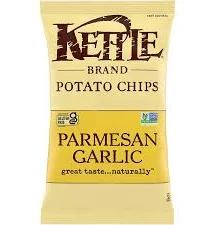
These chips. Forever and ever: